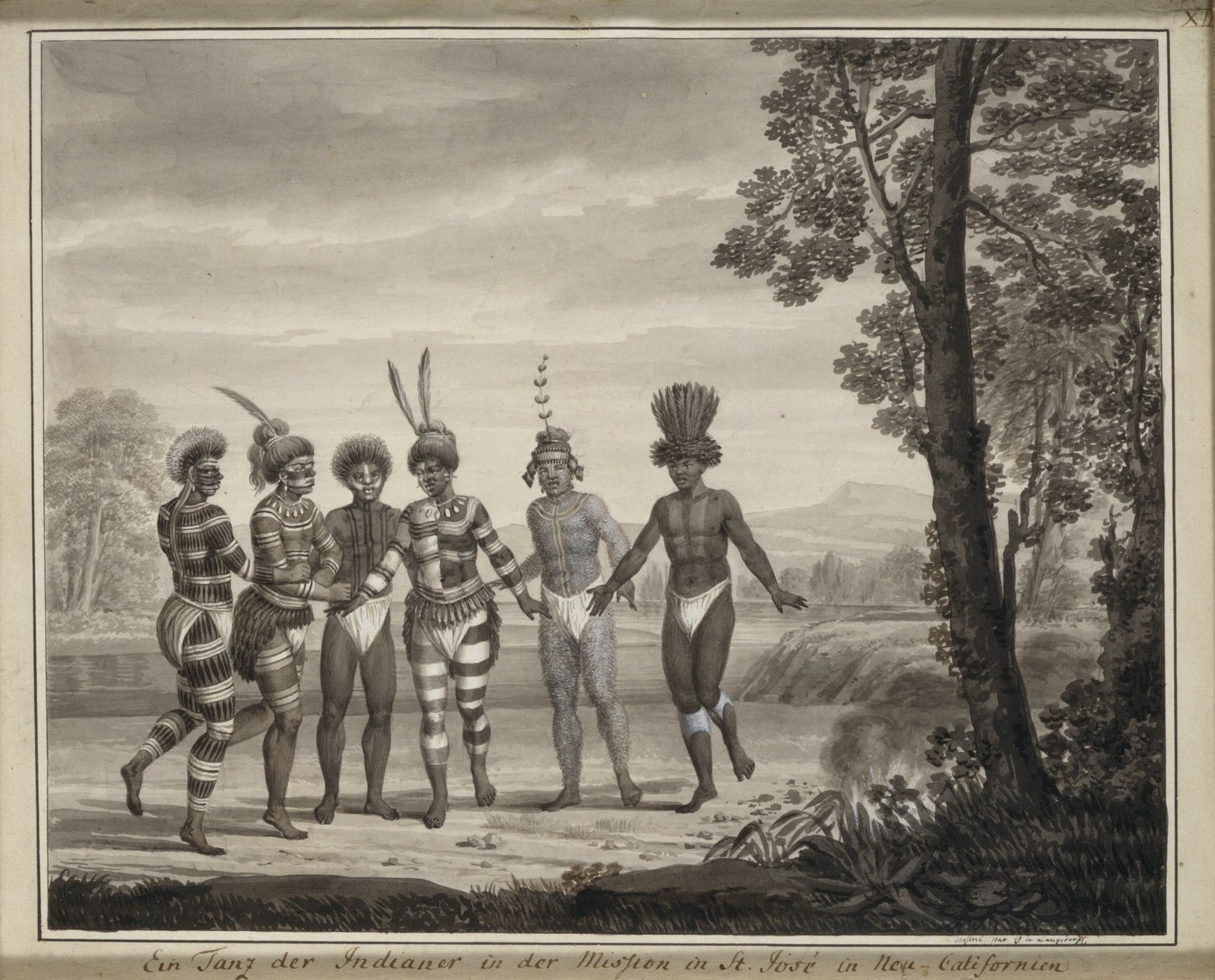
By Wilhelm Gottlieb Tilesius von Tilenau (from Wikipedia Commons)
The Indigenous Roots of Pacific Grove and the Monterey Peninsula Coast
Long before Pacific Grove became known as “America’s Last Hometown,” this stretch of coastline was home to Indigenous communities whose relationship with the land and sea shaped the region for thousands of years.
Understanding this deeper history adds important context to Pacific Grove’s story. It explains not only how the landscape was used, but why the Monterey Peninsula still feels so balanced, preserved, and connected to nature today.
If you are exploring the early development of the town itself, you can also read How Pacific Grove Began: From Methodist Retreat to America’s Last Hometown and Lovers Point and the Early Social Life of Pacific Grove.
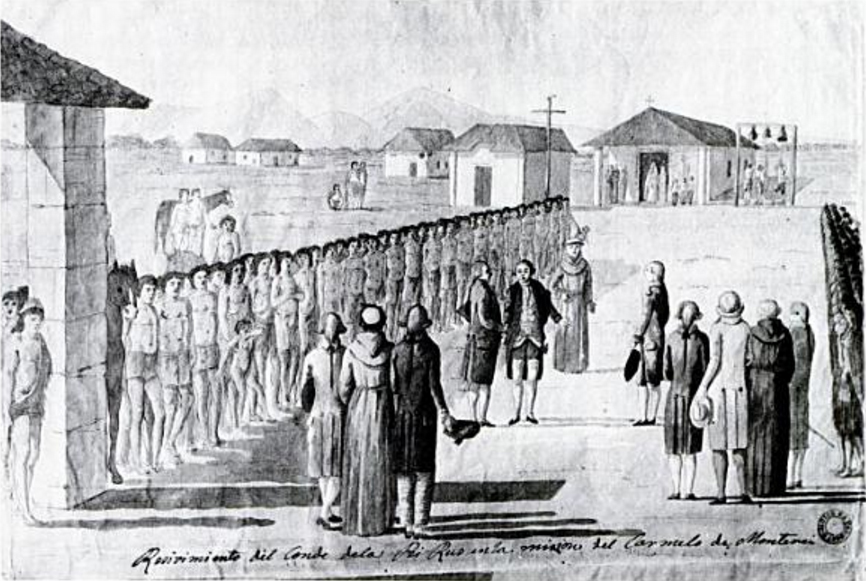
Indians of Mission San Carlos Borromeo are lined up with military precision to greet French expedition led by Jean Francois Galaup, Comte De La Perouse. Watercolor attributed to Tomas de Suria or Jose Cardero, 1791. after a lost original painting at the occasion by Gaspard Duché de Vancy. 1786. (Wikipedia Commons)
The Rumsen Ohlone and the Monterey Peninsula
The land that is now Pacific Grove lies within the traditional territory of the Rumsen Ohlone people. Their presence extended throughout the Monterey Peninsula, including areas around what are now Pacific Grove, Monterey, and Carmel.
Rather than concentrating in dense permanent settlements along the immediate shoreline, the Rumsen Ohlone moved seasonally throughout the region, utilizing coastal, forested, and inland environments as part of a broader system of resource management.
This mobility allowed them to take advantage of the peninsula’s remarkable diversity—harvesting marine resources along the coast, gathering acorns and plants inland, and maintaining a long-term balance with the environment.
The Role of the Coastline
The Monterey Bay has always been one of the most biologically productive marine environments on the California coast. Nutrient-rich waters support an abundance of fish, shellfish, and marine mammals, making the shoreline a critical resource for Indigenous communities.
Protected coves—such as what we now know as Lovers Point—would have provided access points to the ocean, particularly during calmer conditions. These areas offered opportunities for fishing, gathering shellfish, and interacting with the coastal ecosystem in a more controlled setting.
Today, that same coastline continues to define Pacific Grove, offering residents and visitors a direct connection to the ocean and its wildlife.
A Different Approach to Land Use
One of the defining characteristics of Indigenous life on the Monterey Peninsula was a fundamentally different approach to land use. Rather than permanent alteration or large-scale construction, the focus was on sustainability, seasonal use, and long-term stewardship.
Resources were managed carefully, with an understanding of regeneration cycles and environmental limits. This approach helped maintain the natural balance of the region for generations.
While modern development has changed the landscape in many ways, Pacific Grove still reflects aspects of this philosophy through its preserved coastline, limited density, and emphasis on environmental protection.
Disruption and Lasting Impact
The arrival of Spanish explorers and the establishment of the California mission system in the late 1700s brought profound and often devastating changes to Indigenous communities, including the Rumsen Ohlone.
Traditional ways of life were disrupted through forced relocation, disease, and the restructuring of land use under colonial systems. The long-term impact of this period is still part of California’s broader historical narrative.
Today, descendants of Ohlone communities continue efforts to preserve cultural identity, protect ancestral lands, and share their history with future generations.
Why This History Matters Today
Pacific Grove’s modern identity—defined by preserved neighborhoods, protected open space, and a strong connection to the coastline—exists within a much longer timeline of human interaction with this land.
Recognizing that deeper history adds dimension to what makes the area so special. It highlights that the appeal of Pacific Grove is not just architectural or aesthetic—it is also rooted in the natural systems and cultural layers that have shaped it over time.
For many residents and buyers, that sense of place is part of the draw. Pacific Grove offers more than coastal views—it offers continuity.
Explore the complete history of Pacific Grove, California—from its Indigenous roots and Methodist founding to its coastal lifestyle, historic homes, and modern real estate appeal.
Explore Pacific Grove Real Estate