Originally published June 20, 2014; substantially updated August 2026.
Most Monterey neighborhoods are named for geography, old subdivisions or streets. Peter's Gate is different. It carries the name of one of the most colorful figures in early California art: painter Charles Rollo Peters, whose atmospheric nighttime paintings of Monterey's fading Spanish and Mexican-era adobes earned him the nickname "The Prince of Darkness."
At the beginning of the twentieth century, Peters created a remarkable 30-acre estate in the wooded hills above Monterey. He built a home, studio and gallery, entertained artists and writers, and helped make Monterey an important gathering place for California's emerging art community.
The estate eventually disappeared into residential development, but its name did not. More than a century later, the gateposts still stand, the neighborhood is still known as Peter's Gate, and Peters' paintings preserve an eerie and beautiful image of Monterey before much of the city we know today existed.
If you are researching homes rather than neighborhood history, visit our complete guide to Peter's Gate real estate and homes for sale.
Who Was Charles Rollo Peters?
Charles Rollo Peters was born in San Francisco in 1862 into a prominent pioneer California family.
He studied art in California with painters including Jules Tavernier and Virgil Williams before traveling to France, where he attended the Académie Julian and École des Beaux-Arts in Paris.
Europe exposed Peters to a very different artistic world, but one idea in particular would define the rest of his career: the beauty of a landscape after daylight had begun to disappear.
While working in Brittany, Peters became increasingly fascinated by evening and nighttime scenes. Rather than using bright daylight to reveal every detail, he discovered that darkness allowed him to create atmosphere, mystery and emotion.
That approach would eventually make him one of California's best-known painters of nocturnes—landscapes painted at night or twilight.
Why Monterey Captured Peters' Imagination
Peters began visiting the Monterey Peninsula during the late nineteenth century and was drawn to a landscape that looked very different from the Monterey we see today.
Modern development had not yet covered the surrounding hills. Monterey still contained deteriorating adobe homes and civic buildings from the Spanish and Mexican eras, many standing partly abandoned or altered by decades of weather.
Monterey's old adobes were especially well suited to Peters' style.
Under moonlight, their white walls, red-tile roofs, dark windows and irregular shapes became mysterious forms rather than architectural documents. Monterey cypress, eucalyptus, coastal fog and moonlight added even more atmosphere.
Peters painted the Carmel Mission, old Monterey adobes, the coast, Carmel River and other Peninsula subjects repeatedly.
In many of his paintings, a tiny glowing window provides the only obvious source of warmth against a landscape dominated by blue, green, gray and black.
Monterey's "Prince of Darkness"
Peters became so closely associated with nocturnal paintings that he acquired one of the more memorable nicknames in California art history: "The Prince of Darkness."
The name sounds ominous today, but it referred to his ability to paint night.
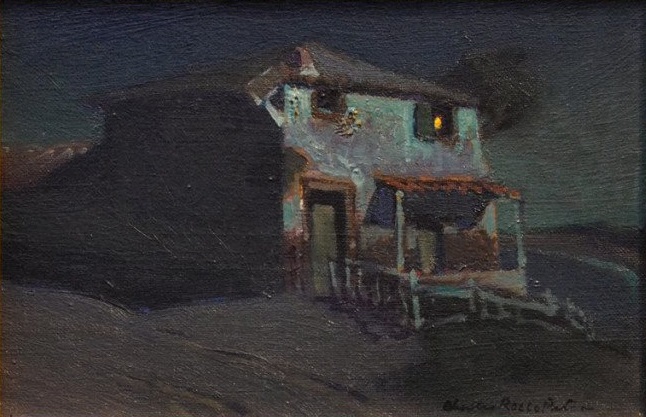
Monterey Adobe at Night, c. 1918, by Charles Rollo Peters. Peters became famous for nocturnal paintings of Monterey's aging adobes, earning him the nickname “The Prince of Darkness.” Image via Wikimedia Commons, CC BY-SA 4.0.
His nocturnes rarely attempt to show every architectural detail. Instead, they suggest Monterey through shadow, moonlight and limited illumination. An adobe wall that would appear white during daylight might become blue or green under Peters' brush, while a single orange or yellow window implied someone was awake inside.
The Monterey Museum of Art preserves an important collection of Peters' work, including paintings of Carmel Mission, Carmel River and historic Monterey adobes.
One particularly striking example depicts the old Castro-Work Adobe—today associated with La Mirada—as a nearly silent structure reflected in water beneath the night sky.
Charles Rollo Peters Builds His Monterey Estate
Around 1900, Peters purchased approximately 30 acres of wooded hillside land above Monterey.
At the time, this was not an established residential neighborhood. The property was near the edge of developed Monterey, surrounded by hills, creeks, pine and oak forest.
The location offered both privacy and broad views across the surrounding landscape.
Peters developed the property into much more than a house.
The estate eventually included a residence, art studio and gallery, guest and servant quarters, stables, gardens and an orchard.
A 1907 description of his studio praised its remarkable location away from the busier parts of Monterey.
The property became known as Peters Gate.
Before Peters Gate: Peters Lived in Old Monterey
Peters already had an interesting connection with Monterey before establishing his estate.
For several years during the 1890s, he and his family lived on property associated with what is now known as the historic Finch-Fleischer House in Monterey.
That placed Peters close to the old adobes and historic buildings he was painting while he became increasingly connected to Monterey's emerging artistic community.
Only later did he move uphill to the 30-acre property that would permanently attach his name to the city.
Buyers and visitors interested in Monterey's earlier residential history can explore our guide to Old Town Monterey.
Peters Gate Becomes an Artists' Gathering Place
Peters did not retreat to his estate simply to paint in isolation.
He was known for entertaining.
Artists, writers, Bohemian Club members and members of San Francisco society traveled to Monterey and gathered at Peters Gate. Dinner parties and artistic gatherings helped connect Monterey with the cultural life of San Francisco.
Peters belonged to the San Francisco-based Bohemian Club, which had originated among journalists, writers and artists before attracting a broader group of prominent members.
The Peter's Gate estate became one of the places where that artistic and bohemian culture migrated south to the Monterey Peninsula.
That matters historically because Monterey and neighboring Carmel were beginning to develop reputations as places where artists and writers could escape San Francisco while still remaining connected to its cultural community.
The 1906 San Francisco Earthquake Strengthens the Monterey Art Colony
The devastating San Francisco earthquake and fire of 1906 accelerated that movement.
Artists and other creative people displaced by the disaster traveled south, and Peters temporarily provided refuge for some of them at his Monterey estate.
Other artists were establishing themselves throughout Monterey and Carmel during the same general period.
The result was not one formally organized "art colony" but a network of painters, writers, photographers and patrons who found the Monterey Peninsula's landscape, older architecture and relative isolation compelling.
Peters' estate became one of the important social centers of that world.
The Hotel Del Monte and Monterey's Emerging Art Community
Monterey's transformation into an artistic destination was happening alongside another major development: the rise of the Hotel Del Monte as one of the West's great resorts.
Affluent visitors arriving at the hotel brought an audience for California art. In 1907, the Hotel Del Monte Art Gallery opened and became an important venue for California artists.
Peters was part of this expanding cultural scene.
The combination of a luxury resort, dramatic landscape, historic architecture and a growing population of working artists helped establish Monterey as more than a tourist stop.
It became a place where California's changing identity was being interpreted through art.
Read more about the resort's influence in our History of Hotel Del Monte.
The Original Peters Gates
The neighborhood name is not merely figurative. Actual gateposts associated with the estate survive in Monterey.
Historical research by the Monterey Vista Neighborhood Association identifies two sets of Peters Gates marking boundaries of the original property.
They are located around:
- Alameda Street and Grove Street
- Alameda Street and Munras Avenue
The gate structures date to the Peters era and became permanent neighborhood landmarks even after the original estate was subdivided.
The City of Monterey has participated in maintaining and restoring the gates, including reconstruction work after deterioration and damage.
Not Every Old Gate Nearby Is a Peters Gate
There is a great piece of local-history confusion worth clearing up.
The impressive stone-and-wood gates around Colton Street near Monterey Circle are sometimes casually described as Peters Gates.
They are not.
Historical research by the Monterey Vista Neighborhood Association indicates that those gates stood outside Peters' acreage and were probably associated with the nearby estate of the Bruguiere family, another affluent San Francisco family that maintained a Monterey property during the same era.
The similarity of the old estate entrances—and the fact that both families belonged to roughly the same social world—has understandably created confusion over the years.
But the Bruguiere gates and the Peters Gates represent two separate Monterey estates.
Personal Tragedy Behind the Glamorous Peters Gate Years
Peters' Monterey years were not simply a story of paintings and lavish entertaining.
His family experienced profound personal losses.
His wife Kathleen died in the early 1900s, followed not long afterward by the death of their young daughter.
The Monterey Museum of Art notes that Peters' increasingly extravagant social life was accompanied by financial decline and alcoholism.
Behind the romantic image of artists gathering under Monterey pines was a far more complicated personal story.
Peters eventually left Monterey in 1909. His artistic connection to the Peninsula continued, but his brief period actually living at Peters Gate had ended.
What Happened to the 30-Acre Estate?
One of the most important corrections to our original 2014 article is the timing of neighborhood development.
The old article suggested that Peter's Gate broadly grew from the 1910s through the 1950s. More detailed neighborhood research shows a more nuanced story.
Work on subdividing the Peters Gate property did not begin until the late 1920s, well after Peters himself had departed.
Nearby Monte Regio subdivisions were being planned during roughly the same period.
Even then, the hills did not suddenly become a dense neighborhood. Much of the major residential construction occurred after World War II.
That explains why Peter's Gate contains such an interesting mixture of architecture. Early houses and prewar residences sit alongside postwar ranch homes, mid-century properties and later remodels.
Peter's Gate and Monte Regio Are Not Historically the Same Place
This is another point worth correcting from older Monterey real-estate descriptions.
Peter's Gate and Monte Regio have different histories.
Peter's Gate originated with Charles Rollo Peters' private estate.
Monte Regio developed through separate residential subdivisions nearby.
Over time, however, local real-estate terminology began grouping the adjoining areas together. Today, buyers and agents frequently use Peter's Gate as a broader shorthand for residential streets that historically belonged to more than one development.
The City of Monterey still uses the name Monte Regio in its planning documents.
And importantly, the correct spelling is Monte Regio—not "Monte Rogio," as our original 2014 post incorrectly stated.
How Peters' Art Preserved a Vanishing Monterey
Charles Rollo Peters matters to Monterey for more than the neighborhood carrying his name.
His paintings capture a city undergoing enormous change.
By the turn of the twentieth century, Monterey's Spanish and Mexican-era adobes were aging, being altered or disappearing entirely. Peters repeatedly painted these structures at night, transforming ordinary aging buildings into mysterious monuments.
His paintings are artistic interpretations rather than architectural records, but they preserve an emotional image of old Monterey that is difficult to recreate from conventional historical photographs.
The darkened missions, tiled adobe roofs, glowing windows and moonlit trees suggest a Monterey suspended between its Spanish and Mexican past and the modern American city that was beginning to replace it.
For the broader story of that transformation, read our Complete History of Monterey, California and Monterey as the Capital of Alta California.
Peter's Gate Today
The original 30-acre artistic retreat is long gone as a unified estate, but its influence remains surprisingly visible.
The gates survive. Portions of the original property survive. The wooded hills Peters found attractive still shape the neighborhood. And an eclectic collection of homes developed over generations rather than through a single modern subdivision.
That history helps explain why Peter's Gate feels different from many later Monterey neighborhoods.
Its identity did not begin with tract homes or a developer's marketing campaign. It began with an artist who looked at Monterey after sunset and saw something worth preserving on canvas.
Peter's Gate Real Estate and Historic Character
Today's Peter's Gate and neighboring Monte Regio area includes a varied collection of Spanish and Mediterranean-influenced residences, Craftsman homes, Tudor and traditional architecture, cottages, ranch homes, mid-century residences and extensively remodeled properties.
Some elevated homes also offer Monterey Bay views.
But the purpose of this article is to tell the history behind the neighborhood. For current homes, maps, buyer guidance and live MLS listings, visit our dedicated Peter's Gate Real Estate & Homes for Sale page.
Frequently Asked Questions About Peter's Gate History
Who was Charles Rollo Peters?
Charles Rollo Peters was a San Francisco-born California painter who became internationally known for atmospheric nighttime paintings, or nocturnes. He studied in California and Paris before establishing a home and studio on a 30-acre estate above Monterey around the beginning of the twentieth century.
Why is Peter's Gate in Monterey named after him?
The modern neighborhood developed in and around Charles Rollo Peters' former 30-acre Monterey estate, which was known as Peters Gate. The estate was eventually subdivided, but the name survived and became associated with the surrounding residential area.
Why was Charles Rollo Peters called the Prince of Darkness?
Peters specialized in nocturnes—paintings of landscapes, missions and Monterey adobes at night or twilight. His distinctive dark palette and mastery of nighttime scenes earned him the nickname "The Prince of Darkness."
When did Charles Rollo Peters live at Peters Gate?
Historical research indicates Peters lived on his Monterey estate for less than a decade, roughly from 1901 until 1909, although his artistic connection with Monterey began earlier and continued beyond those years.
Where are the original Peters Gates?
Two sets of gateposts associated with the original Peters Gate property survive around Alameda Street at Grove Street and Alameda Street at Munras Avenue in Monterey.
Are the large gates on Colton Street also Peters Gates?
No. The large stone-and-wood gates on Colton Street near Monterey Circle are frequently confused with Peters Gates, but neighborhood historical research indicates they were outside Peters' estate and were likely associated with the Bruguiere family property.
Are Peter's Gate and Monte Regio the same neighborhood?
Historically, no. Peter's Gate developed from the former Charles Rollo Peters estate, while Monte Regio was developed separately. Modern real-estate usage frequently groups the adjoining areas together, which is why buyers often see both names associated with the same broader search area.
When was Peter's Gate subdivided?
Subdivision of the former Peters estate began in the late 1920s. A substantial portion of residential construction in Peter's Gate and nearby Monte Regio occurred later, particularly after World War II.
Explore Peter's Gate and Monterey
Charles Rollo Peters' estate lasted only a brief period, but the name he gave it has survived for more than a century.
Today, Peter's Gate is a reminder that Monterey's residential neighborhoods did not develop independently of the city's artistic and cultural history. The same wooded hills, old adobes, Monterey Bay light and coastal atmosphere that attracted Peters continue to shape how people experience the city today.
To continue exploring Monterey, visit:
Considering a home in Peter's Gate, Monte Regio or elsewhere in Monterey?
Explore current Monterey real estate or call Mark Bruno and the Monterey Peninsula Home Team at (831) 917-8190.