


This is part of our series exploring the unusual stories, forgotten places and people who helped shape the communities of the Monterey Peninsula. Explore the complete Local Lore collection →
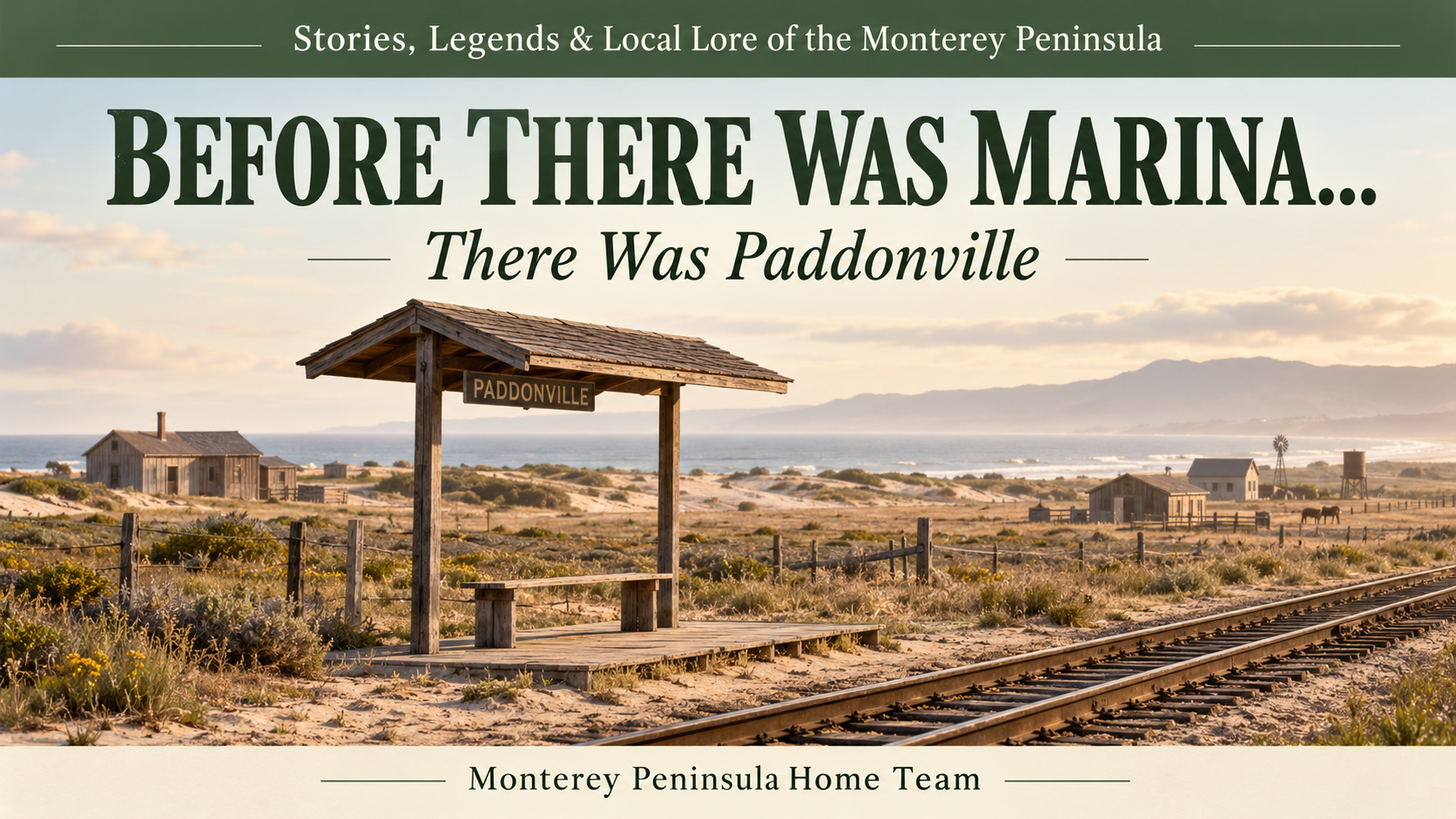
AI-generated historical recreation inspired by photographs and historical descriptions of the early Paddonville/Marina railroad stop. This is not an original historical photograph.
And before Paddonville, there was Locke-Paddon Colonies.
And before that, at least one map simply called the area Bardin.
Today Marina is one of the fastest-changing communities on the Monterey Peninsula, with new neighborhoods, California State University Monterey Bay, the former Fort Ord, Marina Municipal Airport, established residential areas and thousands of acres of protected coastal landscape nearby.
But the city's beginnings were considerably more modest.
The original vision was essentially a farming colony carved out of sandy coastal land.
Its settlers grew vegetables, lived in primitive wooden shelters and depended upon a railroad flag stop to connect their isolated community with the outside world.
And the man behind much of it wasn't originally from Marina at all.
The area that became Marina really was associated with several names before “Marina” became permanent, including Bardin, Locke-Paddon Colonies and Paddonville.
William Locke-Paddon then promoted the land as a small farming community, persuaded the Southern Pacific Railroad to establish a flag stop and ultimately chose the name Marina.
Before Marina, There Were Jacks and Bardin
The story starts well before William Locke-Paddon arrived.
Long before the ranching and subdivision era, Indigenous communities lived throughout the area. The City of Marina's Downtown Vitalization Specific Plan identifies Ohlone settlements in the region, including the village of Wacharon between present-day Marina and Moss Landing. The story of Paddonville represents a much later chapter in the history of this landscape.
By about 1868, roughly 9,000 acres stretching along Monterey Bay and toward the Salinas River were associated with two names that appear repeatedly in early Monterey County land history:
David Jacks and James Bardin.
During the 1880s, this enormous landholding began to break apart.
The Bardin heirs sold large sections for farming and grazing. Other acreage became known as Sand Hill Ranch.
A portion near the coast was eventually acquired by the San Francisco Sand Company, which built a sand plant in 1906.
The landscape that would become modern Marina was beginning to divide into farms, industrial land and potential development tracts.
For a Brief Time, It Was Bardin
According to the City of Marina's historical chronology, a 1913 land map identified the general area as:
Bardin.
The name didn't last long.
Within only a few years, another name appeared:
Locke-Paddon Colonies.
And then came the name residents apparently found much easier to use:
Paddonville.
Who Was William Locke-Paddon?
William Locke-Paddon was a San Francisco real-estate businessman who specialized in subdividing land into small parcels and marketing them to prospective settlers.
His projects were promoted under the name Locke-Paddon Colonies.
In 1915, he saw an opportunity on the sandy coastal land north of Monterey.
On May 29 of that year, he purchased approximately 1,500 acres identified as Pueblo Tract No. 1, City Lands of Monterey.
His idea was straightforward:
Break the land into small farms and create a new agricultural community.
Five Acres and a Dream
Locke-Paddon divided the property into roughly five-acre parcels.
The City of Marina's historical account records an asking price of approximately $75 per acre.
It sounded like an opportunity to own land and establish a small farm near the Monterey coast.
But there was a problem.
This was not the lush agricultural soil most buyers might picture when imagining Monterey County farming.
Much of the area consisted of coastal sand and prairie.
Settlement came slowly.
Early Marina Wasn't Easy Living
This may be my favorite part of the story because it makes early Marina feel less like an abstract subdivision map and more like a real frontier community.
According to the City's history, many of the first settlers weren't experienced farmers.
Still, they managed to grow crops including:
- Peas
- Potatoes
- Turnips
- Cabbage
Rabbits were plentiful.
The historical account even describes settlers supplementing what they could grow with rabbit stew and homemade sourdough bread.
That is a very different picture of Marina than today's neighborhoods, shopping centers and newer communities.
Some of the First Homes Were Barely Homes
Housing could be just as primitive.
The City's history describes early shelters as simple, unpainted wooden shacks.
Some were covered with tar paper on the outside.
Cardboard lined the interiors.
Burlap sacks were sometimes used as room dividers.
These weren't vacation cottages.
They were inexpensive shelters built by people trying to establish themselves on newly subdivided land.
No Highway 1.
No Fort Ord neighborhoods.
No Marina State Beach parking area.
No Dunes shopping center.
No Sea Haven.
No CSUMB.
Just scattered small farms and homes, coastal sand, agricultural land and a railroad running through it.
The Railroad Changed Everything
Fortunately for Locke-Paddon, Southern Pacific's railroad already crossed through the area.
That gave him an idea.
He persuaded the railroad to establish a flag stop so prospective buyers and residents traveling from the San Francisco area could get off near his development.
Unlike a major railroad station, a flag stop was a small stop where trains halted when passengers needed to board or leave.
The stop was initially associated with Mile Post 117 and later became known as:
Paddonville.
There Was Just One Problem: Locke-Paddon Didn't Like “Paddonville”
Paddonville may have been an obvious nickname for a community developed by Locke-Paddon.
But apparently he wasn't particularly fond of it.
He preferred something that sounded more appealing for his coastal settlement.
By 1918, the community had a new name:
Marina.
It was a remarkably appropriate choice for a place sitting alongside Monterey Bay.
Building a Community, Not Just Selling Lots
Locke-Paddon seems to have understood that a collection of five-acre parcels wasn't enough to create a lasting town.
Land was set aside for community needs including a school and church.
When a permanent school building wasn't immediately available, part of Locke-Paddon's former sales office — a small cottage on Elm Street — became the community's first school in 1916.
The beginnings were modest, but the basic pieces of a town were appearing.
The Post Office Made “Marina” Official
In April 1919, Marina received its own post office.
Like many small communities of that era, the post office didn't initially occupy a large government building.
It operated alongside a general store and gasoline pump.
By then, Marina was replacing Paddonville not merely as a developer's preferred name, but as the identity of the growing settlement itself.
By 1926, Marina Had About 70 Families
Growth remained gradual.
According to the City's historical account, the community had reached roughly 70 families by 1926.
Marina was still small.
It was still rural.
And its future was about to be shaped by something much larger happening immediately next door.
Then Came Fort Ord
Military activity in the surrounding area would eventually transform Marina.
In 1917, the U.S. Army purchased land for the Gigling Reservation, a training area that later became Fort Ord. The military installation expanded considerably before and during World War II.
As Fort Ord expanded, particularly during the years surrounding World War II, the need for housing, businesses, schools and services grew dramatically.
Marina's original identity as a small agricultural colony gradually gave way to its role as a community closely connected to one of the largest military installations on the West Coast.
The Little Colony Eventually Became a City
Marina continued growing through the 1950s, 1960s and 1970s.
But here's another surprising part of the story:
Marina wasn't incorporated until 1975.
That means the community existed under the Marina name for more than half a century before becoming an incorporated city.
William Locke-Paddon lived almost long enough to see it happen.
He died in 1972.
Three years later, Marina voters approved incorporation.
The Locke-Paddon Name Never Disappeared
Paddonville may have vanished from everyday use, but the founder's name remains very visible in Marina.
One of the best examples is Locke-Paddon Wetland Community Park near Reservation Road and Del Monte Boulevard.
The park protects a portion of Marina's distinctive seasonal wetland landscape and keeps the Locke-Paddon name connected to the city more than a century after his development venture began.
Even more interestingly, the Marina Foundation's Historical Committee reports that its archive contains an original map drawn by William Locke-Paddon.
So the paper plans behind the colony still survive.
Marina Has Reinvented Itself More Than Once
This early story also helps explain something about Marina today.
Marina has repeatedly changed identities.
After centuries of Indigenous history, the area entered a period of ranching and agricultural settlement.
Then came Bardin.
Then Locke-Paddon Colonies.
Then Paddonville.
Then Marina.
Fort Ord transformed the community again.
And after Fort Ord closed in 1994, Marina entered yet another period of reinvention.
Former military land is now home to CSUMB, new housing, commercial development, parks, trails and communities such as The Dunes and Sea Haven.
Marina Station is adding another new chapter today.
From Five-Acre Farm Lots to Today's Marina
The contrast is remarkable.
The original buyers were being offered five-acre farming parcels on sandy coastal land.
Today's Marina housing market includes mid-century neighborhoods, former military housing, contemporary subdivisions, townhomes, condos and large-scale new-home communities.
Yet the city's unusual beginnings still matter.
Some of the street patterns, older neighborhoods and public spaces grew out of that early settlement era.
And knowing the story makes modern Marina easier to understand.
The familiar name “Paddonville” wasn't the name Locke-Paddon ultimately wanted for his community.
The developer whose own surname had become attached to the settlement helped replace it with the name we still use today:
Marina.
Why This Story Matters
It's easy to think of Marina primarily through Fort Ord or its current wave of new construction.
But Marina's story started before either one.
It began with ranch land, sand, speculative subdivision maps, small farms and people willing to take a chance on a new community.
Those early settlers weren't arriving at a finished town.
They were creating one.
And for a brief period, the place we now call Marina answered to a much stranger name:
Paddonville.
Explore Marina
Marina Real Estate & Community Guide
Established Marina Neighborhoods
More Stories, Legends & Local Lore of the Monterey Peninsula →
Historical Sources & Further Reading
- City of Marina — Marina's History (historical chronology, original subdivision, railroad and early settlement).
- Monterey Peninsula Regional Park District — Locke-Paddon Wetland Community Park (settlement and park history).
- Marina Foundation — Historical Committee (preservation of local records, including a Locke-Paddon map).
- City of Marina — Downtown Vitalization Specific Plan, historical background (Indigenous and community history).
- U.S. Environmental Protection Agency — Fort Ord Site History (military acquisition, development and closure).
Historical note on land prices: The City of Marina reports approximately $75 per acre for the original five-acre farm lots. The Regional Park District gives a different figure of $75 per five-acre parcel. Because these accounts differ, this article attributes the price specifically to the City rather than treating it as independently settled.