


Part one of a two-part look at the extraordinary early history of Pacific Grove. Explore the Local Lore collection.
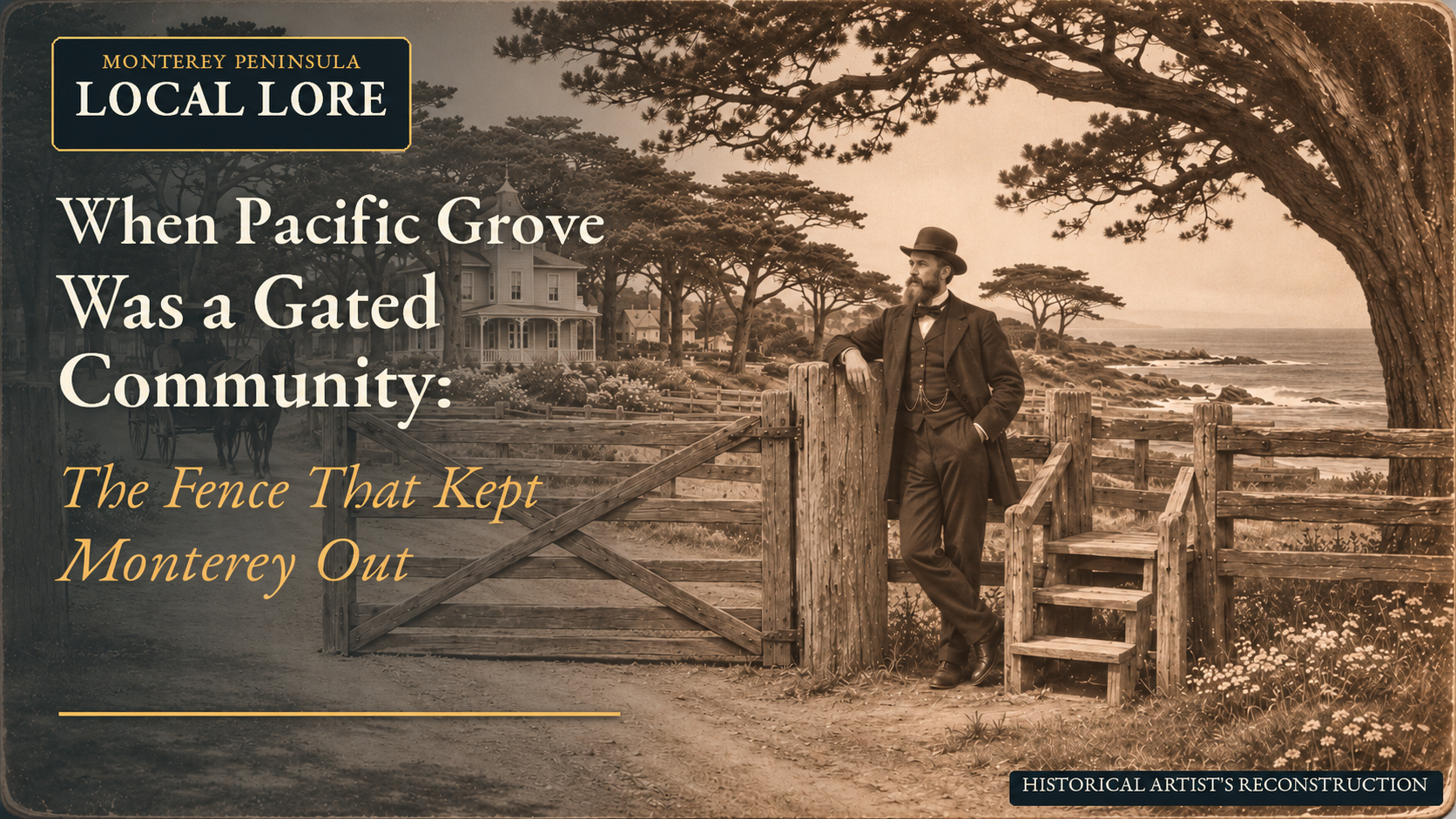
A few weeks ago, I wrote about how Carmel once considered building a fence around the village and charging a toll to enter. If you missed that Local Lore story, you can read it here.
But did you know Pacific Grove actually had a fence?
Imagine driving into Pacific Grove and finding a locked gate across the road. Not a private subdivision, not a military installation, but the entrance to the community itself.
It sounds like a story someone made up. But in the nineteenth century, Pacific Grove really was a fenced Methodist seaside retreat. Visitors arriving from Monterey encountered a boundary that made one thing clear: this was supposed to be a different kind of place.
And according to one of the town's best-known early stories, an irritated state senator eventually took an axe to a gate.
The retreat had fences and controlled wagon access, and the Langford gate-demolition story is recorded in Pacific Grove's official historical research. The precise gate he destroyed and the date of the incident remain less certain.
Why Did Pacific Grove Have a Fence?
Pacific Grove began in 1875 as a Methodist seaside retreat rather than an ordinary town. Its founders envisioned a place for religious gatherings, lectures, summer vacations and family recreation beneath the Monterey pines.
The original retreat, surveyed by St. John Cox, extended roughly from Monterey Bay to Lighthouse Avenue and from First Street toward Pacific Avenue. What we now recognize as the Old Retreat neighborhood grew from that early plan.
Its founders wanted a peaceful atmosphere, deliberately set apart from the distractions and temptations they associated with neighboring Monterey. The fence helped give that distinction a physical form.
Local historical accounts describe fencing along the landward sides of the retreat, with pedestrian access by a stile - an opening that people could step through - and a wagon gate that was normally kept locked. Entering on foot was relatively easy. Bringing in a horse or carriage was another matter.
Where Was the Original Gate?
One entrance is particularly well documented. An early photograph by C. W. J. Johnson, dated to about 1881, shows a retreat gate at what is now the intersection of Lighthouse and Grand avenues. The photograph includes Joseph Oscar Johnson, who served as superintendent of the retreat.
Accounts also refer to other gates or access points. That matters because it is easy to assume that every surviving reference to "the gate" describes the same entrance. The precise location of the gate in the Langford axe story is not established beyond doubt.
The fence was not an impenetrable barrier. It was partly practical, but just as importantly it represented the founders' expectations about how life inside the retreat should be conducted.
The Yellow House at 225 Central Avenue
One of the most interesting clues to this history survives today on Central Avenue.
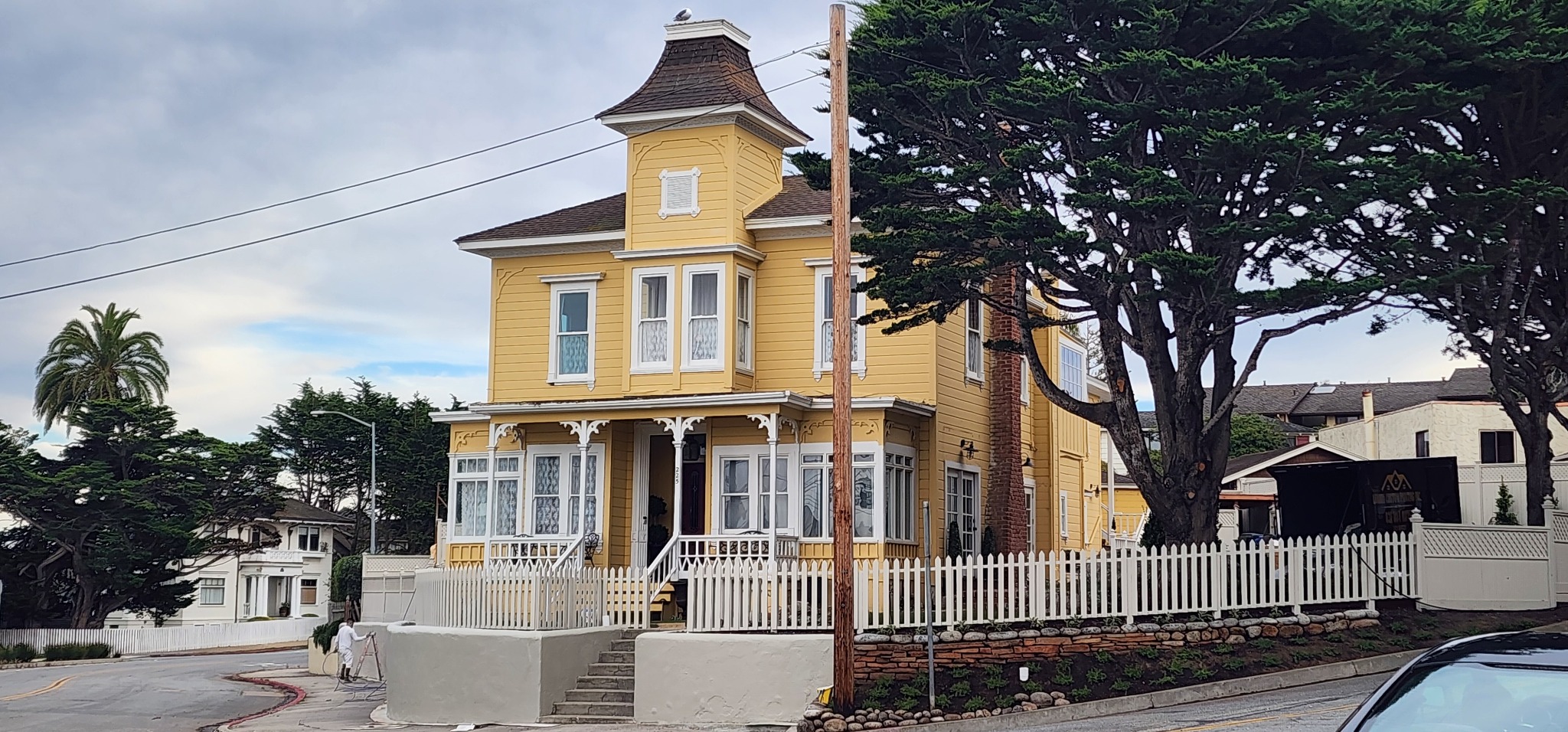
The striking yellow Victorian house at 225 Central Avenue, with its prominent tower, was constructed in the early 1880s for Benjamin J. Langford, a prominent attorney and former California state senator. Pacific Grove's official 2011 Historic Context Statement identifies the property as Lot 1, Block 1, at the eastern edge of the original retreat.
People sometimes connect this building with the old entrance and call it the "Gate House." Historically, however, it was Langford's residence, not the wooden gate shown in the nineteenth-century photograph.
The house itself tells us something about the neighborhood's rapid transformation. Pacific Grove had begun with tents and modest seasonal cottages. Within a few years, substantial Victorian houses were appearing near the old campground.
The Senator Who Had Enough of the Locked Gate
Langford's property stood close to an entrance to the retreat. According to the city's historical report, he apparently became frustrated by the routine required to bring his carriage home: stop at the locked gate, walk into the retreat for the key, return to unlock the gate, and then bring the key back.
Eventually, as the story goes, Langford decided not to make that trip again.
He used an axe to demolish the gate.
The Pacific Grove Chamber of Commerce and the city's historical report both recount the episode. A Stanford-hosted local history dates it to 1886, but the city's report does not give a definitive year. The surviving accounts also do not prove precisely which entrance Langford destroyed.
Those uncertainties do not make the story less remarkable. They remind us that local lore can preserve a real event even when the finer details become blurred over generations.
What Happened to the Fence?
As Pacific Grove developed into a permanent residential community, the idea of a locked wagon gate became increasingly impractical. The famous gate was not rebuilt after Langford destroyed it, according to the historical accounts.
Sources differ about when every last section of fencing disappeared. What is clear is that Pacific Grove gradually changed from a controlled summer retreat into an incorporated city, a milestone reached in 1889.
Today there are no gates stopping traffic from Monterey. Yet the unusually small lots, historic cottages, distinctive street pattern and surviving Victorian houses around the Old Retreat area still reveal how deliberately this neighborhood was laid out.
Our earlier story, Before the Victorians: When Pacific Grove Was a Tent City, explores how the campground itself became a neighborhood.
Three Peninsula Communities, Three Very Different Gate Stories
Pacific Grove was hardly the only Monterey Peninsula community with an unusual history involving gates. But the reasons behind them could not have been more different.
The original 17-Mile Drive began as a scenic carriage excursion for guests of Monterey's Hotel Del Monte. Over time, access to the drive through Pebble Beach became controlled through gates and visitor fees. Those entrances served a scenic resort and privately maintained drive, rather than a Methodist retreat.
Then there was Carmel-by-the-Sea's proposed wall and toll gates. During the 1930s, a plan to fence the village and charge people to enter was suggested as an expression of concerns about preserving Carmel's character. Unlike Pacific Grove's original fence, Carmel's proposal was never built.
Three neighboring communities, three different approaches: Pacific Grove used a fence to distinguish and regulate its religious retreat, Pebble Beach developed controlled entry to its scenic drive, and Carmel considered gates as a way to protect its village identity. Their contrasting stories help explain why the Monterey Peninsula's communities still feel so distinctive today.
The Gates Disappeared. The Rules Had a Longer Life.
The fence is only half the story. The retreat's founders also had strong opinions about drinking, dancing, curfews and even what residents could do with their window shades.
Those rules - and how long some of them endured - are the subject of our next Local Lore story, No Drinking, No Dancing, and Don't Close the Curtains. I'll share more about that fascinating side of Pacific Grove's history soon.
Discover the Central Avenue and downtown neighborhood, the town's historic Victorian homes, and our Pacific Grove community guide.
Historical sources: City of Pacific Grove, Historic Context Statement (2011), pp. 62-64; Pacific Grove Chamber of Commerce, The Way We Were; California Views, Pacific Grove Retreat Gate photograph; Stanford Seaside, Chautauqua history.