


This is part of our ongoing series exploring the unusual stories, forgotten places and characters that help explain the Monterey Peninsula we know today. Explore the complete Local Lore collection →
 For more than a century, prisoners were locked inside a small granite jail beside Colton Hall in Monterey.
According to the City of Monterey, not one of them ever escaped.
The walls were thick.
The windows were reinforced with iron.
The cells were constructed to make getting out extraordinarily difficult.
But there was one problem the builders apparently hadn't solved:
Keeping angry people from getting in.
During one of the most turbulent periods in Monterey County history, vigilante groups sometimes decided that courts were moving too slowly — or couldn't be trusted at all.
On more than one occasion, prisoners inside Monterey's supposedly secure jail discovered that the granite walls protecting society from them could not necessarily protect them from the society outside.
The Old Monterey Jail operated for roughly a century without a successful prisoner escape.
But nineteenth-century vigilantes did break into or seize prisoners from the jail, sometimes with fatal consequences.
A Jail Built for a Rougher California
The jail still standing beside Colton Hall was constructed in 1854, only a few years after California became a state.
Monterey was then the Monterey County seat as well as an important center of government and commerce.
The Gold Rush had transformed California.
Thousands of new residents had arrived. Cattle and horse theft were serious problems. Highway robbery and violent crime were not uncommon, and law enforcement across the young state was still developing.
Monterey needed something considerably stronger than its earlier adobe lockup.
They Built It Almost Like a Fortress
The new jail was deliberately designed to be difficult to defeat.
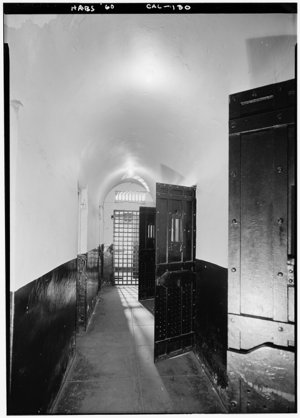
Historical descriptions record walls built of heavy Monterey granite and ironwork brought from San Francisco.
The building contained six jail cells along with a debtor's room and a room for the jailer.
A walled yard completed the small compound.
An 1855 account in the Monterey Sentinel praised the structure for its solidity.
With the exception of the roof, very little wood was used in the secure portions of the building.
Even the cells were capped with arched stone overhead.
It worked.
The City of Monterey records that during the jail's long period of use, no prisoner ever successfully escaped from its thick granite walls.
The Jail Beside the Birthplace of California Statehood
The location makes the story even more interesting.
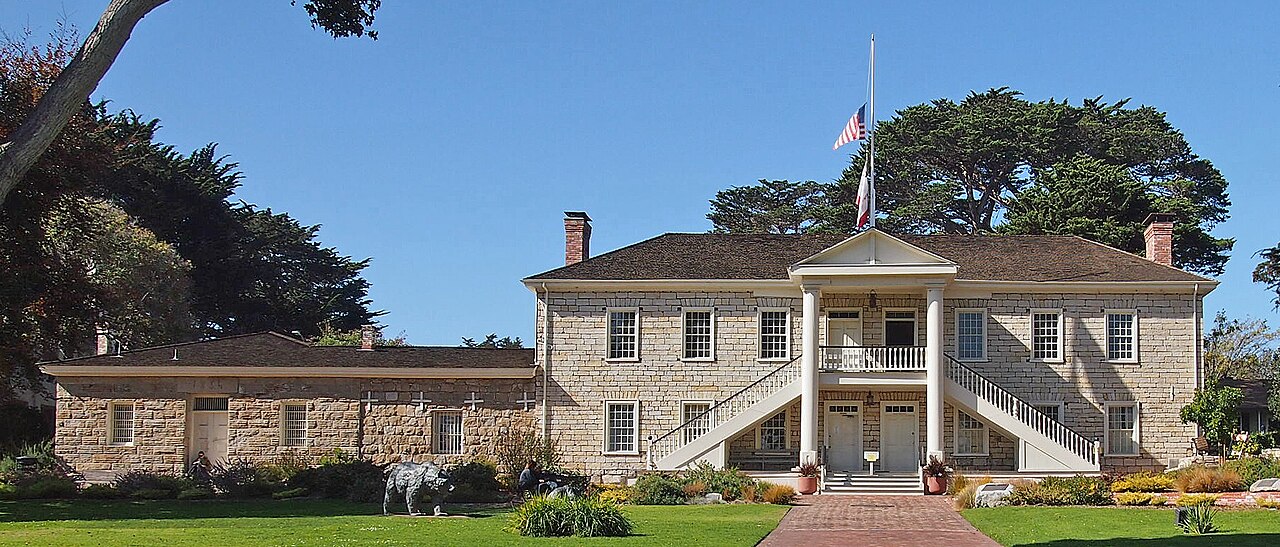
The jail stands immediately beside Colton Hall.
Only a few years before the jail was constructed, delegates gathered inside Colton Hall in 1849 to draft the constitution that helped bring California into the Union.
One building therefore represents the creation of California's constitutional government.
The other reminds us how difficult it could be to impose law and order in the new state.
For the larger story of Monterey's political importance, read Monterey as the Capital of Alta California.
The Problem Wasn't Always Prisoners Trying to Get Out
The Old Monterey Jail was very good at keeping prisoners inside.
But nineteenth-century Monterey County had another problem.
Vigilante justice.
During periods when residents believed sheriffs, judges or courts were corrupt, ineffective or simply too slow, groups of citizens sometimes took punishment into their own hands.
Suspected thieves and killers could face consequences before a court ever determined their guilt.
And Monterey was not immune.
Anastacio Garcia Enters the Story
One of the most feared figures associated with this period was Anastacio Garcia.
Historical accounts describe Garcia as a violent outlaw connected with a series of killings and robberies around Monterey County.
His story also intersects with another name that would become famous in California outlaw history:
Tiburcio Vásquez.
Vásquez grew up in Monterey and, according to historical accounts, became involved with Garcia as a young man before beginning the outlaw career that eventually made him one of California's most notorious bandits.
Garcia was eventually captured and placed inside the granite Monterey jail.
But imprisonment did not lead to a trial.
February 1857: The Vigilantes Come for Garcia
In February 1857, vigilantes entered the jail.
Historical accounts vary somewhat in their descriptions of exactly how the confrontation unfolded, but the outcome is documented.
Garcia was killed inside the jail.
The surviving Monterey jail register contains a stark entry recording that Anastacio Garcia, who had been charged with murder, was found strangled in his jail cell on the morning of February 17, 1857.
The building had done exactly what it had been designed to do.
Garcia hadn't escaped.
The danger came through the door.
Its granite walls successfully prevented prisoners from escaping for roughly a century.
They could not always prevent vigilantes from reaching the prisoners inside.
Then the Story Reversed
About sixteen years later, the Monterey Jail became the setting for an even stranger chapter of vigilante history.
This time, the prisoner wasn't known primarily for being hunted by vigilantes.
He had been one himself.
His name was Matt Tarpy.
Matt Tarpy: The Vigilante Who Became the Prisoner
Tarpy was an Irish immigrant and Pajaro Valley rancher who became deeply involved in efforts to pursue cattle thieves and suspected bandits.
By 1870 he had become a leader of a vigilante organization known as the Pajaro Property Protective Society.
The group emerged during a period of continuing conflict over theft, violence and the effectiveness of the justice system.
But vigilante organizations often created their own cycle of violence.
Tarpy eventually found himself on the opposite side of it.
1873: A Mob Removes Tarpy From the Monterey Jail
In March 1873, Tarpy became involved in a property dispute near Watsonville that ended with the shooting death of Sarah Nicholson.
Tarpy turned himself in and was transferred to the Monterey jail to await trial.
He would not remain there long.
Two days later, an armed group surrounded the jail, restrained law enforcement officers and removed Tarpy.
He was placed in a buggy and taken inland from Monterey.
The group eventually stopped along what is now the Highway 68 corridor.
There, Tarpy was lynched from a pine tree.
The surrounding area became known as Tarpy Flats — a name that survives in local geography today.
The irony was difficult to miss.
A man who had participated in extrajudicial vigilante justice was himself killed by vigilantes before his own trial could take place.
No Escape Doesn't Mean Everyone Stayed Inside
This is why the familiar claim that nobody ever escaped the Old Monterey Jail is both true and incomplete.
Prisoners apparently couldn't break through the granite, iron and stone.
But some didn't leave through an escape.
They were forcibly removed or killed by people who believed they had the right to bypass the legal system entirely.
That distinction tells us something important about nineteenth-century Monterey.
The problem was not simply crime.
It was the struggle to establish public confidence in courts, sheriffs and government during a period of extraordinary social change.
The Prison Register Still Exists
One of the most remarkable surviving pieces of this history is not the building itself.
It is a book.
The Monterey Public Library's California History Room preserves the Monterey Jail Register covering 1850 through 1872.
The register contains 644 prisoner entries.
Names, charges, dates of confinement, discharge information and remarks were recorded by jail officials.
The earliest entries relate to Monterey's older adobe jail. Later entries document prisoners held in the granite jail beside Colton Hall.
That means the surviving register provides an unusually direct record of Monterey's transition from the Mexican and early American periods into California statehood.
The Old Jail Survives
Unlike many buildings associated with California's frontier-era criminal justice system, Monterey's old jail is still here.
It stands beside Colton Hall at 570 Pacific Street in the historic heart of Monterey.
The building is small enough that someone passing along Pacific Street could easily overlook it.
But its scale is part of what makes it so interesting.
This isn't a reconstructed movie-set jail or a massive prison complex.
It is the actual granite building that confined prisoners during some of Monterey County's most turbulent years.
Is the Old Monterey Jail Haunted?
Not surprisingly, a building associated with confinement, violence and nineteenth-century vigilante killings has accumulated ghost stories.
Visitors and paranormal investigators have reported unexplained sounds, footsteps and other experiences around the jail and neighboring Colton Hall.
Those stories belong firmly in the lore category.
We have historical documentation for the jail, its prisoners and the vigilante episodes.
We do not have historical evidence that establishes paranormal activity.
As with the best Local Lore stories, separating the documented history from the legend actually makes the real story more interesting.

Why This Story Matters
Old Monterey is filled with buildings that tell California's political story.
The Custom House recalls international trade and the American takeover of California.
Colton Hall tells the story of the 1849 Constitutional Convention.
The surviving adobes reflect Spanish, Mexican and early American Monterey.
The Old Jail tells a different story.
It reminds us that creating laws and creating a society in which people trusted those laws were two very different things.
California's constitution was drafted only a few steps away.
Yet within a decade, vigilantes were still breaking into a granite jail to impose their own version of justice.
For a building that no prisoner supposedly escaped, the Old Monterey Jail has a surprisingly complicated history of people getting through its doors.
Explore Monterey
Monterey Real Estate & Neighborhood Guide
Old Town Monterey Real Estate & Neighborhood Guide
Monterey as the Capital of Alta California
The Whalebone Sidewalk of Monterey
More Stories, Legends & Local Lore of the Monterey Peninsula →
Frequently Asked Questions About the Old Monterey Jail
When was the Old Monterey Jail built?
The granite jail beside Colton Hall was constructed in 1854, and prisoners began being housed there during the following year.
Did anyone ever escape from the Old Monterey Jail?
According to the City of Monterey, no prisoner successfully escaped from the jail during its roughly century-long period of use.
How long was the Monterey Jail used?
The building served as a jail until 1956, approximately a century after it was constructed.
Were prisoners really taken from the jail by vigilantes?
Yes. Historical records document vigilante activity involving prisoners held there. Anastacio Garcia was killed inside the jail in 1857, while Matt Tarpy was forcibly removed by a mob in 1873 and lynched outside Monterey.
Is the Old Monterey Jail the same as the old Monterey County Jail in Salinas?
No. The Old Monterey Jail discussed here is the small nineteenth-century granite building beside Colton Hall in the City of Monterey. It should not be confused with the much later former Monterey County Jail in Salinas.
Where is the Old Monterey Jail?
It stands beside Colton Hall at 570 Pacific Street in Old Monterey, within walking distance of downtown and other landmarks along Monterey's historic district.
Historical sources consulted: City of Monterey historical materials and Path of History records; Monterey Public Library California History Room and the Monterey Jail Register, 1850–1872; Monterey History & Art Association historical archives; California historical records; and contemporary historical research into Monterey County's nineteenth-century vigilante period.