Originally published April 17, 2026; substantially updated September 2026.
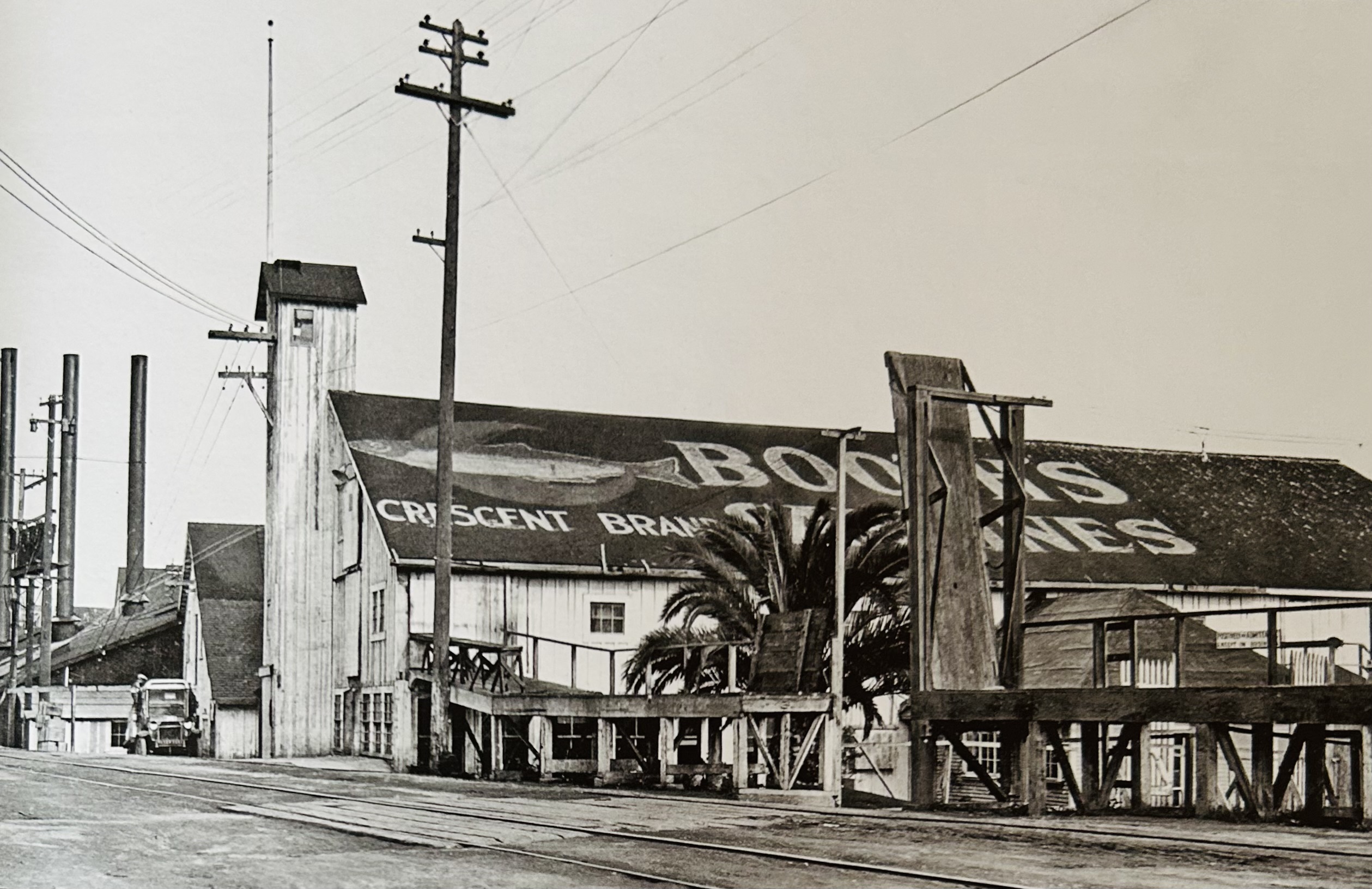
By the end of the 1940s, Monterey faced an economic crisis.
For decades, enormous schools of sardines had supported one of the busiest industrial fishing districts on the West Coast.
Fishing boats filled Monterey Bay. Canneries crowded Ocean View Avenue. Reduction plants operated around the clock. Thousands of people depended directly or indirectly on the industry.
Then the sardines largely disappeared.
Catches collapsed. Canneries closed. Industrial buildings stood vacant. The waterfront economy that had made Monterey famous appeared to be dying with the fishery.
Monterey could have become another former industrial town whose best years were behind it.
Instead, the city reinvented itself.
Over the next several decades, Monterey converted a declining industrial waterfront into a destination centered on history, recreation, dining, marine science and conservation.
An old railroad became a coastal recreation trail.
Former cannery buildings became restaurants, shops and hotels.
Fisherman's Wharf shifted from freight and commercial fishing toward dining, recreation and visitor excursions.
The former Hovden Cannery became the Monterey Bay Aquarium.
Historic adobes that might have disappeared during redevelopment became part of Monterey State Historic Park and the Path of History.
And in 1992, the ocean immediately offshore became part of one of America's great national marine sanctuaries.
The remarkable part is that Monterey did not create its new identity by completely erasing its old one.
It learned how to turn its history into part of its future.
Part of our Monterey History Series: This article begins where Monterey's great industrial era ends. Read The Sardine Boom and Cannery Row for the fishing and cannery story, or explore the complete chronology in our Complete History of Monterey, California.
The Sardine Economy Collapses
Monterey's industrial success had been extraordinary.
At the sardine industry's peak during World War II, approximately 16 canneries and 14 reduction plants operated around Ocean View Avenue.
But the industrial infrastructure depended on one critical resource:
enormous quantities of sardines.
During the late 1940s, catches fell dramatically as intense fishing pressure, changing ocean conditions and poor recruitment combined to reduce the fishery.
Monterey suddenly had factories designed to process huge catches without enough fish to keep them running.
Cannery Row Falls Quiet
One by one, plants reduced operations or closed.
Jobs disappeared.
Buildings deteriorated.
Fires removed portions of the industrial landscape.
Factories that had once been valuable because of their machinery and waterfront access became difficult obsolete properties.
The whistles that had summoned cannery workers when fishing boats returned increasingly fell silent.
Monterey had to answer a fundamental question:
What was an industrial waterfront worth when the industry was gone?
Steinbeck Had Already Given Cannery Row a Second Identity
Ironically, Cannery Row's industrial decline occurred just as the district's cultural fame was growing.
John Steinbeck published Cannery Row in 1945.
His fictional portrait of the waterfront and its unconventional inhabitants gave readers around the world an image of Monterey that had little to do with canned sardines as a commercial product.
Steinbeck transformed the Row from an industrial address into a literary place.
That distinction became increasingly valuable after the factories closed.
Ed Ricketts Leaves Another Legacy
Marine biologist Ed Ricketts also helped create a second way of understanding Monterey Bay.
While the canneries treated marine life primarily as a resource to harvest and process, Ricketts studied organisms in relation to their habitats and ecological communities.
His work at Pacific Biological Laboratories and in Between Pacific Tides helped establish an ecological perspective that would become increasingly relevant to Monterey's modern identity.
Read that story in Ed Ricketts, Pacific Biological Laboratories & the Real "Doc" of Cannery Row.
1958: Ocean View Avenue Becomes Cannery Row
The literary identity eventually overtook the original street name.
In 1958, Monterey officially renamed Ocean View Avenue Cannery Row.
The timing is significant.
The city adopted the name of its industrial past at almost exactly the moment the original industrial economy was disappearing.
That decision preserved an identity that might otherwise have vanished along with the factories.
 TheConduqtor, CC BY-SA 3.0, via Wikimedia Commons
Fisherman's Wharf Reinvents Itself First
Another section of Monterey's waterfront had already begun adapting.
Old Fisherman's Wharf had spent generations serving shipping, freight and commercial fishing.
When the sardines disappeared after World War II, the Wharf increasingly shifted toward visitors.
By 1956, its businesses included restaurants, gift and candy shops, an aquarium, snack bars, boat rentals, fish markets and marine services.
The transformation was not absolute.
Commercial fishing remained part of Monterey Harbor, particularly around Municipal Wharf II.
But Old Fisherman's Wharf demonstrated an important idea:
a working waterfront could evolve toward recreation and tourism without completely losing its maritime identity.
1960: Monterey Builds a Modern Marina
The city's relationship with the harbor also changed as recreational boating became increasingly important.
Construction of the Monterey Municipal Marina began in 1959, and the facility was dedicated on September 11, 1960.
The original project provided 367 berths.
Instead of a waterfront dominated exclusively by commercial fishing and freight, Monterey Harbor increasingly accommodated sailboats, recreational craft, charter fishing and other marine activities.
A Cultural Reinvention Was Happening Too
Monterey's transformation was not limited to waterfront real estate.
The city increasingly became associated with major cultural events.
In 1958, the first Monterey Jazz Festival was held at the Monterey County Fairgrounds.
The festival became one of Monterey's enduring cultural institutions and helped establish the city as a destination for music as well as scenery and history.
1967: The Monterey International Pop Festival
Another extraordinary cultural moment arrived in June 1967.
The Monterey International Pop Festival brought some of the most important musicians of the era to the Monterey County Fairgrounds.
Performers associated with the festival included Jimi Hendrix, Janis Joplin, The Who, Otis Redding and others who would become central figures in rock history.
The festival helped launch the era of large modern rock festivals and gave Monterey another form of international recognition.
For a city still emerging from the collapse of its old industrial economy, this new cultural identity mattered.
Preservation Versus Redevelopment
Postwar Monterey was also confronting a problem shared by historic cities across the United States.
Older buildings occupied valuable land.
Automobiles required parking and wider transportation corridors.
Urban-renewal programs encouraged cities to replace aging structures with modern commercial development.
During the 1960s and 1970s, urban renewal substantially changed parts of Monterey.
Some historic buildings were lost.
Others were saved, moved or restored through the efforts of preservation organizations, California State Parks and the City.
Old Monterey Becomes an Asset Rather Than an Obstacle
The preservation movement gradually changed the way Monterey's oldest architecture was viewed.
Spanish, Mexican and early American buildings were not simply obsolete structures occupying downtown property.
They were physical evidence of Monterey's exceptional role in California history.
The Custom House, Larkin House, Pacific House and other historic buildings became part of Monterey State Historic Park.
In 1970, the Monterey Old Town Historic District was designated a National Historic Landmark.
The district contains an unusual collection of surviving adobe and early American buildings associated with Monterey's period as the Spanish and Mexican capital of California.
The Path of History Connects the City's Past
Rather than isolate Monterey's historic buildings inside a single fenced museum complex, the city's historic resources remain distributed throughout downtown and Old Monterey.
The Path of History connects many of them.
Visitors can walk between the Custom House, Pacific House, Colton Hall, Larkin House, historic adobes and other sites while moving through a functioning modern city.
This became an important part of Monterey's new destination identity.
History itself became something visitors could experience.
The surrounding residential area is explored in our Old Town Monterey Real Estate & Neighborhood Guide.
Cannery Row Begins Changing Hands
On Cannery Row, redevelopment followed a different path.
Beginning in the late 1950s and continuing through the 1960s and early 1970s, investors began acquiring former industrial properties.
Some old buildings were adapted for:
- restaurants
- specialty shops
- visitor attractions
- lodging
- commercial uses
Not every cannery survived.
But increasingly, developers discovered that the industrial character itself had value.
A new building could be constructed almost anywhere.
An old Monterey cannery could exist only on Cannery Row.
Adaptive Reuse Becomes Part of Cannery Row's Identity
This realization helped create the Cannery Row visitors recognize today.
Former industrial structures could be repurposed rather than completely erased.
Old crossovers remained suspended over the street.
Cannery walls, boilers, foundations and warehouse forms survived inside or beside new commercial uses.
The Row's industrial architecture became part of its appeal.
Modern redevelopment therefore began using history as a design asset.
 bahniuk, CC BY 3.0, via Wikimedia Commons
1968: The Sardine Factory Opens
One of the most important early milestones came on October 2, 1968.
Ted Balestreri and Bert Cutino opened The Sardine Factory restaurant.
At the time, Cannery Row was still widely viewed as a run-down former industrial district.
The restaurant began with only 72 seats.
Its success demonstrated that people would travel to Cannery Row for an upscale dining experience even though the surrounding district had not yet completed its transformation.
The Sardine Factory became one of the clearest early signals that Cannery Row's future might lie in hospitality rather than fish processing.
Tourism Was Not Completely New to Monterey
Monterey's shift toward a visitor economy after the sardine collapse was a reinvention—but it was also a return to an older idea.
Hotel Del Monte had already demonstrated in 1880 that visitors would travel to Monterey for scenery, recreation and lifestyle.
The resort helped create 17-Mile Drive and Del Monte Golf Course and eventually influenced the development of Pebble Beach.
In that sense, postwar Monterey was not discovering tourism for the first time.
It was combining the old destination economy with an entirely new appreciation for industrial history, culture and the marine environment.
Explore the earlier resort era in Hotel Del Monte: Monterey's Resort, Golf & Military History.
The California Coast Becomes Something to Protect
While Monterey was reinventing its built waterfront, California's broader relationship with the coast was changing.
During the 1970s, environmental concerns and public demand for coastal access led to a new statewide planning framework.
The California Coastal Act of 1976 established policies addressing shoreline access, habitat, development and coastal resources.
For Monterey, that shift mattered enormously.
The waterfront was no longer evaluated only for its commercial development potential.
Public access, environmental quality and the long-term relationship between the city and Monterey Bay became increasingly important.
The Hovden Cannery Finally Closes
One major industrial operation survived long after the sardine collapse.
The Hovden Cannery, opened in 1916, continued processing other seafood after sardines were no longer dependable.
It eventually turned to products including squid.
But in 1973, Hovden finally closed.
The largest cannery on Cannery Row had become one of the last major links with the district's industrial past.
Its closure also created the site for Cannery Row's most important future institution.
A Different Idea for the Hovden Site
Stanford University's nearby Hopkins Marine Station already made the western end of Cannery Row an important center for marine research.
In the late 1970s, marine scientists associated with Stanford began imagining a public aquarium devoted specifically to the marine life of Monterey Bay.
Plans took shape beginning in 1977.
David and Lucile Packard provided the financial support that allowed the idea to grow into a major institution.
The chosen site was the former Hovden Cannery.
1984: The Monterey Bay Aquarium Opens
On October 20, 1984, the Monterey Bay Aquarium opened its doors.
The transformation was remarkable.
For generations, the Hovden property had been dedicated to processing marine life removed from Monterey Bay.
The new institution was devoted to helping people understand the living ecosystems within the bay.
The Aquarium did not hide the site's industrial past.
Elements of the former cannery were incorporated into the new building.
Once again, Monterey used adaptive reuse rather than complete erasure.
The Aquarium Changes More Than Cannery Row
The Aquarium quickly became far more than another visitor attraction.
It gave Monterey a new international identity centered on marine science and conservation.
Its exhibits emphasized the actual habitats immediately offshore, including kelp forests and Monterey Bay marine life.
Visitors increasingly came to Monterey not simply to look at the ocean but to understand what lived within it.
This represented a fundamental change from the industrial era.
From Extraction to Understanding
The symbolic progression is extraordinary:
Fishing grounds → canneries → marine laboratory → aquarium → conservation.
That progression does not mean commercial fishing vanished or that Monterey stopped benefiting economically from the ocean.
Fishing, recreation, hospitality, scientific research and marine-related businesses all remain part of the local economy.
What changed was the dominant public relationship with Monterey Bay.
The bay itself became something worth understanding and protecting.
1986: Railroad Tracks Become a Recreation Trail
Another industrial corridor was undergoing its own transformation.
The Southern Pacific railroad had once moved freight along Monterey's waterfront and served Cannery Row businesses.
After rail service declined and the corridor was abandoned, local agencies recognized that the right-of-way offered an unusual opportunity.
Beginning in 1986, the former railroad route was transformed into what became the Monterey Bay Coastal Recreation Trail.
Today the paved corridor extends for miles along the shoreline and connects Monterey with communities to the north and Pacific Grove to the west.
The Recreation Trail Changes How People Experience Monterey
The trail did more than replace railroad tracks with pavement.
It altered the relationship between neighborhoods and the waterfront.
People could walk or bicycle between:
- Del Monte Beach
- downtown Monterey
- Fisherman's Wharf
- Cannery Row
- the Monterey Bay Aquarium
- New Monterey
- Pacific Grove
A transportation corridor once designed to move industrial goods became public recreational infrastructure.
Few changes better represent Monterey's economic evolution.
Del Monte Beach Reflects the Same Changing Philosophy
Monterey's changing relationship with the coastline was not confined to Cannery Row.
At Del Monte Beach, cottages and condominiums had been constructed among coastal dunes while other old subdivision lots remained undeveloped.
Later coastal planning increasingly emphasized dune habitat, public access and shoreline hazards.
Some land originally mapped for residential development was preserved and restored instead.
Read the full story in From Sand Dunes to Beach Neighborhood: The History of Del Monte Beach.
1992: Monterey Bay Becomes a National Marine Sanctuary
The evolution toward conservation reached another milestone on September 18, 1992.
NOAA designated the Monterey Bay National Marine Sanctuary.
The protected area today encompasses approximately 6,094 square miles of ocean and 276 miles of shoreline from the Marin coast south to Cambria.
Its habitats include:
- kelp forests
- rocky shores
- sandy beaches
- estuaries
- open ocean
- deep-sea habitat
- Monterey Canyon
- Davidson Seamount
The designation placed the waters immediately offshore within a national framework for conservation, research and sustainable use.
A Century-Long Reversal
Compare Monterey in approximately 1920 with Monterey at the end of the twentieth century.
In the industrial era, economic success meant catching more fish and processing them faster.
By the end of the century, some of Monterey's most important institutions were built around understanding, preserving and experiencing the marine environment.
The ocean had not become economically irrelevant.
Quite the opposite.
Its economic value increasingly depended on the fact that it remained alive, accessible and visually extraordinary.
Old Fisherman's Wharf Finds a New Role
Fisherman's Wharf continued evolving alongside Cannery Row.
Restaurants and shops expanded.
Charter fishing, sailing and whale-watching excursions became increasingly important.
Visitors could still watch commercial fishing activity and buy seafood, but the Wharf now functioned primarily as a place to experience Monterey Harbor rather than as a major freight terminal.
The physical infrastructure survived.
Its economic purpose changed.
Cannery Row Becomes a Conservation District
As redevelopment accelerated, Monterey also developed planning and design standards intended to retain important elements of Cannery Row's historic character.
That meant the district could change without being reconstructed as a generic modern waterfront.
Industrial forms, building scale, historic structures and visual remnants of the cannery era continued to inform new development.
This is why Cannery Row still looks recognizably industrial even though sardine processing disappeared generations ago.
A Waterfront Built From Layers
Modern Cannery Row therefore contains several historical periods simultaneously.
You can find:
- remnants of nineteenth-century residential development
- early fishing-community sites
- cannery-era industrial structures
- worker housing
- Ed Ricketts' Pacific Biological Laboratories
- mid-century restaurants
- modern hotels
- the Monterey Bay Aquarium
- the former railroad corridor
That layering is precisely what distinguishes it from a purpose-built tourist development.
New Monterey Changes With Cannery Row
The transformation also affected New Monterey.
Homes built for fishermen and cannery workers increasingly became desirable because of their proximity to the waterfront, Aquarium, restaurants, recreation trail and Pacific Grove.
The relationship changed dramatically.
During the sardine era, living above Cannery Row meant being close to industrial employment.
Today it often means being close to one of Monterey's most recognizable lifestyle and visitor districts.
Historic Preservation Becomes Part of Monterey's Brand
Old Monterey and Cannery Row evolved differently, but the underlying lesson was similar.
Monterey increasingly discovered that old buildings could have economic value precisely because they were old.
Historic adobes differentiated downtown Monterey from newer California cities.
Cannery structures differentiated Cannery Row from ordinary shopping districts.
The waterfront's working history made it more interesting, not less.
Preservation therefore became intertwined with tourism and place-making.
Monterey Did Not Become a Resort Town in the Carmel Sense
There is an important distinction here.
Modern Monterey did not simply imitate Carmel-by-the-Sea or Pebble Beach.
Its identity remained more urban and institutional.
Monterey continued to include:
- a working harbor
- military institutions
- government
- marine research
- historic neighborhoods
- hotels and visitor businesses
- commercial districts
- residential communities
Tourism became enormously important, but it existed alongside other major institutions.
The Military Remained Part of Modern Monterey
Monterey's reinvention after the sardine collapse also occurred alongside a growing military-education presence.
The Defense Language Institute developed at the Presidio of Monterey after its predecessor moved to the city in 1946.
The Naval Postgraduate School moved to the former Hotel Del Monte property in 1951.
These institutions brought students, faculty, military families and international visitors to Monterey independently of tourism.
Explore those stories in The Presidio of Monterey: 250+ Years of Military History and Hotel Del Monte: Monterey's Resort, Golf & Military History.
A More Diverse Modern Economy Emerges
The old sardine economy was extraordinarily concentrated.
Fishing supplied the raw material.
Canneries processed it.
Reduction plants used the remaining fish.
A collapse in sardines therefore affected nearly the entire industrial chain.
Modern Monterey became more diversified.
Its economy increasingly drew from:
- tourism and hospitality
- military education
- marine science
- government
- healthcare
- recreation
- restaurants and retail
- events and conferences
- residential and commercial real estate
That diversification was itself part of the city's reinvention.
Modern Monterey Is Still a City of the Bay
What did not change was Monterey's dependence on Monterey Bay.
The relationship simply evolved.
Spanish officials valued the protected harbor.
Mexican Monterey relied on maritime trade.
Chinese, Japanese, Sicilian and other fishing communities built commercial fisheries.
Canneries processed enormous quantities of sardines.
Marine scientists studied the shoreline.
Visitors came to see whales, sea otters and kelp forests.
The Aquarium interpreted the ecosystem.
The National Marine Sanctuary protected it.
Through every era, the bay remained central.
How Reinvention Changed Monterey Real Estate
The transformation of Monterey also changed the way residential locations were valued.
Neighborhoods once associated primarily with proximity to employment gained new advantages.
New Monterey became attractive for walking access to Cannery Row and Pacific Grove.
Old Town offered proximity to preserved historic architecture and downtown.
Del Monte Beach combined beach access with the recreation trail.
Areas above the city offered views across a waterfront increasingly valued for recreation rather than heavy industry.
Those changes helped create many of the location preferences that influence Monterey real estate today.
.jpg)
Tony Hisgett from Birmingham, UK, CC BY 2.0, via Wikimedia Commons
Cannery Row Today
Modern Cannery Row bears little economic resemblance to the industrial district Steinbeck knew.
Yet much of its appeal depends on the fact that the earlier place is still visible.
Old factory walls and crossovers remain.
Pacific Biological Laboratories survives.
The Aquarium incorporates the former Hovden site.
Industrial names and stories remain attached to modern properties.
For current residential information, visit our Cannery Row Real Estate & Homes for Sale guide.
The Reinvention Was Not a Single Project
It is tempting to credit Monterey's transformation entirely to the Aquarium.
The Aquarium was enormously important, but Monterey's reinvention had already been underway for decades.
Fisherman's Wharf began changing immediately after the sardine decline.
Historic preservation protected Old Monterey.
Restaurants and commercial operators invested in Cannery Row.
Cultural festivals brought international attention.
Coastal policy emphasized public access.
The Aquarium accelerated and elevated a transformation that many different people and institutions had already begun.
Monterey Reinvented Itself Without Erasing Itself
That may be the most important lesson of Monterey's modern history.
Many industrial districts are redeveloped by demolishing what existed and starting over.
Monterey did lose important historic buildings during its transition.
But enough remained that the city's earlier identities are still legible.
You can walk through Spanish and Mexican Monterey.
You can see the old Custom House.
You can follow the former railroad line.
You can stand beside an old cannery crossover.
You can visit Ed Ricketts' laboratory.
You can enter an Aquarium built on a former sardine cannery.
You can walk from Fisherman's Wharf to Cannery Row beside the same bay that created every previous version of Monterey.
The modern city grew from its past instead of replacing it entirely.
Frequently Asked Questions About Modern Monterey History
What happened to Monterey after the sardine industry collapsed?
Monterey gradually shifted away from a sardine-dependent industrial economy toward tourism, hospitality, recreation, historic preservation, military education, marine science and conservation. Cannery Row and Fisherman's Wharf were progressively adapted to new uses.
When was Ocean View Avenue renamed Cannery Row?
The City of Monterey officially renamed Ocean View Avenue Cannery Row in 1958, recognizing the name made internationally famous by John Steinbeck's 1945 novel.
When did Fisherman's Wharf become a tourist destination?
The transition began after the sardine fishery declined following World War II. By 1956, Fisherman's Wharf already included restaurants, gift shops, an aquarium, boat rentals, fish markets and other visitor-oriented businesses.
When did the Monterey Jazz Festival begin?
The Monterey Jazz Festival was founded in 1958 and became one of the city's most enduring cultural institutions. It continues to be held at the Monterey County Fairgrounds.
When was the Monterey Pop Festival?
The Monterey International Pop Festival was held at the Monterey County Fairgrounds in June 1967. It became one of the defining music festivals of the 1960s and helped establish the model for large modern rock festivals.
When did the Sardine Factory restaurant open?
Ted Balestreri and Bert Cutino opened The Sardine Factory on October 2, 1968. Its success became an important early milestone in Cannery Row's transition from declining industrial district to restaurant and visitor destination.
When did the Hovden Cannery close?
The Hovden Cannery continued processing other seafood after the sardine collapse but finally closed in 1973. The Monterey Bay Aquarium later opened on the former cannery property.
When did the Monterey Bay Aquarium open?
The Monterey Bay Aquarium opened on October 20, 1984 on the site of the former Hovden Cannery. It became a defining institution in Cannery Row's transformation and Monterey's modern marine-conservation identity.
When was the Monterey Bay Coastal Recreation Trail created?
Local agencies began transforming the abandoned Southern Pacific railroad right-of-way into the Monterey Bay Coastal Recreation Trail in 1986. The trail now connects communities along the Monterey Bay shoreline.
When was the Monterey Bay National Marine Sanctuary created?
NOAA designated Monterey Bay National Marine Sanctuary on September 18, 1992. The sanctuary now protects approximately 6,094 square miles of ocean along 276 miles of California coastline.
Is Cannery Row still an industrial district?
No. Modern Cannery Row is primarily a visitor-serving commercial, cultural and marine-science district. However, surviving cannery structures, industrial architecture and historic sites preserve important evidence of its earlier working-waterfront identity.
Why is Monterey's modern transformation historically important?
Monterey provides an unusually clear example of a city converting a declining resource-based industrial economy into one centered on historic preservation, recreation, marine science, conservation and tourism while retaining many physical reminders of the earlier waterfront.
Continue the Monterey History Series
This article completes the main chronological sequence of our Monterey History Series. Explore the earlier chapters:
- Monterey as the Capital of Alta California
- The Presidio of Monterey: 250+ Years of Military History
- Hotel Del Monte: Monterey's Resort, Golf & Military History
- The Sardine Boom and Cannery Row
- Ed Ricketts, Pacific Biological Laboratories & the Real "Doc" of Cannery Row
- Complete History of Monterey, California
Explore Modern Monterey Neighborhoods & Real Estate
- Cannery Row Real Estate & Homes for Sale
- New Monterey Real Estate & Homes for Sale
- Old Town Monterey Real Estate & Homes for Sale
- Del Monte Beach Real Estate & Oceanfront Homes
- Monterey Ocean View Real Estate
- Monterey Real Estate & Homes for Sale
Considering a home in Monterey or elsewhere on the Monterey Peninsula?
Call Mark Bruno and the Monterey Peninsula Home Team at (831) 917-8190.

.jpg)