


_(cropped).tif.jpg)
Originally published April 2026; substantially updated September 2026.
Few military installations in the United States occupy a landscape with a history as long and layered as the Presidio of Monterey.
The story begins in 1770, when Spain established a fortified settlement beside Monterey Bay to protect its claim to Alta California.
It continues through Mexican rule, the American takeover of California, an early U.S. fort associated with officers who would later become famous Civil War generals, decades of abandonment, the return of the U.S. Army in 1902, Buffalo Soldiers, cavalry and infantry training, the creation of nearby Fort Ord, World War II and ultimately one of the world's best-known military language schools.
Today the Presidio remains an active U.S. Army installation and is home to the Defense Language Institute Foreign Language Center.
That makes Monterey unusual.
The city's military importance did not end with the Spanish Empire or the Mexican-American War. Instead, the role of the military changed repeatedly as Monterey itself changed.
Part of our Monterey History Series: The Presidio developed alongside Monterey's role as the capital of Alta California. For the broader chronology, visit our Complete History of Monterey, California and Monterey as the Capital of Alta California.
The Presidio also borders today's New Monterey and overlooks Old Town Monterey, making its history unusually visible within the modern city.
1770: Spain Establishes the Presidio of Monterey
Spain had claimed portions of the California coast long before it established permanent settlements there.
By the eighteenth century, however, Spanish officials became increasingly concerned that other European powers—particularly Russia—might expand southward along the Pacific Coast.
Spain responded by establishing a chain of missions and military presidios in Alta California.
In May 1770, an expedition led by Gaspar de Portolá reached Monterey Bay.
Portolá commanded the military component of the expedition, while Franciscan missionary Junípero Serra led its religious mission.
On June 3, 1770, the Spanish formally established the Presidio of Monterey and Mission San Carlos Borromeo.
The mission soon moved south toward the Carmel River and developed into today's Carmel Mission.
The military post remained in Monterey.
The Original Presidio Was Near Today's Downtown
The first Presidio did not occupy exactly the same area people associate with the modern Army installation.
The original Spanish compound consisted primarily of adobe buildings arranged around a central square near what is now the area between downtown Monterey and Lake El Estero.
It contained military quarters, storage areas, administrative spaces and the chapel serving soldiers and their families.
That settlement became one of the foundations around which early Monterey grew.
_-_panoramio.jpg)
MARELBU, CC BY 3.0, via Wikimedia Commons
_-_panoramio.jpg)
The Royal Presidio Chapel
One of the most important surviving links with the original Spanish Presidio is the Royal Presidio Chapel.
Today's stone church, known as the Cathedral of San Carlos Borromeo, replaced earlier structures associated with the original Presidio community.
The chapel remains one of the oldest continuously functioning religious sites associated with Spanish California and provides a rare physical connection with Monterey's earliest colonial settlement.
1792: El Castillo Guards Monterey Bay
The Spanish recognized that a presidio in the settlement itself was not sufficient to defend Monterey's harbor.
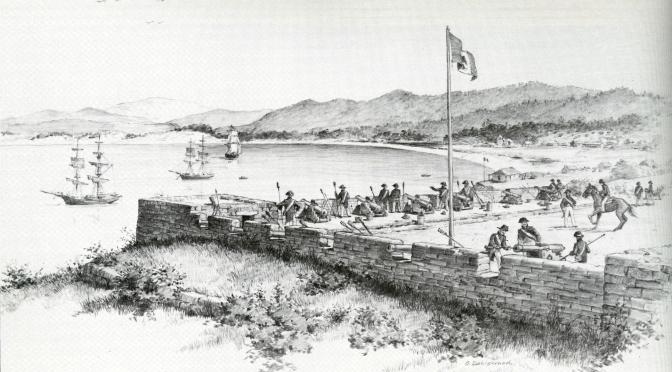
In 1792, Spain constructed a separate artillery fortification on the hill overlooking the bay.
The battery became known as El Castillo.
According to the U.S. Army's history of the Presidio, the fort contained 11 cannons.
Its commanding position gave artillery crews a broad view across Monterey Bay and the harbor below.
The site of El Castillo is particularly important because it provides the geographic connection between the Spanish defensive system and the later American military installation.
Monterey Becomes the Capital of Alta California
The Presidio's importance extended beyond military defense.
Monterey became the political capital of Alta California during the Spanish era.
The military post and capital city therefore developed together.
Governors, soldiers, government officials and civilians formed a small but strategically important settlement on the edge of the Spanish Empire.
Read the larger political story in Monterey as the Capital of Alta California.
1822: Mexican Rule Changes the Presidio
Mexico gained independence from Spain in 1821, and Monterey formally came under Mexican authority the following year.
The Presidio remained part of Monterey's military landscape, but the old Spanish installation gradually declined.
Mexico faced limited financial resources and enormous distances between California and the central government.
The original Presidio deteriorated, while Monterey increasingly became known for government, ranching and international maritime trade rather than as a heavily fortified military post.
The Hill Above Monterey Remained Strategically Important
Although the original Presidio deteriorated, the military value of the hill above the harbor did not disappear.
The same elevation that had attracted Spanish artillery planners offered commanding views of Monterey Bay to anyone responsible for defending the port.
That fact became important again in 1846.
1846: The United States Takes Monterey
During the Mexican-American War, Commodore John Drake Sloat sailed the U.S. Pacific Squadron into Monterey Bay.
On July 7, 1846, American sailors and Marines landed without significant resistance and raised the United States flag at the Monterey Custom House.
The United States had taken military control of Monterey.
Sloat left a small force behind to defend the town and harbor.
Rather than simply occupy the deteriorated Spanish compound, the Americans concentrated defensive work near the old El Castillo site on the hill.
Fort Mervine
The new American fortification became known as Fort Mervine, named for Navy Captain William Mervine, whose ship participated in Sloat's squadron.
Sailors and Marines initially improved the defenses.
In January 1847, Company F of the U.S. Army's 3rd Artillery Regiment arrived, and the Army assumed responsibility for construction.
Several young officers associated with the project later became nationally important military figures.
Sherman, Halleck and Ord in Monterey
The Monterey garrison included officers whose names would become much better known during the Civil War.
William Tecumseh Sherman served in California before becoming one of the Union's most famous generals.
Edward Otho Cresap Ord later became a senior Union Army commander.
Engineer Henry Wager Halleck also worked on the Monterey defenses and eventually served as General-in-Chief of the Union armies.
Their connection gives early American Monterey an unexpected link with the later history of the Civil War.
A Fort With Several Names
The early American defensive works acquired several names.
Historical records refer to:
- Fort Mervine
- Fort Halleck
- Fort Savannah
- the Monterey Redoubt
The changing terminology can make Monterey's military history confusing.
These names generally relate to evolving uses of the American fortifications on or near the former Spanish defensive site rather than to completely unrelated installations scattered around Monterey.
1852: The Monterey Ordnance Depot
In 1852, the Monterey Redoubt was redesignated the Monterey Ordnance Depot.
It served primarily as a military storehouse rather than a major active garrison.
By 1856, even that role had diminished.
The Presidio Was Not Continuously Occupied
This is an important correction to a common version of Monterey's military story.
The Presidio has an extraordinarily long military history, but the American installation was not continuously occupied throughout the nineteenth century.
The post was abandoned from 1856 until 1865.
It was briefly reoccupied during the closing months of the Civil War and then abandoned again in 1866.
The federal government nevertheless retained approximately 140 acres of the military reservation for possible future use.
That decision turned out to be consequential.
The Army Returns in 1902
More than three decades passed before Monterey again became home to a substantial active Army post.
Near the end of the Philippine-American War, the U.S. Army was looking for additional military installations on the West Coast.
Army planners recognized that the federal government already owned the old military reservation above Monterey.
In July 1902, the Army announced plans to establish a permanent cantonment there.
The 15th Infantry Builds the New Post
The 15th Infantry Regiment, which had served in China and the Philippines, arrived in Monterey in September 1902.
Its soldiers began constructing a new Army post around what is now Soldier Field.
The early construction included:
- wooden barracks
- officers' quarters
- a hospital
- a commissary
- quartermaster facilities
- support buildings
Many of the historic buildings associated with this period remain part of the Presidio's architectural landscape.
The Buffalo Soldiers Come to Monterey
Shortly after the 15th Infantry arrived, Monterey welcomed soldiers of the 1st Squadron, 9th Cavalry Regiment.
The 9th Cavalry was one of the African American Army regiments whose members became widely known as Buffalo Soldiers.
The soldiers established cavalry facilities at the new Monterey post and trained with horses on the Peninsula.
Their presence adds an important chapter to both Monterey and African American military history.
Army historical records preserve photographs of the 9th Cavalry encampment and its soldiers participating in activities around Monterey and Pacific Grove.
1903: Ord Barracks
The modern installation's name changed quickly.
The Army initially referred to the site as the Monterey Military Reservation.
On July 13, 1903, it became Ord Barracks, honoring Edward O.C. Ord, the officer who had served at Monterey decades earlier and later became a Civil War general.
That name lasted only about a year.
1904: The Presidio of Monterey Returns
On August 30, 1904, the War Department renamed the installation the Presidio of Monterey.
The name deliberately honored the Spanish military post established 134 years earlier.
This is the origin of the name used by today's U.S. Army installation.
The Army School of Musketry
Monterey soon became involved in military education as well as troop housing and training.
From 1907 to 1913, the Army School of Musketry operated at the Presidio.
The Army identifies it as a predecessor of the modern Infantry School.
That educational role foreshadowed the specialized training mission that would eventually define the Presidio after World War II.
Monterey Needs More Training Land
The Presidio itself was not large enough for all of the training required by a modern Army.
In 1917, the War Department purchased approximately 15,609 acres of nearby land known as the Gigling Reservation.
The new training area gave Presidio troops room for field exercises beyond the relatively compact Monterey installation.
This land would eventually become the foundation of another military post whose name became synonymous with the Monterey Peninsula.
The Creation of Fort Ord
The Gigling Reservation expanded over time.
On August 15, 1940, the larger training installation was officially named Fort Ord.
This created an important distinction.
The Presidio of Monterey and Fort Ord were separate military installations.
The Presidio remained on the hill immediately above Monterey.
Fort Ord occupied thousands of acres farther north and east between Monterey Bay and the Salinas Valley.
The two installations were closely connected, but they served different functions.
Cavalry at the Presidio
Cavalry remained an important part of Presidio life during the early twentieth century.
The 11th Cavalry Regiment was stationed at the Presidio from 1919 until 1940.
Artillery units also served there.
Stables, riding areas and other cavalry-related structures once occupied substantial portions of the military landscape.
The Lower Presidio Historic Park still contains physical traces and interpretive sites associated with this period.
The Great Depression and Civilian Conservation Corps
During the Depression, Army personnel from the Presidio also helped administer and support Civilian Conservation Corps activities.
Presidio soldiers participated in organizing CCC camps as well as Citizens' Military Training Corps and ROTC programs.
This expanded the post's influence beyond the boundaries of the installation itself.
World War II Changes Monterey's Military Landscape
World War II dramatically increased military activity throughout the Monterey Peninsula.
Fort Ord expanded into one of the largest Army training installations on the West Coast.
The Presidio itself became the temporary headquarters of III Corps in 1940 and later served as a military reception center.
By late 1944, the post was briefly declared inactive.
But its next mission was already approaching.
Preparing for the Occupation of Japan
The Presidio reopened in 1945 as a Civil Affairs Staging and Holding Area.
Personnel preparing for civil-affairs responsibilities connected with the occupation of Japan passed through Monterey.
This role created a logical connection with a specialized Army school that was about to need a permanent home.
The Language School Did Not Begin in Monterey
Today's Defense Language Institute is so closely associated with Monterey that it is easy to assume the school originated at the Presidio.
It did not.
Its roots go back to November 1941, shortly before the United States entered World War II.
The Army established a small secret Japanese-language school at the Presidio of San Francisco.
The first class consisted of four instructors and approximately 60 students, most of whom were second-generation Japanese Americans, or Nisei.
The Nisei Linguists
The history of these first military linguists is one of the most important chapters in the Defense Language Institute story.
Following the attack on Pearl Harbor and the forced removal of Japanese Americans from the West Coast, the school could no longer remain in California.
It moved first to Camp Savage, Minnesota, in 1942 and then to nearby Fort Snelling in 1944.
Thousands of graduates served as linguists, interpreters and intelligence specialists in the Pacific Theater and during the subsequent occupation of Japan.
Many served the United States while their own families were subjected to wartime incarceration.
Their contribution remains central to the institutional history of today's Defense Language Institute.
1946: The Language School Comes to Monterey
After World War II, the military's need for trained linguists did not disappear.
In 1946, the Military Intelligence Service Language School moved from Fort Snelling to the Presidio of Monterey.
The move permanently transformed the purpose of the installation.
A post historically associated with infantry, cavalry and artillery increasingly became a center for language, intelligence and education.
1947: The Army Language School
In 1947, the school became the Army Language School.
The curriculum expanded rapidly beyond Japanese.
Languages taught during the early Cold War included Russian, Chinese, Korean, Arabic and numerous European and Asian languages.
Native-speaking instructors were recruited from around the world.
This created an unusual cultural effect in Monterey.
Military students arrived from across the United States while civilian faculty came from countries around the globe.
The Cold War Makes Language Training Essential
The Cold War dramatically increased demand for military linguists.
The Korean War, expanding intelligence requirements and America's growing international commitments required service members who could speak and understand languages rarely taught in conventional American schools.
The Monterey program expanded in faculty, students and the number of languages offered.
New classroom buildings, barracks and support facilities gradually transformed the Presidio.
1963: The Defense Language Institute
In 1963, the Department of Defense created the Defense Language Institute to coordinate military foreign-language education.
The Presidio became the Institute's West Coast branch.
This also reflected another major evolution in the Monterey school's mission.
The installation was no longer serving only Army personnel.
Language education increasingly supported students from multiple branches of the U.S. military.
Monterey Becomes the Center of Military Language Education
During the 1970s, the military further consolidated its language programs.
East and West Coast headquarters were eventually combined, and Monterey became the central location for the institution now known as the Defense Language Institute Foreign Language Center.
The Presidio's principal mission had completed a remarkable transition:
from defending a harbor with cannons to educating military linguists for operations around the world.
The Presidio and the Naval Postgraduate School Are Different Institutions
Monterey's modern military presence sometimes creates understandable confusion.
The Presidio of Monterey is a U.S. Army installation and is home to the Defense Language Institute Foreign Language Center.
The Naval Postgraduate School occupies the former Hotel Del Monte property elsewhere in Monterey.
They are separate institutions with different missions.
The Naval Postgraduate School moved to Monterey in 1951 and provides advanced graduate education and research for military officers and others.
Read that property's unusual transition from resort to military campus in The History of Hotel Del Monte.
The Lower Presidio Historic Park
Part of the most historically important military landscape is accessible today through the Lower Presidio Historic Park.
In 1998, the U.S. Army leased approximately 25 acres of the Lower Presidio to the City of Monterey for development as a historic park.
The area includes sites associated with multiple layers of Monterey history, from Indigenous occupation and the Spanish fortifications to the nineteenth- and twentieth-century U.S. Army.
The Presidio Museum of Monterey
The Presidio Museum of Monterey opened in 2002 within a former Army ammunition building constructed in 1908.
The museum interprets the military history of the site and the broader evolution of the Presidio.
Nearby historic features include the location of El Castillo, former stables, Army buildings and monuments associated with Monterey's military past.
The Sloat Monument
One of the most visible landmarks on Presidio Hill is the Sloat Monument.
Construction began with the laying of its cornerstone in 1896.
The large stone monument took years to complete and was finally dedicated in 1910.
It commemorates Commodore John Drake Sloat and the July 1846 American takeover of Monterey.
The monument's location is especially symbolic.
It looks from the military hill toward the Custom House where the American flag was raised.
A Landscape With Multiple Layers of Archaeology
The historical significance of the Presidio is not limited to surviving buildings.
Archaeological resources within the Lower Presidio include evidence associated with:
- Indigenous use of the landscape
- Spanish El Castillo
- Mexican-era military activity
- American Fort Mervine
- later Army development
This makes the Presidio landscape unusually complex.
Several different governments constructed military works on essentially the same strategic hill overlooking Monterey Bay.
The 1902–1940 Army Post Is Historic in Its Own Right
It would be easy to focus only on the Spanish and Mexican periods because they are older.
But the early twentieth-century Army post is itself historically significant.
The Presidio's cultural-resource program identifies dozens of buildings, structures, monuments, roads, rock walls and landscape features associated with the 1902–1939 American military period.
Historic wooden barracks with long verandas remain particularly recognizable.
These buildings provide physical evidence of the years when Monterey was home to infantry, cavalry and artillery troops before language education became the installation's principal mission.
Why the Presidio Matters to New Monterey
The Presidio also influenced residential development outside its gates.
Today's New Monterey sits immediately beside the military installation.
During different periods, military personnel, civilian employees, language instructors and students added another layer to a neighborhood already shaped by Cannery Row's fishing and canning economy.
The result is part of what makes New Monterey's history unusually diverse.
Its location connects one residential neighborhood simultaneously with Cannery Row, Pacific Grove and more than two centuries of military activity.
Monterey's Continuing Relationship With the Military
The relationship between Monterey and the military has never been entirely confined inside military property lines.
Service members and their families live throughout the Peninsula.
Faculty and civilian employees become part of the local community.
Students shop, dine and recreate throughout Monterey.
Internationally recruited language instructors have added to the cultural diversity of the city.
Military education has therefore affected Monterey socially and economically as well as institutionally.
The Presidio of Monterey Today
The Presidio remains an active U.S. Army installation.
Its primary tenant organization is the Defense Language Institute Foreign Language Center, which provides foreign-language education, training, evaluation and sustainment in support of U.S. national-security requirements.
The mission is completely different from the one Gaspar de Portolá envisioned in 1770.
Yet there is a remarkable continuity of purpose.
Spain created the Presidio because Monterey had strategic importance in an international world.
Today's students study languages because international understanding remains essential to national security.
The tools changed from cannons to classrooms.
The strategic dimension remained.
Is the Presidio of Monterey the Original Spanish Presidio?
This question requires a nuanced answer.
The modern Army installation carries the name and military heritage of the original Spanish Presidio, but the original 1770 adobe compound was located closer to today's downtown Monterey.
The hill occupied by the modern Presidio includes the site of El Castillo, Spain's 1792 harbor-defense battery, and later American Fort Mervine.
So the modern installation is historically connected with the Spanish military landscape without sitting entirely on the footprint of the original 1770 presidio compound.
More Than 250 Years of Military History
The Presidio's history cannot be reduced to one uninterrupted military base operating since 1770.
The truth is more interesting.
The landscape was used, abandoned and reused.
Its mission repeatedly changed.
Spain fortified Monterey against rival empires.
Mexico inherited the military post as Monterey remained the capital of Alta California.
The United States fortified the harbor after taking Monterey in 1846.
The Army abandoned the post and then returned decades later.
Infantrymen, Buffalo Soldiers, cavalry troops and artillery units occupied the early twentieth-century Presidio.
World War II reshaped military activity throughout the Peninsula.
And after the war, language education transformed the installation again.
That ability to adapt is the real continuity in Presidio history.
Frequently Asked Questions About the Presidio of Monterey
When was the Presidio of Monterey founded?
Spain established the original Presidio of Monterey on June 3, 1770 under the leadership of Gaspar de Portolá. The original compound was located closer to today's downtown Monterey than the principal modern Army installation.
What was El Castillo?
El Castillo was an 11-cannon Spanish defensive battery constructed in 1792 on the hill overlooking Monterey Bay. Its site lies within today's Lower Presidio area and provides an important geographic connection between Spanish and later American military use.
What was Fort Mervine?
Fort Mervine was the American fortification developed near the old El Castillo site after U.S. forces took Monterey in 1846. It was named for Navy Captain William Mervine.
Did William Tecumseh Sherman serve in Monterey?
Yes. Sherman was one of several young Army officers associated with early American military operations in California. Edward O.C. Ord and Henry W. Halleck also served in Monterey before becoming prominent Civil War generals.
Was the Presidio continuously occupied after 1846?
No. The American military post was abandoned from 1856 to 1865 and again after 1866. The federal government retained the military reservation, and the U.S. Army returned to establish a substantial permanent post in 1902.
When did the Buffalo Soldiers serve at Monterey?
Members of the 1st Squadron, 9th Cavalry Regiment arrived shortly after the Army reestablished the Monterey post in 1902. The 9th Cavalry was one of the African American Army regiments historically known as Buffalo Soldiers.
Why was the post called Ord Barracks?
The Monterey Military Reservation was renamed Ord Barracks in July 1903 in honor of Edward O.C. Ord. In August 1904, the Army changed the name again to Presidio of Monterey to honor the original Spanish military post.
How is Fort Ord connected with the Presidio of Monterey?
The War Department purchased the large Gigling Reservation in 1917 as a training area for troops stationed at the Presidio. That property expanded over time and was officially named Fort Ord in 1940. Fort Ord and the Presidio were separate but closely connected installations.
When did the Defense Language Institute come to Monterey?
The institution's predecessor, the Military Intelligence Service Language School, moved from Fort Snelling, Minnesota, to the Presidio of Monterey in 1946. It became the Army Language School in 1947 and later evolved into the Defense Language Institute Foreign Language Center.
Did the Defense Language Institute begin in Monterey?
No. Its origins date to a Japanese-language intelligence school established at the Presidio of San Francisco in 1941. The school moved to Minnesota during World War II and then relocated to Monterey in 1946.
Is the Presidio of Monterey the same as the Naval Postgraduate School?
No. The Presidio of Monterey is a U.S. Army installation and home to the Defense Language Institute Foreign Language Center. The Naval Postgraduate School is a separate military graduate institution occupying the former Hotel Del Monte property elsewhere in Monterey.
Can you visit historic portions of the Presidio?
The active Army installation has access restrictions, but the Lower Presidio Historic Park is a City-operated historic area on Army-owned property. It includes the Presidio Museum, historic military sites, monuments and views across Monterey Bay. Visitors should verify current park and museum access information before visiting.
Continue the Monterey History Series
The Presidio connects several major chapters in Monterey's history.
- Complete History of Monterey, California
- Monterey as the Capital of Alta California
- The History of Hotel Del Monte
- The Sardine Boom and Cannery Row
- From Industry to Destination: Modern Monterey History
Explore the Monterey Neighborhoods Around the Presidio
- New Monterey Real Estate & Homes for Sale
- Old Town Monterey Real Estate & Homes for Sale
- Peter's Gate Real Estate & Homes for Sale
- Monterey Real Estate & Homes for Sale
Considering a home in Monterey or elsewhere on the Monterey Peninsula?
Call Mark Bruno and the Monterey Peninsula Home Team at (831) 917-8190.