


Originally published April 17, 2026; substantially updated September 2026.
.jpg)
Before Cannery Row became a destination of restaurants, hotels, shops and the Monterey Bay Aquarium, it was one of the hardest-working industrial waterfronts on the West Coast.
Fishing boats returned to Monterey Bay carrying tons of sardines.
Factory whistles summoned workers when the fleet came in.
Canneries operated late into the night processing fish while reduction plants converted enormous quantities of sardines and waste into fishmeal, oil and fertilizer.
At the industry's peak, Monterey became known as the "Sardine Capital of the World."
But Monterey's fishing history did not begin with sardines—or with the Italian fishermen most often associated with the later fleet.
The industry was built in layers by generations of Chinese, Japanese, Sicilian, Italian, Portuguese, Filipino, Mexican and other residents who brought different skills to Monterey Bay.
Technology changed the scale of the catch. Two world wars created enormous demand. Women made up an essential part of the cannery workforce. Industrial buildings crowded the shoreline. Residential neighborhoods grew uphill to house workers.
Then, almost as dramatically as the industry had risen, the sardines disappeared.
Canneries closed. Jobs vanished. Monterey's industrial waterfront fell into decline.
Yet the same era produced John Steinbeck's Cannery Row, Ed Ricketts' pioneering ecological work and the physical waterfront that Monterey would eventually reinvent as one of California's best-known destinations.
Part of our Monterey History Series: This article tells the industrial story of Monterey's fishing fleet and canneries. For Ed Ricketts, John Steinbeck and Pacific Biological Laboratories, read Ed Ricketts, Pacific Biological Laboratories & the Real "Doc" of Cannery Row. For the complete chronology, visit our Complete History of Monterey, California.
For current homes, condominiums and buyer information around the district, visit our Cannery Row Real Estate & Homes for Sale guide.
Monterey Was a Fishing Town Before It Was a Cannery Town
Monterey's relationship with Monterey Bay stretches back thousands of years.
Indigenous communities harvested marine resources long before European colonization.
After California entered the American era, commercial fishing expanded dramatically as immigrant communities established specialized fishing operations around the bay.
One of the most important early groups was the Chinese fishing community.
Chinese Fishermen Build an Early Commercial Industry
By the early 1850s, Chinese fishing families had established settlements around Monterey Bay.
One important community developed at Point Alones, near today's Hopkins Marine Station and Monterey Bay Aquarium.
Chinese fishermen harvested fish, squid and abalone and developed sophisticated drying and export businesses.
Their operations predated the famous sardine canneries by decades.
This history matters because Cannery Row did not suddenly appear when someone built a factory.
The industrial waterfront grew from an already-established maritime economy.
Japanese Fishermen Transform the Early Fleet
Japanese immigrants became increasingly important to Monterey fishing during the late nineteenth and early twentieth centuries.
They were particularly successful in salmon fishing.
City historical research records that in 1909, 145 of approximately 185 salmon boats fishing Monterey Bay were Japanese-owned.
That means Japanese fishermen controlled a substantial majority of Monterey's salmon fleet before sardines became the dominant catch.
Japanese entrepreneurship also played a direct role in the development of Cannery Row itself.
1902: The First Cannery on Ocean View Avenue
In 1902, Japanese businessman Otosaburo Noda and Harry Malpas founded the Monterey Fishing and Canning Company.
The plant packed salmon and abalone along Ocean View Avenue—the shoreline street that would later become Cannery Row.
City historical studies identify it as the first successful canning operation on the street that eventually became the center of Monterey's industrial fishing economy.
At that point, however, sardines were not yet the star of the industry.
.jpg)
Frank Booth and the Monterey Packing Company
Another major figure was Frank E. Booth.
Booth had operated fish-processing businesses near Monterey's wharf before creating the Monterey Packing Company in 1903.
His operation helped introduce standardized one-pound oval cans that became closely associated with the sardine industry.
At first, salmon remained more commercially important.
Sardines were so abundant they could be treated almost as secondary fish.
That was about to change.
Knut Hovden Brings Engineering to the Cannery
In 1905, Booth hired Norwegian fisheries engineer Knut Hovden.
Hovden became one of the most important technological figures in Cannery Row history.
He helped mechanize the canning process through improvements involving:
- automatic fish cutting
- mechanized cooking
- can soldering
- conveyance and processing systems
- greater production efficiency
Industrialization dramatically increased the amount of fish a cannery could process.
But factories could only process enormous quantities of sardines if fishermen could catch enormous quantities of sardines.
That problem was solved partly by another immigrant innovation.
Pietro Ferrante and the Lampara Net
Sicilian fisherman Pietro Ferrante introduced Monterey fishermen to the lampara net.
The net could surround an entire school of sardines rather than catching individual fish or small quantities.
Its use dramatically increased potential catches.
Instead of bringing back a few tons, fishing crews could land twenty or thirty tons of sardines at a time.
The fishing fleet and canneries now possessed technologies capable of operating on an industrial scale.
By the late 1910s, the lampara net had become a standard tool of the Monterey sardine fleet.
1908: Pacific Fish Company Expands Cannery Row
The enormous catches created by improved fishing methods quickly exceeded the capacity of Booth's original operation.
In 1908, the Pacific Fish Company was organized.
Its plant along Ocean View Avenue between Hoffman and McClellan became the first major cannery along the New Monterey shoreline.
By 1912, Booth's Monterey Packing Company and Pacific Fish Company were packing and shipping tens of thousands of cases of sardines.
Cannery Row was taking shape.
New Monterey Grows Above the Waterfront
The new industry needed workers—and those workers needed somewhere to live.
Residential development expanded uphill from the canneries into what became New Monterey.
Small cottages and modest homes provided housing relatively close to the waterfront.
This is why New Monterey's history cannot be separated from Cannery Row.
One was the workplace.
The other increasingly became home.
Why the Canneries Concentrated in New Monterey
Industrial development created a political problem for Monterey.
The city was already known as a resort destination because of Hotel Del Monte.
Smoke, industrial smells and factories were not exactly compatible with the luxury resort image.
By the late 1910s, Monterey zoning concentrated new industrial development in the lower portions of New Monterey along Ocean View Avenue.
This created a geographic compromise:
the fishing and canning industry could continue expanding while remaining separated from Hotel Del Monte and much of central Monterey.
World War I Creates the First Sardine Boom
World War I dramatically accelerated the industry.
Canned fish could be transported easily, stored for long periods and used as military provisions.
Demand soared.
Monterey's Cannery Row Cultural Resources Survey records the scale of the change:
sales increased from approximately 75,000 cans in 1915 to 1.4 million cans in 1918.
Five new canneries were constructed along Cannery Row between 1916 and 1918.
A local fishing business had become a wartime industrial complex.
1916: Knut Hovden Builds His Own Cannery
Hovden eventually separated from Booth and constructed his own operation.
On July 7, 1916, the Hovden Cannery opened near David Avenue and Ocean View Avenue.
The plant became one of Cannery Row's largest and most important canneries.
Decades later, that same site would become home to the Monterey Bay Aquarium.
That transformation—from major fish-processing plant to marine-conservation institution—is one of the most remarkable reversals in Monterey history.
The Reduction Plants Change the Economics
Canned sardines were only part of the industry's value.
Reduction plants converted fish and cannery waste into products such as:
- fishmeal
- fertilizer
- fish oil
- industrial by-products
By the early 1920s, large-scale reduction had become economically important.
This meant almost every part of the catch could generate revenue.
It also created an incentive to catch even greater quantities of sardines.
Cannery Row Was Loud, Crowded and Industrial
Modern Cannery Row is built around views of Monterey Bay.
Historic Cannery Row often blocked them.
Factories crowded the shoreline.
Elevated enclosed bridges crossed Ocean View Avenue, carrying fish, cans and materials between buildings on opposite sides of the street.
Railroad tracks ran through the district.
Boilers, machinery and reduction plants operated around the clock when the catch demanded it.
Smoke and steam rose above the waterfront.
It was not picturesque in the modern resort sense.
It was productive.
The Cannery Whistle Controlled the Workday
The fishing industry did not operate on an ordinary nine-to-five schedule.
Workers often did not know exactly when they would be needed.
When boats returned with sardines, cannery whistles summoned employees to work.
If the catch was enormous, processing could continue for hours.
The rhythm of the neighborhood followed the fishing fleet.
Women Were Essential to Cannery Row
The industrial history is sometimes told mainly through fishermen and cannery owners.
That leaves out a huge portion of the workforce.
Women performed much of the cannery processing work.
They cleaned, packed, trimmed and handled fish moving through the production lines.
Monterey's 2023 Path of History research specifically notes that women were predominantly employed in cannery work even when servicemen returned to the labor force after wartime service.
The sardine economy depended on labor both offshore and inside the factories.
A Multicultural Industrial Neighborhood
Cannery Row and New Monterey became extraordinarily diverse working communities.
People associated with the fishing and cannery economy included:
- Chinese
- Japanese
- Sicilian and other Italian immigrants
- Portuguese
- Filipino workers
- Mexican and Mexican American residents
- other European and American workers
These communities did not all arrive at the same time or perform identical roles.
Their influence changed as immigration law, economics and discrimination altered who could work and settle in California.
Filipino Workers Become Part of Cannery Row
Filipino workers became increasingly visible in California labor during the 1920s and 1930s.
Some worked in Monterey canneries and lived in modest worker housing near the Row.
Reconstructed Cannery Worker Shacks at 799 Cannery Row commemorate the type of small dwellings occupied by Japanese fishermen and Filipino cannery workers during this period.
Those buildings remind visitors that today's expensive waterfront district once included extremely modest worker housing.
Ocean View Avenue Was More Than Factories
Although industry dominated the waterfront, Cannery Row was never exclusively industrial.
The surrounding district also included:
- worker housing
- boarding houses
- markets
- restaurants
- bars
- small businesses
- entertainment
It was a complete working neighborhood built around the waterfront economy.
That human landscape would eventually become the raw material for John Steinbeck.
Ed Ricketts Works in the Middle of the Row
Marine biologist Ed Ricketts operated Pacific Biological Laboratories at what is now 800 Cannery Row.
His presence created an extraordinary contrast.
Outside his laboratory, businesses were extracting Monterey Bay's marine resources on a massive industrial scale.
Inside, Ricketts was studying the relationships among marine organisms and the environments in which they lived.
His 1939 book Between Pacific Tides, written with Jack Calvin, became an influential work in intertidal ecology.
Read his complete story in Ed Ricketts, Pacific Biological Laboratories & the Real "Doc" of Cannery Row.
The 1924 Cannery Row Fire
Industrial Monterey also carried significant fire risk.
On September 14, 1924, a major fire beginning at the Associated Oil Company destroyed several Cannery Row facilities and threatened a much larger portion of Monterey.
Fire would remain an ongoing danger in a district containing wooden industrial buildings, fuel, machinery and densely packed development.
The Purse Seine Changes Fishing Again
Fishing technology continued evolving.
The lampara net had revolutionized the early sardine fleet.
Larger purse seine nets eventually allowed fishermen to surround and capture even larger schools of sardines.
Boats became more powerful and efficient.
Catch capacity kept increasing.
The industrial system was becoming extraordinarily effective at removing sardines from Monterey Bay and the broader California Current.
The Great Depression Does Not End the Industry
The Depression affected seafood prices and national demand, but Monterey's sardine industry survived.
Reduction helped maintain profitability by creating additional products from fish.
The waterfront remained an important source of employment during economically difficult years.
Then another global war created an even greater demand for canned food.
World War II Brings Cannery Row to Its Peak
During World War II, Monterey's sardine industry reached extraordinary production levels.
The City of Monterey records that by the peak in 1945, approximately 16 canneries and 14 reduction plants surrounded Ocean View Avenue.
The city became widely known as the Sardine Capital of the World.
Factories operated at enormous scale.
But the prosperity concealed two profound problems.
One involved people.
The other involved fish.
1942: Japanese Americans Are Forced Out
Before World War II, Japanese Americans played a major role in Monterey's fishing industry.
City historical records indicate that Japanese Americans owned more than half of the fishing companies on Fisherman's Wharf before the war.
After the United States entered World War II, the federal government forcibly removed Japanese Americans from the West Coast.
Fishing boats were impounded and families were sent to incarceration camps.
City directories show the abrupt disappearance of Japanese families from the Cannery Row area after 1942.
This was not a natural change in the fishing economy.
It was the result of government policy based on wartime exclusion and racial discrimination.
Sicilian Fishermen Become Increasingly Dominant
With Japanese fishermen removed from the industry, Sicilian fishing families became even more prominent in Monterey's fleet.
Many of the family names associated with Monterey fishing for generations trace their roots to Sicilian immigrants who brought maritime traditions from the Mediterranean.
Their boats and crews became enduring symbols of Monterey's working harbor.
1945: Steinbeck Publishes Cannery Row
At almost exactly the moment when the sardine industry was reaching its peak, John Steinbeck published Cannery Row.
The 1945 novel transformed Monterey's industrial district into an international literary landscape.
Steinbeck did not write a documentary history.
He created a fictional community inspired by real people, businesses and places he knew.
Ed Ricketts became the primary model for Doc.
Pacific Biological Laboratories inspired Western Biological Laboratory.
The industrial waterfront became a human "tide pool."
Steinbeck gave the Row a cultural identity that would ultimately outlive the industry itself.
Then the Sardines Disappeared
The industry's collapse was astonishingly fast.
Monterey had built an industrial system capable of catching and processing sardines at tremendous scale.
But sardine populations were not unlimited.
A combination of factors contributed to the collapse, including:
- intense fishing pressure
- poor spawning years
- changes in ocean conditions
- shifts in the California Current ecosystem
The exact balance among those factors remains part of the scientific history of the fishery.
What is indisputable is what happened to Monterey.
The sardines virtually disappeared.
From Peak Production to Collapse
City historical research documents the speed of the decline.
The enormous wartime production levels could not be sustained.
By the late 1940s, catches had fallen catastrophically.
Canneries that depended on a constant supply of sardines suddenly had expensive industrial plants but too few fish to process.
One after another, businesses struggled, consolidated or closed.
The Cannery Whistles Fall Silent
The effect on Monterey went beyond factory owners.
Fishermen lost their primary catch.
Cannery workers lost shifts.
Businesses serving the industrial workforce lost customers.
Buildings stood vacant.
Reduction plants stopped operating.
The street that had been one of California's busiest fishing-industrial corridors became increasingly quiet.
Hovden Keeps Going
Some companies tried to survive by processing other seafood.
The Hovden Cannery continued operating after the sardine collapse and eventually processed products such as squid.
But even Hovden could not restore the old Cannery Row economy.
The plant finally closed in 1973.
It had survived longer than the other major sardine-era canneries, making its closure an important symbolic end to the industrial period.
1958: Fiction Renames the Real Street
The sardine industry was disappearing, but Steinbeck's Cannery Row was becoming increasingly famous.
In 1958, Monterey officially renamed Ocean View Avenue as Cannery Row.
This created one of the more unusual relationships between literature and geography.
Steinbeck had used a colloquial name for a real industrial district.
The fictional fame became so powerful that the city eventually adopted that name officially.
What Survived the Sardine Era?
Many industrial buildings disappeared after the collapse.
Others survived through adaptive reuse.
Remnants of former canneries, warehouses, crossovers, boilers, foundations and worker buildings remain embedded throughout Cannery Row.
The street therefore retains an industrial visual vocabulary even though its economic purpose has completely changed.
The Railroad Becomes a Recreation Trail
Freight rail once served Cannery Row's industrial businesses.
Tracks carried products and supplies along the waterfront corridor.
Much of that former rail alignment later became the Monterey Bay Coastal Recreation Trail.
Today people walk and bicycle through a corridor once dominated by freight movement and industrial production.
The physical transformation mirrors the economic one.
From Cannery Workers to Visitors
Beginning in the 1950s and accelerating during the following decades, Cannery Row gradually developed a new economy.
Restaurants, shops, hotels and attractions began replacing or reusing industrial properties.
The transition was not immediate.
For years, the Row contained vacant buildings, abandoned industrial remnants and uneven redevelopment.
But the direction was clear.
Monterey was turning an industrial waterfront into a visitor destination.
The next chapter is explored in From Industry to Destination: How Modern Monterey Reinvented Itself.
1984: The Hovden Cannery Becomes the Monterey Bay Aquarium
The ultimate symbol of Cannery Row's transformation came on October 20, 1984.
The Monterey Bay Aquarium opened on the former Hovden Cannery property.
Think about the reversal.
The Hovden Cannery had been created to process enormous quantities of marine life harvested from Monterey Bay.
The Aquarium was created to help visitors understand the marine ecosystems living in that same bay.
A center of extraction became a center of education and conservation.
Few redevelopment projects could symbolize Monterey's changing relationship with the ocean more clearly.
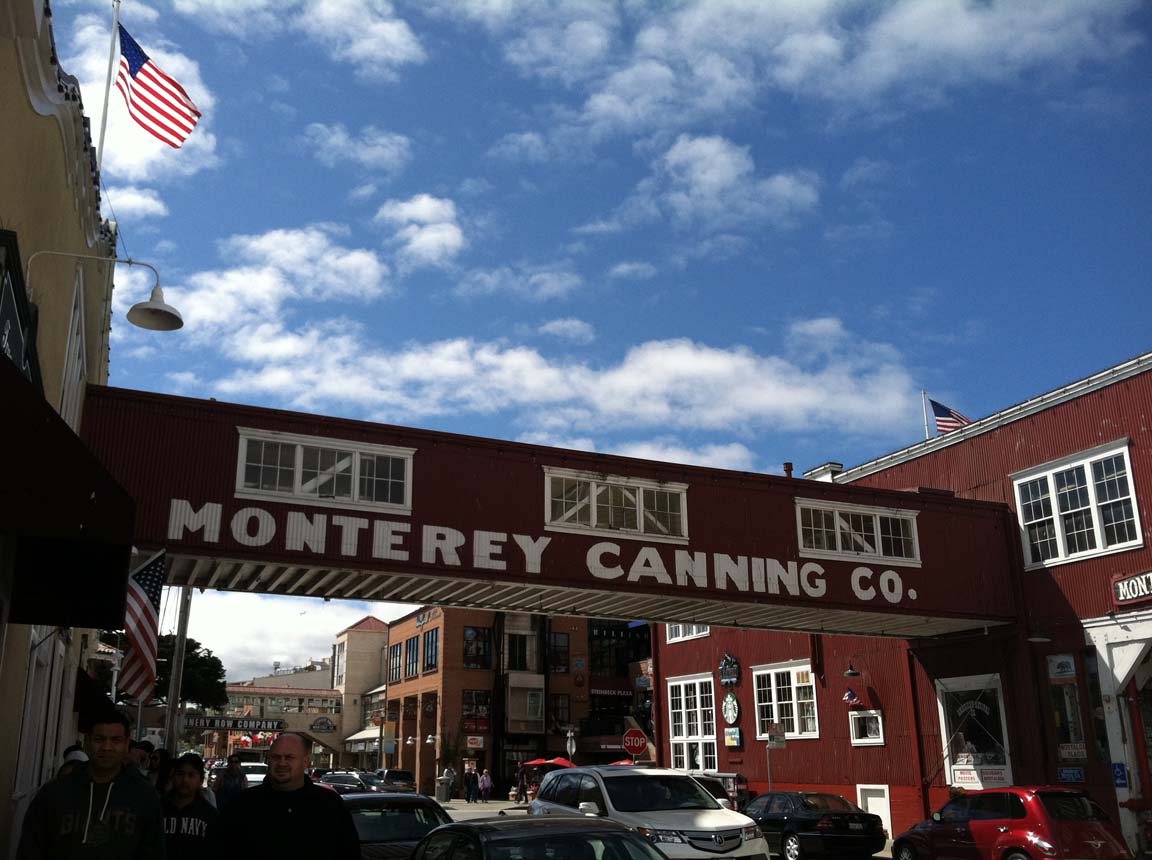
The Sardine Boom Still Shapes Monterey
The canneries are largely gone, but the industry remains embedded in Monterey.
It survives in:
- Cannery Row's name
- historic industrial buildings
- Fisherman's Wharf
- New Monterey cottages
- Italian fishing families
- Japanese and Chinese community history
- Steinbeck's literature
- Ed Ricketts' scientific legacy
- the Monterey Bay Aquarium
- the city's continuing identity as a place tied closely to Monterey Bay
The modern city cannot be understood without the industrial waterfront that preceded it.
New Monterey Is Part of Cannery Row History
Modern visitors often treat Cannery Row and New Monterey as completely separate places.
Historically, the relationship was much closer.
The canneries occupied the waterfront.
Workers, fishermen and their families lived uphill.
Businesses serving those residents developed along Lighthouse Avenue and adjoining streets.
To understand the residential side of this history, explore our New Monterey Real Estate & Neighborhood Guide.
Cannery Row Real Estate Today
Modern Cannery Row is primarily a historic commercial and visitor district rather than a conventional residential neighborhood.
Residential properties within or immediately adjacent to the actual Row are relatively limited.
Many homes marketed as being "near Cannery Row" are technically in adjoining New Monterey.
For modern housing, zoning, location and current MLS information, visit our Cannery Row Real Estate & Homes for Sale guide.
Why the Sardine Boom Belongs at the Center of Monterey History
Monterey has repeatedly reinvented itself.
It was the capital of Alta California.
Then it became a fishing and maritime town.
Hotel Del Monte helped turn the Peninsula into a resort destination.
The sardine industry then transformed Monterey into a global industrial center.
When the fishery collapsed, the city was forced to reinvent itself again.
Today's combination of historic preservation, tourism, marine science and recreation grew partly from the ruins of that industrial economy.
The sardine boom therefore was not simply one colorful period in Cannery Row history.
It was the bridge between old Monterey and modern Monterey.
Frequently Asked Questions About Monterey's Sardine Industry and Cannery Row
When did Monterey's sardine industry begin?
Commercial fishing in Monterey predates the sardine canneries by decades. Large-scale sardine processing developed during the early twentieth century as mechanized canning, improved fishing nets and new cannery operations allowed much larger catches to be processed.
Who started Cannery Row?
No single person created Cannery Row. Otosaburo Noda and Harry Malpas opened an important early cannery on Ocean View Avenue in 1902. Frank Booth expanded sardine canning, Knut Hovden introduced major mechanical innovations, and Sicilian fisherman Pietro Ferrante helped revolutionize catching through the lampara net.
Were Japanese fishermen important to Monterey's fishing industry?
Yes. Japanese fishermen played a major role in Monterey's early commercial fleet. City historic research records that in 1909, 145 of approximately 185 salmon boats fishing Monterey Bay were Japanese-owned. Japanese Americans remained important to the industry until their forced removal from the West Coast during World War II.
What did Sicilian fishermen contribute to Monterey fishing?
Sicilian fishermen brought extensive Mediterranean fishing experience to Monterey. Pietro Ferrante introduced the lampara net, which could surround entire schools of sardines and dramatically increased catch sizes. Sicilian fishing families subsequently became central to Monterey's fishing identity.
When did Knut Hovden open his cannery?
Knut Hovden opened his Cannery Row plant on July 7, 1916. It eventually became the largest sardine cannery on Cannery Row and continued operating until 1973. The Monterey Bay Aquarium later opened on the Hovden site.
Why did the sardine industry grow so rapidly during World War I?
Wartime demand for shelf-stable canned food increased dramatically. Monterey's Cannery Row survey records sales growing from approximately 75,000 cans in 1915 to 1.4 million cans in 1918, while five new canneries were constructed between 1916 and 1918.
How many canneries were on Cannery Row at its peak?
City historical research records approximately 16 canneries and 14 reduction plants around Ocean View Avenue at the industry's peak in 1945.
Why did Monterey's sardine industry collapse?
The collapse resulted from a combination of intense fishing pressure, weak spawning years and changing oceanographic conditions. Sardine populations fell dramatically during the late 1940s, leaving Monterey's large industrial processing infrastructure without enough fish to sustain it.
When was Ocean View Avenue renamed Cannery Row?
The City of Monterey officially renamed Ocean View Avenue Cannery Row in 1958 in recognition of the name made internationally famous by John Steinbeck's 1945 novel.
What happened to the Hovden Cannery?
Hovden continued processing other seafood after the sardine fishery collapsed but eventually closed in 1973. The Monterey Bay Aquarium opened on the former cannery site in 1984.
Did women work in Monterey's canneries?
Yes. Women formed an essential part of Cannery Row's industrial workforce and performed much of the fish cleaning, packing and processing work inside the canneries.
How is New Monterey connected with Cannery Row?
The waterfront canneries created substantial demand for nearby housing. New Monterey grew uphill from Cannery Row with cottages and homes occupied by fishermen, cannery workers and their families.
Continue the Monterey History Series
- Complete History of Monterey, California
- Ed Ricketts, Pacific Biological Laboratories & the Real "Doc" of Cannery Row
- From Industry to Destination: How Modern Monterey Reinvented Itself
- Hotel Del Monte: Monterey's Resort, Golf & Military History
- The Presidio of Monterey: 250+ Years of Military History
Explore Cannery Row and New Monterey Today
- Cannery Row Real Estate & Homes for Sale
- New Monterey Real Estate & Homes for Sale
- Monterey Ocean View Real Estate
- Monterey Real Estate & Homes for Sale
Considering a home in Monterey or elsewhere on the Monterey Peninsula?
Call Mark Bruno and the Monterey Peninsula Home Team at (831) 917-8190.