


This is part of our weekly series exploring the unusual stories, traditions, characters and forgotten places that help explain the Monterey Peninsula we know today. Explore the complete Local Lore collection →
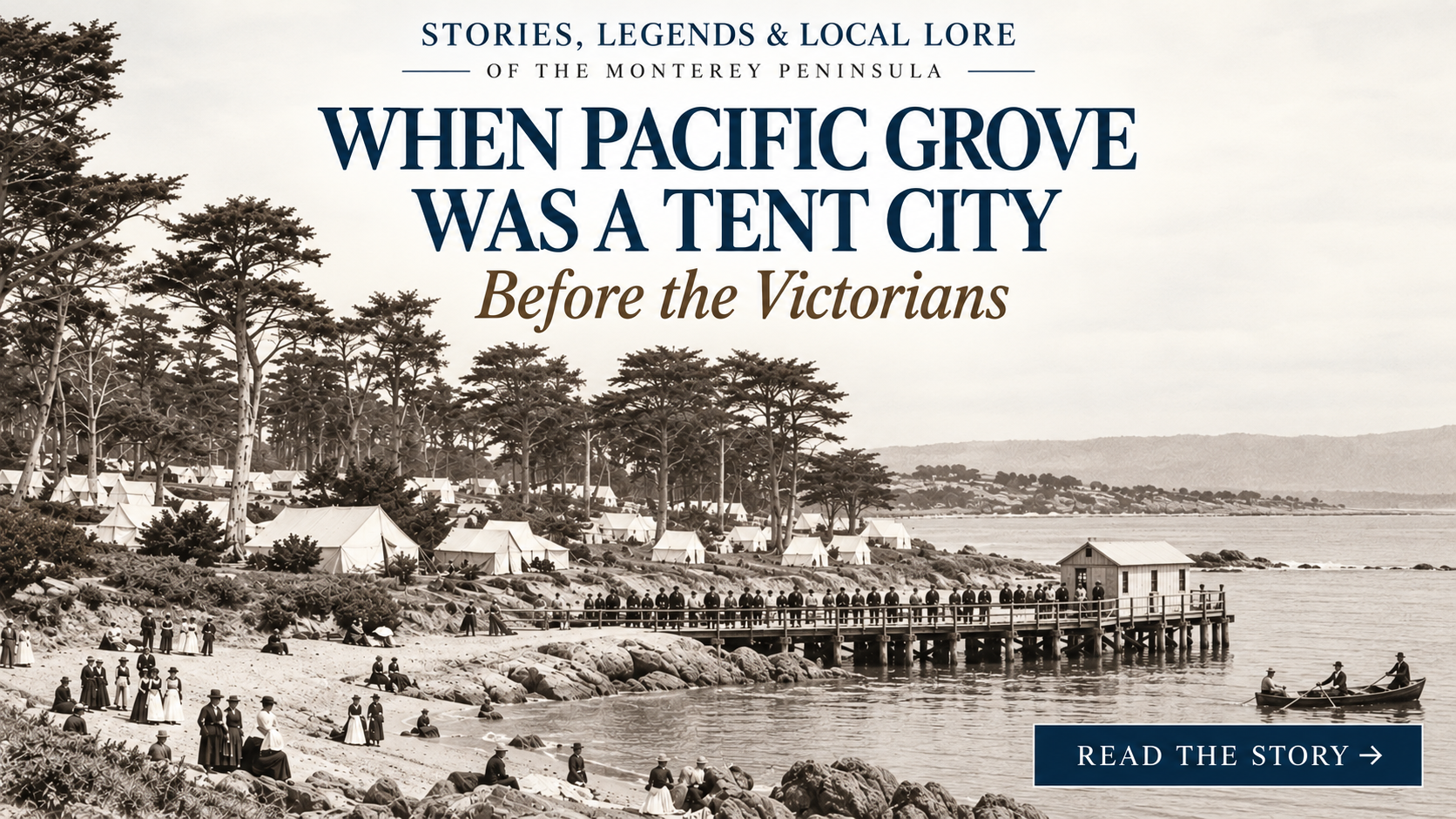
AI-generated historical visualization of Pacific Grove during its early tent-city era, before permanent Victorian homes began reshaping the community.
Walk through the historic neighborhoods surrounding downtown Pacific Grove today and it is easy to think the little cottages have always been there.
Victorian homes sit close together on compact lots. Front porches face narrow streets. Gardens fill tiny spaces between houses. Lovers Point and Monterey Bay are only a short walk away.
But go back to the 1870s and much of this neighborhood looked very different.
Instead of rows of cottages beneath the Monterey pines, there were rows of tents.
Lots that now hold homes worth well into seven figures were originally laid out as places where families could pitch canvas shelters for a few weeks beside the sea.
Pacific Grove did not begin as a conventional town.
It began as a campground.
Pacific Grove really did function as a seasonal tent community during its earliest years.
But this was not an improvised settlement. It was an intentionally planned Methodist seaside retreat with surveyed lots, stores, dining facilities, meeting spaces, water service and recreational facilities near the beach.
Why Was Pacific Grove Created?
The story begins in the 1870s, when Methodist leaders were looking for a place along the California coast where families could gather for religious meetings, education, fellowship and recreation.
The forested land beside Monterey Bay offered almost everything they wanted.
There were pine and cypress trees, cool coastal weather, access to the shoreline and enough isolation from nearby Monterey to create a genuine retreat.
In 1875, the Pacific Grove Retreat Association reached an agreement with prominent Monterey landowner David Jacks involving approximately 100 acres of coastal property.
Five acres were dedicated to the camp-meeting grounds, while the remainder could be divided into lots.
Those lots would eventually help create the street pattern of modern Pacific Grove.
The First Pacific Grove Camp Meeting
The first official camp meeting opened on August 8, 1875.
It lasted three weeks.
At the center of the Retreat stood a wooden Preacher's Stand surrounded by benches arranged in a large circle beneath the trees.
Around that meeting area was space for tents.
Nearby were a restaurant, camp stores, a grocery operation, lodging facilities and tent dormitories.
A bath house was also constructed near what we know today as Lovers Point.
For the families arriving that summer, Pacific Grove was part religious gathering, part summer vacation and part experiment in creating a seaside community.
The Original Lots Were Designed for Tents
One of the most fascinating parts of this story is that the original Pacific Grove subdivision can still affect homeowners more than 150 years later.
Surveyor St. John Cox filed the original Retreat map in 1875.
The planned area extended roughly from Monterey Bay south to Lighthouse Road and from First Street west toward what is now Pacific Avenue.
Many of the lots measured only:
30 feet wide by 60 feet deep.
That's only about 1,800 square feet.
By modern residential standards, that is extremely small.
But these parcels were not initially intended to hold large permanent houses.
They were intended primarily as campsites.
A 30-by-60-foot parcel provided plenty of room for a tent, outdoor living space and the necessities of a summer stay.
Those original 30-by-60-foot parcels are one reason Old Retreat still contains so many unusually small residential lots, narrow side yards, compact cottages and homes positioned close together.
Some present-day properties combine two or more original lots, but the old subdivision pattern remains remarkably visible.
What Did the Pacific Grove Tent City Actually Look Like?
By the late 1870s and early 1880s, the summer version of Pacific Grove could look remarkably different from the quiet winter community.
Historical records indicate that in 1878 there were only eight wood-frame cottages at the Retreat, along with approximately 40 to 50 permanent tent frames.
During the off-season, Pacific Grove was nearly empty.
Even in 1881, only eight families were living in Pacific Grove year-round.
Summer was another story.
One visitor arriving in 1880 remembered the scene simply as:
“Tents, tents! Nothing but tents.”
The forest filled with seasonal residents.
Families cooked, attended meetings, socialized, visited the shoreline and spent weeks living beneath canvas among the Monterey pines.
You Could Even Rent Your Tent
You did not necessarily have to bring camping equipment with you.
Visitors could rent tents after arriving.
Historical records describe two major tent operators during the early 1880s.
David Jacks rented tents distinguished by blue stripes, while tents offered through the Pacific Improvement Company were white.
The tents came in different sizes.
Some measured roughly 10 by 12 feet.
Larger versions could reach approximately 12 by 24 feet and might be divided into multiple rooms.
One description even mentions a large rental tent equipped with a cook stove and kitchen table.
So while “tent city” sounds primitive, some families were creating surprisingly elaborate seasonal homes.
Then the Tents Began Turning Into Houses
This is where Pacific Grove's tent-city story becomes especially important to the houses we see today.
To make setting up camp easier each summer, wooden tent frames began appearing throughout the Retreat.
Instead of rebuilding the entire structure every season, families could stretch canvas over an existing frame.
Then some residents took the next logical step.
They enclosed the frames.
According to Pacific Grove's historic research, some tent frames were covered with single-wall redwood board-and-batten siding to create small permanent cottages.
In some cases, the original tent canvas was actually retained inside the walls as a barrier against dust.
A temporary campsite was literally becoming a house.
These early structures became known as tent cottages.
Their simple, narrow, front-gabled shape worked particularly well on the tiny 30-by-60-foot Retreat lots and influenced the scale and appearance of Pacific Grove's earliest residential neighborhoods.
From Tent Cottages to Victorians
As families returned year after year, something predictable happened.
Some decided they didn't want to leave.
Temporary accommodations became cottages.
Cottages became permanent homes.
Larger houses followed.
By the late nineteenth century, Pacific Grove increasingly contained the Victorian-era homes that now define much of its historic residential character.
This transition didn't happen overnight.
For years, tents and permanent houses existed side by side.
That mixture must have created an unusual scene: elaborate Victorian residences, modest wooden cottages and canvas tents all sharing the same wooded streets.
For a closer look at the smaller homes that grew from this period, visit our guide to Pacific Grove cottages and historic homes.
Chautauqua Hall: A Surviving Piece of the Tent Era
There is still a building in Pacific Grove directly connected to these early summer encampments.
Chautauqua Hall was built in 1881 near 16th Street and what is now Central Avenue.
During summer gatherings it served as a meeting place for religious services, Sunday schools, lectures and other programs associated with the growing Chautauqua movement.
But during the off-season it had another very practical purpose.
It stored the tents.
That makes Chautauqua Hall one of the most tangible surviving links between modern Pacific Grove and the era when much of the neighborhood around it was a seasonal campground.
The building survives today and is recognized as a California Historical Landmark.
Pacific Grove's Street Pattern Still Tells the Story
Some of the Retreat's history survives in places you might never notice unless you know what you're looking for.
The original 1875 plan created a central meeting area surrounded by the campground.
The geometry of that gathering place affected the streets around it.
Even today, the unusual angles around Central and Fountain avenues preserve evidence of the original camp-meeting layout.
The streets themselves are part of the historical record.
The tiny lots are another clue.
So are the cottages.
Once you understand the origins of the Retreat, Old Pacific Grove starts to look different.
A Seasonal Retreat Becomes a Real Town
Over time, Pacific Grove became less seasonal and increasingly permanent.
Businesses developed along Lighthouse Avenue.
More homes were built.
Transportation improved.
The railroad eventually reached Pacific Grove.
And in June 1889, Pacific Grove formally incorporated as a city.
The original Methodist Retreat was becoming a full-fledged coastal community.
Yet even after incorporation, the summer encampment tradition continued for a time.
By the early twentieth century, however, the tents had largely given way to permanent cottages and houses.
Why This Still Matters to Pacific Grove Real Estate
This isn't simply an interesting piece of nineteenth-century history.
It explains real characteristics buyers encounter in Pacific Grove today.
Much of the Old Retreat and Downtown Pacific Grove neighborhood still reflects the original campground subdivision.
Buyers may encounter:
- Very small residential lots
- Homes built close together
- Narrow side yards
- Limited off-street parking
- Compact cottages
- Unusual lot configurations
- Older additions completed over many generations
- Exceptional walkability to downtown and the waterfront
Those characteristics aren't accidental.
They are direct descendants of a neighborhood designed for tents rather than automobiles, garages and modern suburban houses.
That is one reason understanding Pacific Grove's history can be genuinely useful when evaluating its real estate.
The Old Retreat Still Feels Different
Walk around the blocks near downtown, Lovers Point, Central Avenue and the historic Retreat today and the neighborhood has an unusually intimate scale.
Homes face the street closely.
Neighbors live near one another.
Gardens fill small spaces.
Downtown shops, restaurants and the shoreline can often be reached on foot.
It feels almost as though the neighborhood was designed before anyone imagined that every household would own multiple cars.
Because, of course, it was.
What Can You Still See Today?
You don't have to imagine the entire story.
Several pieces of the original Retreat remain visible.
You can walk the compact streets of Old Retreat and see the original small-lot pattern.
You can visit the area around Central and Fountain avenues and notice the unusual geometry created by the early meeting grounds.
You can see Chautauqua Hall, built while the tent encampments were still thriving.
You can walk to Lovers Point, where recreation was part of Retreat life from the beginning.
And throughout the surrounding neighborhoods, small historic cottages preserve the residential scale that evolved from the campground.
From Canvas Walls to Million-Dollar Cottages
There is something remarkable about the transformation.
A parcel originally intended to hold a canvas tent for a summer gathering might eventually receive a simple wooden cottage.
That cottage might be expanded, remodeled and cared for by generations of owners.
Today, a beautifully restored cottage only a few blocks from Monterey Bay can be among Pacific Grove's most desirable properties.
The land didn't necessarily change.
The little 30-by-60-foot lot may still be there.
Everything around it changed.
Why Locals Still Tell This Story
Pacific Grove's tent-city history explains something important about the character of the community.
Pacific Grove didn't begin with developers laying out large residential parcels and building finished homes.
It grew organically from people returning to a place they loved.
They came for a few weeks.
Then they returned the next summer.
They put up permanent tent frames.
Then cottages.
Then homes.
Eventually, the campground became a city.
And if you know where to look, you can still see that transformation in the streets, lots and houses of Pacific Grove today.
For the broader story, visit our complete history of Pacific Grove.
Explore Pacific Grove
Pacific Grove Real Estate & Neighborhood Guide
Old Retreat & Downtown Pacific Grove
Pacific Grove Cottages & Historic Homes
The Complete History of Pacific Grove
How Pacific Grove Became a Full-Time Coastal Community
More Stories, Legends & Local Lore of the Monterey Peninsula →
Historical sources consulted: City of Pacific Grove Historic Context Statement; Pacific Grove Chamber of Commerce historical archives; California Office of Historic Preservation records for Chautauqua Hall; and historical materials associated with the Pacific Grove Retreat and Chautauqua movement.