


This is part of our ongoing series exploring the unusual stories, forgotten places and colorful characters that helped shape the Monterey Peninsula. Explore the complete Local Lore collection →
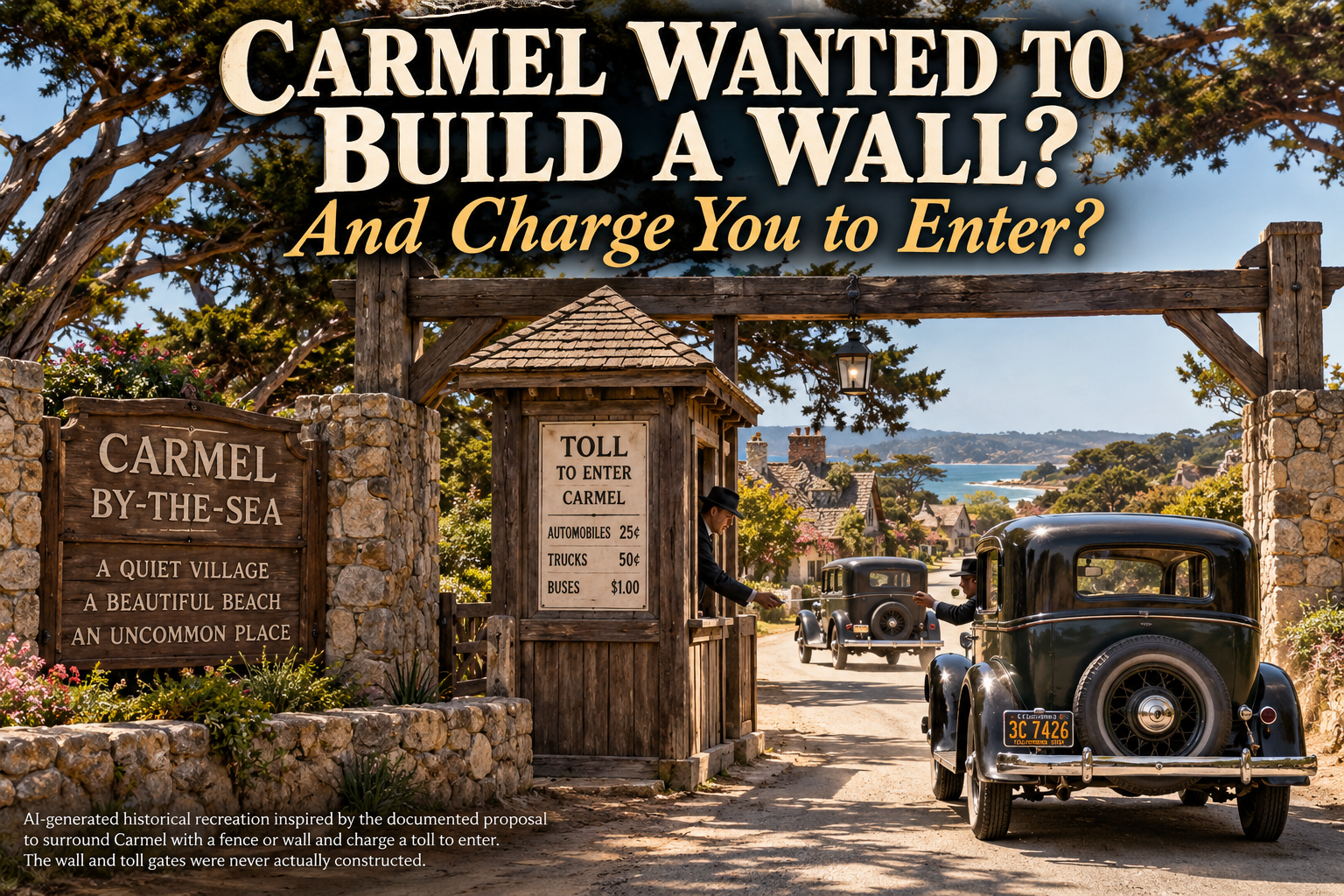
Imagine driving toward Carmel-by-the-Sea in the 1930s and discovering a wall or fence surrounding the village.
There is a gate across the road.
And before entering Carmel, you have to pay a toll.
It sounds like the setup for one of Carmel's more exaggerated legends.
Except this one has a remarkably solid historical foundation.
According to Carmel-by-the-Sea's official Historic Context Statement, during the 1930s longtime Carmel resident, writer and political figure Perry Newberry suggested building a fence around Carmel and charging a toll to enter.
The idea never became reality.
But understanding why someone seriously suggested it tells us quite a bit about how Carmel became the unusual village we know today.
The idea of surrounding Carmel and charging people to enter really was proposed during the 1930s.
Carmel never actually constructed the wall, fence or toll gates.
Instead, the village ultimately protected much of its character through zoning, development restrictions and an unusually strong resistance to conventional urbanization.
This Wasn't Really About Keeping People Out
To understand the idea, we have to forget the Carmel we know today for a moment.
Modern Carmel-by-the-Sea is internationally known for its white-sand beach, restaurants, galleries, luxury real estate, hidden courtyards and storybook architecture.
Early Carmel was something very different.
It was a young village populated by an unusual collection of artists, writers, actors, builders, teachers and independent-minded residents.
Many of them had deliberately chosen Carmel because it wasn't San Francisco, Los Angeles or even a conventional California resort town.
They liked the trees.
They liked the beach.
They liked the cottages and dirt roads.
And many of them were deeply suspicious of anything that looked too much like “progress.”
You can see that philosophy throughout the story of Carmel's early artist colony.
Meet Perry Newberry
Perry Newberry was one of early Carmel's most colorful and influential personalities.
He was a writer, actor, theatrical producer, newspaper publisher and political figure who became deeply involved in the cultural and civic life of the village.
Newberry was closely associated with Carmel's Forest Theater and later became co-publisher of the Carmel Pine Cone.
But politically, he became especially well known for his opposition to uncontrolled growth and commercialization.
To Newberry and others who shared his outlook, Carmel's greatest asset was precisely what it had not become.
“Keep Carmel Off the Map”
Newberry became associated with one of the most memorable political slogans in Carmel history:
“Keep Carmel Off the Map.”
National Park Service historical documentation describes Newberry's campaign under that name as an important influence on Carmel's development.
The phrase shouldn't necessarily be interpreted literally.
The objective wasn't to pretend Carmel didn't exist.
It represented a broader philosophy:
Don't turn Carmel into a conventional city.
Don't let commercial growth overwhelm the residential village.
Don't automatically adopt every feature other California communities considered progress.
And don't destroy the qualities that attracted people to Carmel in the first place.
Carmel Was Already Fighting Over “Progress”
This debate wasn't theoretical.
Early Carmel residents repeatedly argued over what the village should become.
Should streets be paved?
Should commercial development expand?
Should Carmel adopt the infrastructure and conveniences found in larger cities?
Or would those improvements gradually erase the village's character?
Later historical accounts describe Newberry and City Attorney Argyll Campbell as being firmly aligned with what Newberry called Carmel's “art element,” in contrast with residents more interested in business and development.
Even paving the village's main street became controversial.
Ocean Avenue eventually was paved, of course.
But the larger disagreement did not go away.
Then Someone Suggested a Wall
This is where the Local Lore story gets particularly interesting.
Carmel's official historical timeline records that during the 1930s Perry Newberry suggested building a fence around Carmel and charging a toll to enter.
A later historical account provides a little more color.
According to that version, City Attorney Argyll Campbell suggested surrounding Carmel with a wall and limiting the points of entry.
Newberry then supposedly took the idea one step further:
Put toll gates at the entrances.
Because the City's official history describes the proposal more generally as Newberry's idea, while the later account divides the credit between Campbell and Newberry, it is safest to say this:
The wall-or-fence and toll-gate proposal is historically documented. Exactly how the idea developed between Campbell and Newberry is less certain.
Was This Actually a Serious Proposal?
That is more difficult to answer.
We know the idea existed because Carmel's own historical record preserves it.
What we do not have is evidence that the City reached the point of approving construction plans, financing a wall or preparing actual toll booths.
So this wasn't a public works project that nearly broke ground.
It was better understood as an expression of an increasingly familiar Carmel idea:
There should be limits to how much outside growth and commercialization are allowed to change the village.
The wall itself never happened.
But the philosophy behind it most certainly did.
Carmel did not build a wall around the city.
Carmel did not install toll booths at its entrances.
But the idea was real enough to become part of the City's official historical record.
Pebble Beach Was Right Next Door
The proposal may sound less strange when viewed in the context of the Monterey Peninsula.
Immediately north of Carmel sat the privately developed Del Monte Forest and Pebble Beach, where controlled points of entry were already part of the community's identity.
Later accounts of the Carmel proposal specifically referenced neighboring Pebble Beach as an example of controlled access.
That didn't mean Carmel was about to become another Pebble Beach.
The two communities developed very differently.
But the existence of a nearby community with defined entrances made the idea of controlling access considerably less fantastical than it sounds today.
Carmel Never Built the Wall — It Used Zoning Instead
The physical wall never materialized.
But in 1929, Carmel adopted something far more important to the village's long-term development:
Ordinance 96.
The ordinance formally declared Carmel-by-the-Sea to be primarily and predominantly a residential city, with business and commerce subordinate to that residential character.
It established a limited commercial district while keeping most of Carmel residential.
The basic concept remains central to Carmel planning today.
Carmel's current adopted Historic Context Statement describes Perry Newberry's leadership as instrumental in advocating for and passing the ordinance.
Argyll Campbell, who served for many years as Carmel's city attorney, is also closely associated with the legal framework and zoning philosophy that developed during this period.
In a Way, Carmel Built an Invisible Wall
This is the part of the story I find most interesting.
Campbell and Newberry never succeeded in physically surrounding Carmel.
But many of the principles they advocated became embedded in Carmel's laws and traditions.
Carmel preserved a tightly limited commercial core.
Residential neighborhoods remained deliberately different from conventional suburban development.
Building scale mattered.
Trees mattered.
Architecture mattered.
The beach was not converted into a commercial amusement district.
And the village continued resisting many features other communities considered routine.
National Park Service documentation specifically connects this philosophy with Carmel's longstanding lack of residential sidewalks, street lighting and traditionally numbered houses.
That last tradition survived for more than a century. You can read the full story in Why Carmel Has No Traditional Street Addresses.
The Point Wasn't to Freeze Carmel in Time
It would be easy to describe people like Newberry simply as being opposed to progress.
And at times, that is exactly how their political opponents saw them.
But the larger historical story is more nuanced.
Early Carmel residents were confronting a problem that communities throughout California still wrestle with today:
How do you allow a desirable place to grow without destroying the qualities that made it desirable?
Their answers were sometimes eccentric.
A wall and toll gate certainly qualify.
But the underlying concern was not irrational.
Carmel was a small coastal village sitting on extraordinarily desirable land.
Without limits, it could easily have developed very differently.
Imagine the Carmel That Might Have Been
Consider how many conventional development choices Carmel could have made.
Large beachfront hotels.
A commercial boardwalk.
High-rise buildings.
Wide streets designed primarily around automobiles.
Large-scale commercial development extending well beyond Ocean Avenue.
Standardized residential subdivisions.
Instead, Carmel evolved into something much smaller in scale and much harder to duplicate.
Its cottages, courtyards, narrow lanes, mature trees, residential neighborhoods and tightly concentrated business district became part of the community's identity.
That physical character is explored in more detail in our guide to Carmel-by-the-Sea architecture, cottages and storybook homes.
Why This Still Matters to Carmel Real Estate
Nearly a century later, the decisions made during this period still influence Carmel real estate.
Carmel-by-the-Sea contains a finite amount of land.
Lots are often small.
Development is closely reviewed.
Architectural character and neighborhood compatibility matter.
The commercial district remains compact.
And many buyers specifically seek Carmel because it does not resemble a conventional resort community.
In other words, the same qualities Newberry and his contemporaries were trying to protect eventually became some of Carmel's greatest economic assets.
Scarcity, character, walkability, architecture and a strong sense of place now contribute directly to the appeal — and value — of Carmel real estate.
Did Carmel Really Want to Keep the World Out?
Probably not in the literal sense.
Carmel depended on visitors, artists, businesses and newcomers from its earliest years.
And the village eventually became one of California's most celebrated destinations.
What Newberry and others wanted to control was not simply who came in.
They were trying to control what Carmel became.
The proposed fence and toll gate were an extreme — and never implemented — expression of that philosophy.
The lasting expression was zoning and preservation.
The Wall Carmel Never Built
So, did Carmel really consider building a wall and making people pay to enter?
Yes.
The proposal appears in Carmel's official historical record.
But the wall was never constructed.
The toll gates were never installed.
And in the end, Carmel found another way to draw a boundary around what it wanted to preserve.
Not a stone wall.
Not a wooden fence.
Not a toll booth.
Instead, Carmel used zoning, planning and a century of sometimes fiercely defended traditions to protect the idea that the village should remain primarily residential, human-scaled and unmistakably Carmel.
In that sense, the wall was never built.
But the boundary it represented is still very much with us.
Explore Carmel-by-the-Sea
Carmel Real Estate & Neighborhood Guide
The Complete History of Carmel-by-the-Sea
Carmel's Artist Colony: Writers, Painters & Bohemians
Carmel Architecture, Cottages & Storybook Homes
Why Carmel Has No Traditional Street Addresses
More Stories, Legends & Local Lore of the Monterey Peninsula →
Frequently Asked Questions
Did Carmel-by-the-Sea really plan to build a wall around the city?
Carmel's official Historic Context Statement records that during the 1930s Perry Newberry suggested building a fence around Carmel and charging a toll to enter. Later accounts describe City Attorney Argyll Campbell as suggesting a wall with limited entry and Newberry proposing toll gates. The idea was never constructed.
Were there ever toll gates at the entrances to Carmel?
No. Although toll gates were proposed, Carmel-by-the-Sea never installed them. The proposal remained an idea rather than an implemented public project.
Who was Perry Newberry?
Perry Newberry was a writer, actor, theater producer, newspaper publisher and civic figure who played an important role in early Carmel. He became particularly well known for opposing uncontrolled commercialization and was associated with the “Keep Carmel Off the Map” movement.
Who was Argyll Campbell?
Argyll Campbell served as Carmel-by-the-Sea's city attorney from 1920 to 1937 and was closely associated with the zoning and legal framework that helped protect the village's residential character. Later historical accounts also connect him with the idea of physically restricting entry into Carmel.
What was Carmel's “Keep Carmel Off the Map” campaign?
The phrase was associated with Perry Newberry and reflected a broader effort to resist excessive commercialization and conventional urban development. It did not literally mean erasing Carmel from maps, but rather preserving the village's small-scale residential and artistic character.
What was Carmel Ordinance 96?
Adopted in 1929, Ordinance 96 formally declared Carmel-by-the-Sea to be primarily a residential city, with business and commerce subordinate to its residential character. It established the basic division between Carmel's residential areas and its limited commercial district.
Did these early preservation efforts influence Carmel today?
Yes. Carmel's small-scale residential neighborhoods, compact commercial center, architectural character and longstanding resistance to conventional urban development all reflect principles that were established during the village's early decades.
Historical sources consulted:
City of Carmel-by-the-Sea, Historic Context Statement, adopted by the City Council January 14, 2025.
National Park Service, National Register of Historic Places documentation concerning Carmel's historic development and Perry Newberry's “Keep Carmel Off the Map” campaign.
City of Carmel-by-the-Sea historical and planning records concerning Ordinance 96 and the village's residential zoning philosophy.
Historical account of Argyll Campbell and Perry Newberry preserved by Walker & Reed PC, describing the proposed wall and toll gates. Because details differ slightly from the City's official chronology, Campbell's role has been identified in this article as coming from a later account.