This is part of our weekly series exploring the unusual stories, traditions, characters and forgotten places that help explain the Monterey Peninsula we know today. Explore the complete Local Lore collection →
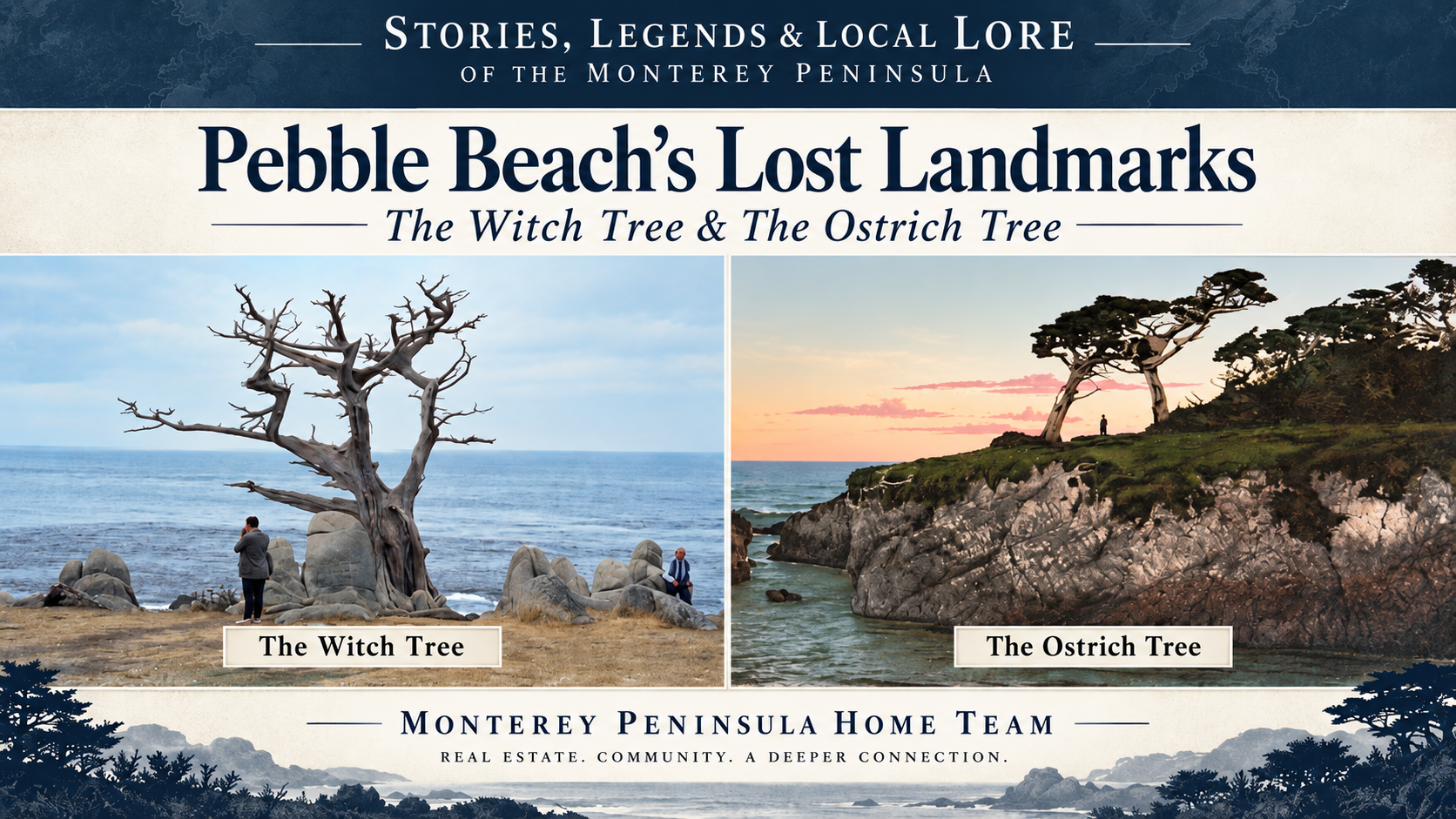 Drive 17-Mile Drive today and one tree receives more attention than all the others.
The Lone Cypress has become one of California's most recognizable natural landmarks, standing alone on its rocky perch above the Pacific and serving as the symbol of Pebble Beach for generations.
But it wasn't the only unusually shaped Monterey cypress that early visitors came to see.
Long ago, two other trees became famous attractions along the route.
One was called the Ostrich Tree.
The other was the Witch Tree.
Both appeared in photographs and postcards. Both became landmarks along the evolving 17-Mile Drive.
And both are gone.
Before Pebble Beach Was Pebble Beach
The story begins before world-famous golf courses, luxury estates and The Lodge transformed Pebble Beach into the community people recognize today.
The original 17-Mile Drive opened in 1881 as a scenic excursion associated with Monterey's Hotel Del Monte.
Visitors traveled by horse-drawn carriage through forest, dunes and rugged coastline, stopping at distinctive natural formations along the way.
These weren't merely viewpoints.
Individual rocks, coves and trees became named attractions.
Early photographs and postcards turned them into recognizable destinations in much the same way social media photographs identify scenic landmarks today.
Two of those attractions were unusual Monterey cypress trees whose shapes inspired memorable names.
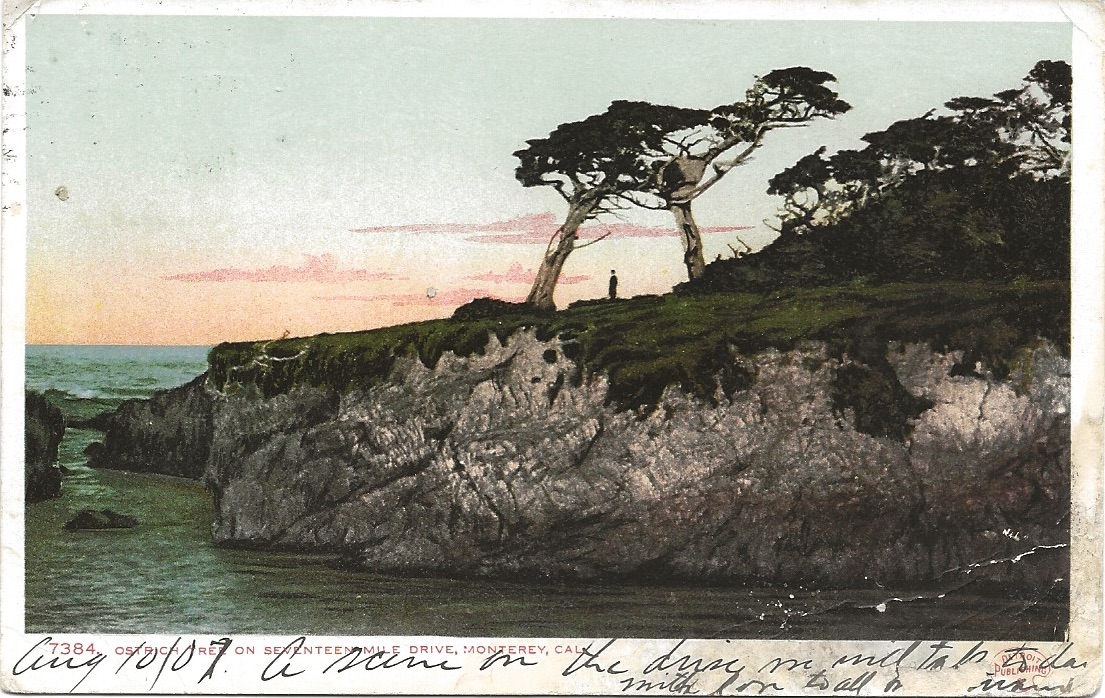
Greg Henderson's post card collection., Public domain, via Wikimedia Commons

The Ostrich Tree Near Cypress Point
The Ostrich Tree was one of the early attractions along 17-Mile Drive.
Pebble Beach historical records describe it as a unique pairing of Monterey cypress trees that had grown together near Cypress Point.
Historic postcards show the tree standing above the rocky coastline, its windswept form creating the kind of natural silhouette that made the early scenic drive so memorable.
Its unusual appearance earned it the name Ostrich Tree.
Exactly who first coined the nickname is not clearly identified in the modern historical record we reviewed, but the name was firmly established by the early twentieth century.
In fact, surviving postcards show that tourists were already being introduced to the Ostrich Tree as one of the recognized sights of 17-Mile Drive.
Historic photographs of famous 17-Mile Drive trees were sold as postcards to visitors. Long before Instagram or travel blogs, these images helped make individual trees and coastal formations recognizable attractions far beyond the Monterey Peninsula.
The Storm of 1906
The Ostrich Tree did not survive long into the automobile age.
According to Pebble Beach's historical archives, a storm blew the landmark over in 1906.
That date is striking for another reason.
Pebble Beach had not yet become the golf and residential community we know today.
The original Lodge would not open until 1909. Pebble Beach Golf Links would not open until 1919.
The Ostrich Tree belonged to an earlier chapter — when this landscape was known primarily to visitors as part of an extraordinary scenic carriage excursion through the Del Monte Forest.
Its disappearance also illustrates something that would become a recurring theme along this coastline:
The same wind and weather that sculpt Pebble Beach's famous trees can eventually destroy them.
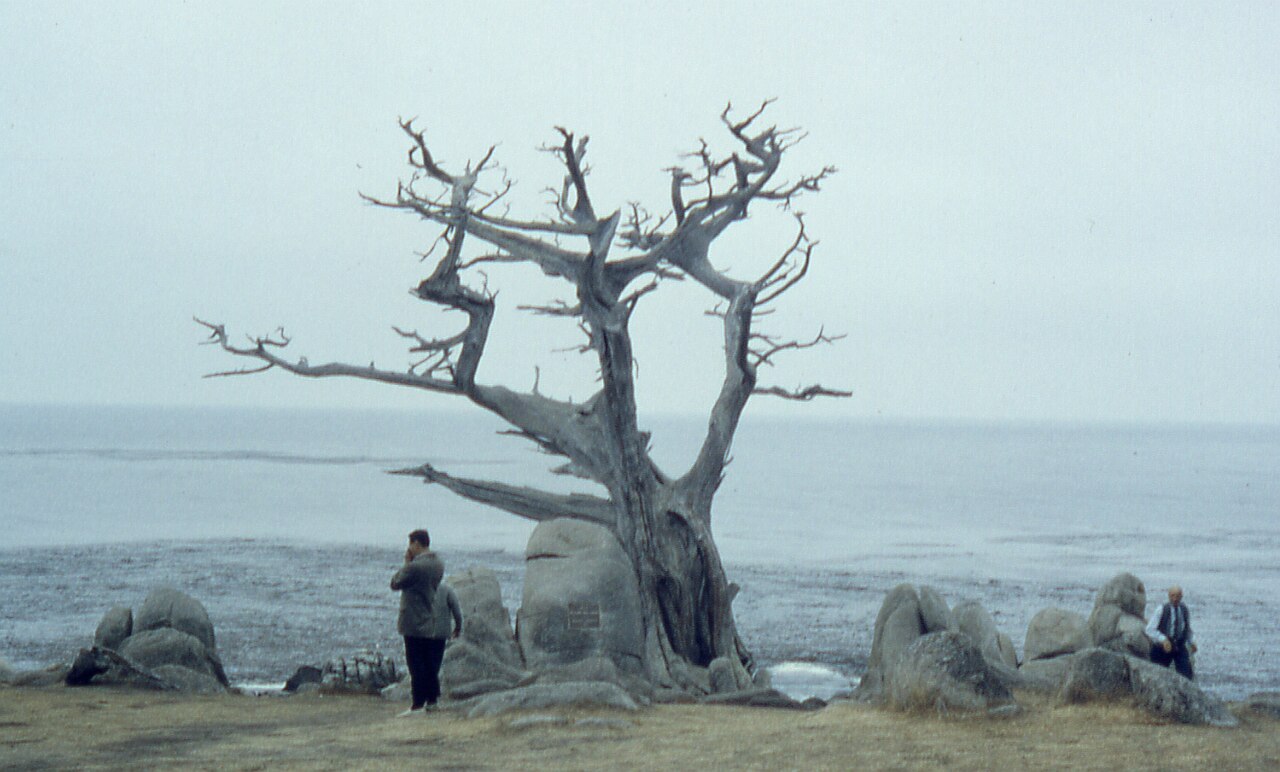
EditorASC at English Wikipedia, CC BY 3.0, via Wikimedia Commons

Then There Was the Witch Tree
Unlike the Ostrich Tree, the Witch Tree survived well into the modern Pebble Beach era.
It stood at Pescadero Point, the dramatic stretch of open-Pacific coastline now associated with the Ghost Trees stop on 17-Mile Drive.
The location is exposed.
Wind, salt spray and storms have shaped generations of Monterey cypress into twisted, bleached and sometimes almost sculptural forms.
The Witch Tree was one of the most memorable.
Pebble Beach's historical account explains that, when viewed from the right direction, the tree's remaining green growth resembled the silhouette of a witch riding a broom.
The resemblance was strong enough to give the Pescadero Point landmark its lasting nickname.
Was the Witch Tree Really Famous?
Very much so.
Vintage photographs and postcards preserve numerous views of the tree, showing how recognizable it had become to travelers along the Monterey Peninsula.
By the twentieth century, 17-Mile Drive was evolving from a Hotel Del Monte carriage excursion into one of California's best-known scenic roads.
The Witch Tree became part of that visual identity.
People photographed it for essentially the same reason visitors photograph the Lone Cypress today:
It looked like it belonged nowhere else.
The tree's twisted form, exposed location and Pacific backdrop created an image that immediately communicated the wild side of the Del Monte Forest coastline.
What Happened to the Witch Tree?
Eventually, the Pacific won.
A storm brought down the Witch Tree in 1964.
By then, Pebble Beach had changed dramatically from the landscape that greeted nineteenth-century carriage passengers.
Pebble Beach Golf Links had become internationally known.
The Lodge had been part of the community for decades.
Residential development had spread through portions of the Del Monte Forest.
17-Mile Drive had become an attraction in its own right.
Yet one of the route's old natural landmarks disappeared in much the same way the Ostrich Tree had nearly six decades earlier:
A coastal storm.
Pebble Beach Company identifies the Ostrich Tree as a paired Monterey cypress formation near Cypress Point that was blown over in 1906.
It identifies the Witch Tree at Pescadero Point by the distinctive witch-on-a-broom silhouette of its surviving foliage and records its loss to a storm in 1964.
Unlike some Local Lore stories, the existence and fate of both trees are well documented.
Why Are Pebble Beach's Cypress Trees So Unusual?
Part of what made these trees special is the remarkable natural environment in which they grew.
Pebble Beach contains one of only two naturally occurring native Monterey cypress forests in the world.
The other lies across Carmel Bay at Point Lobos.
Along the exposed coastline, Monterey cypress can be dramatically shaped by wind and salt.
Rather than growing vertically into the symmetrical form people might expect from an inland tree, coastal specimens can become twisted, flattened or swept sideways.
That interaction between tree and weather helped create the remarkable forms behind names such as the Witch Tree and Ostrich Tree.
It also helps explain why the trees and forest remain such an important part of Pebble Beach's identity today.
The Lone Cypress Survived
The most famous survivor, of course, is the Lone Cypress.
Early travelers knew its location as Midway Point on the original 17-Mile Drive.
Pebble Beach estimates the tree to be more than 250 years old, and it has served as the Pebble Beach symbol since 1919.
That means today's best-known tree was already part of the landscape while visitors were also stopping to photograph the Ostrich Tree and, later, the Witch Tree.
Over time, however, the Lone Cypress became the enduring survivor.
The Ostrich Tree disappeared.
The Witch Tree disappeared.
The Lone Cypress remained.
That survival may be part of what gives the tree so much meaning today.
It isn't simply scenic.
It represents continuity along a coastline where famous landmarks can vanish in a single storm.
What Can You See Today?
You cannot visit the original Ostrich Tree or Witch Tree.
But you can still experience the landscapes that made them famous.
The modern 17-Mile Drive passes through the same extraordinary combination of native forest and rocky Pacific coastline that created these landmarks.
At Pescadero Point, visitors can stop at today's Ghost Trees area, where sun-bleached cypress and rugged coastline still demonstrate the forces that shaped the Witch Tree.
Near Cypress Point, the relationship between native forest, rock and ocean still provides some of the most dramatic scenery in Pebble Beach.
And at the Lone Cypress, visitors can see the most famous surviving representative of this remarkable coastal landscape.
The Ghost Trees Carry On the Tradition
Pescadero Point didn't stop being atmospheric when the Witch Tree disappeared.
Today, the area is known as Ghost Trees.
Weathered, pale cypress forms stand against the Pacific, continuing the same visual tradition that made the Witch Tree such a memorable landmark.
The name feels almost inevitable.
These trees often look less like conventional landscaping and more like sculptures created by wind, salt and time.
It is one reason the coastline around Pescadero Point feels very different from the protected environment of Stillwater Cove only a short distance away.
A Landscape That Also Shapes Pebble Beach Real Estate
The trees in this story are not simply historic curiosities.
They help explain the character of the surrounding community.
The western side of Pebble Beach around Pescadero Point and Cypress Point is one of the places where forest, rocky coastline, open-Pacific exposure and residential property come together in an unusually dramatic way.
Homes in this part of the Pebble Beach Lodge Area can feel very different from properties near Stillwater Cove or farther inland.
Some settings emphasize mature native forest and privacy.
Others capture open-Pacific views, whitewater and rugged coastal scenery.
That landscape is part of the property's identity, not merely the backdrop behind it.
Our guide to Pebble Beach oceanfront homes explains how the Pescadero Point and Cypress Point coastline differs from other coastal environments within Pebble Beach.
Why the Lost Trees Matter
It would be easy to dismiss the Witch Tree and Ostrich Tree as curiosities from an old tourist route.
But they tell us something important about how Pebble Beach became Pebble Beach.
Before championship golf, famous resorts and multimillion-dollar homes, people were already traveling here because the landscape itself was extraordinary.
17-Mile Drive gave individual places names.
Those names created stories.
Photographs and postcards spread those stories beyond the Peninsula.
And eventually a collection of unusual natural landmarks helped establish the identity of a place that would become known around the world.
To explore that larger story, read our History of 17-Mile Drive.
Local Lore Is Sometimes About What Isn't There Anymore
One of the fascinating things about local history is that some of the most memorable places no longer exist.
Buildings burn.
Roads move.
Businesses close.
Trees fall.
Eventually, the story may be all that remains.
The Ostrich Tree disappeared in 1906.
The Witch Tree disappeared in 1964.
Yet more than a century after one was lost and generations after the other came down, their names are still part of the story of 17-Mile Drive.
That's exactly why we're collecting Stories, Legends & Local Lore of the Monterey Peninsula.
Sometimes understanding a place means knowing not only what is there today, but what used to be there.
Explore Pebble Beach
Pebble Beach Real Estate & Neighborhood Guide
Pebble Beach Ocean View Real Estate
More Stories, Legends & Local Lore of the Monterey Peninsula →
Historical sources consulted: Pebble Beach Company historical archives and 17-Mile Drive history; Pebble Beach Company heritage timeline; New York Public Library Digital Collections; and historic public-domain postcards documenting the Witch Tree and Ostrich Tree.