


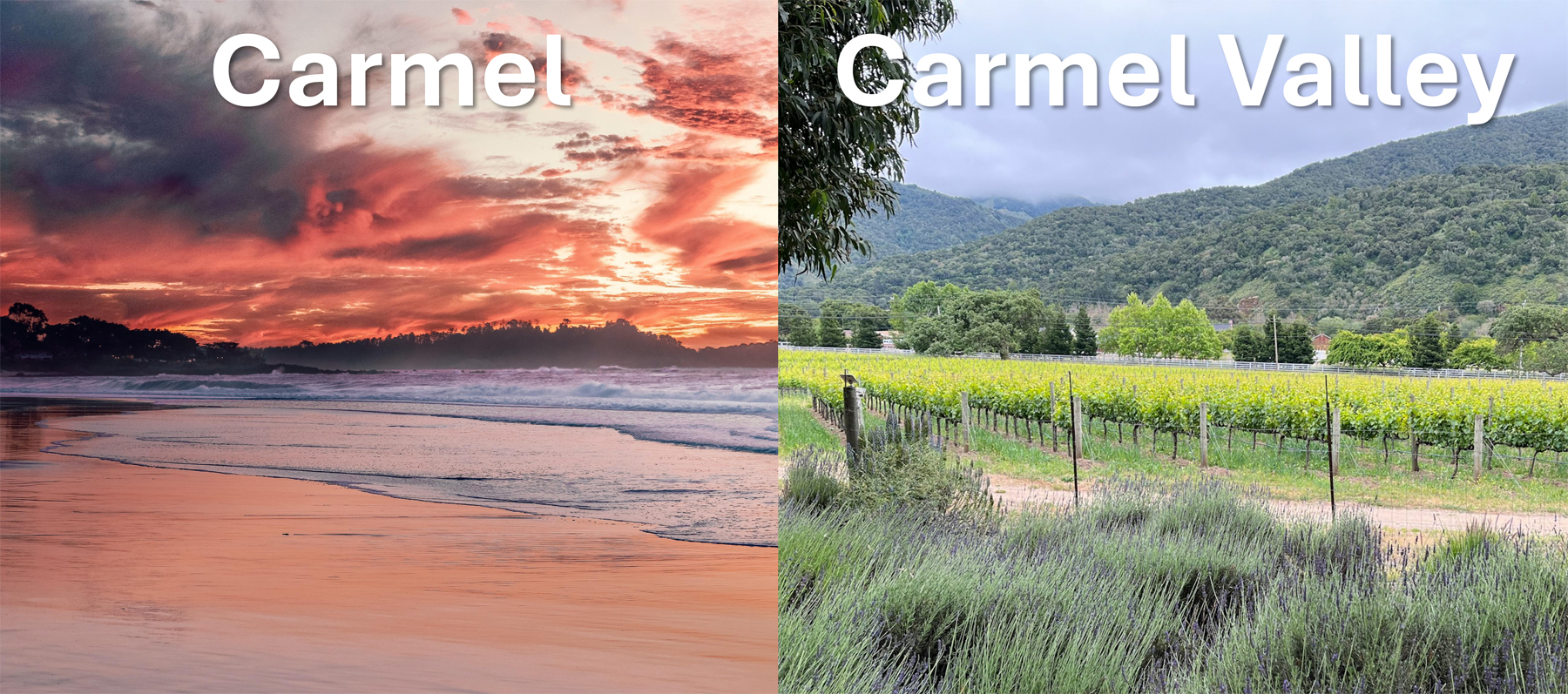
Ask someone who lives on the Monterey Peninsula where Carmel ends and Carmel Valley begins, and the answer may depend on what they mean.
Are they talking about city limits? A mailing address? A ZIP code? The physical Carmel Valley? A Monterey County planning area? Or simply the difference between living near the Pacific Ocean and living farther inland?
All of those answers can be different.
That is why someone can own a home with a Carmel, California 93923 address several miles outside the incorporated City of Carmel-by-the-Sea. It is also why communities along Carmel Valley Road can geographically be part of the lower Carmel Valley while still using a Carmel mailing address.
For people considering a home here, the distinction is much more than semantics. Within only a few miles, the Monterey Peninsula's climate, vegetation, architecture, lot sizes and daily lifestyle can change noticeably.
Understanding those differences makes the geography of Carmel much easier to understand.
 Carmel-by-the-Sea Is an Incorporated City
The easiest place to start is Carmel-by-the-Sea.
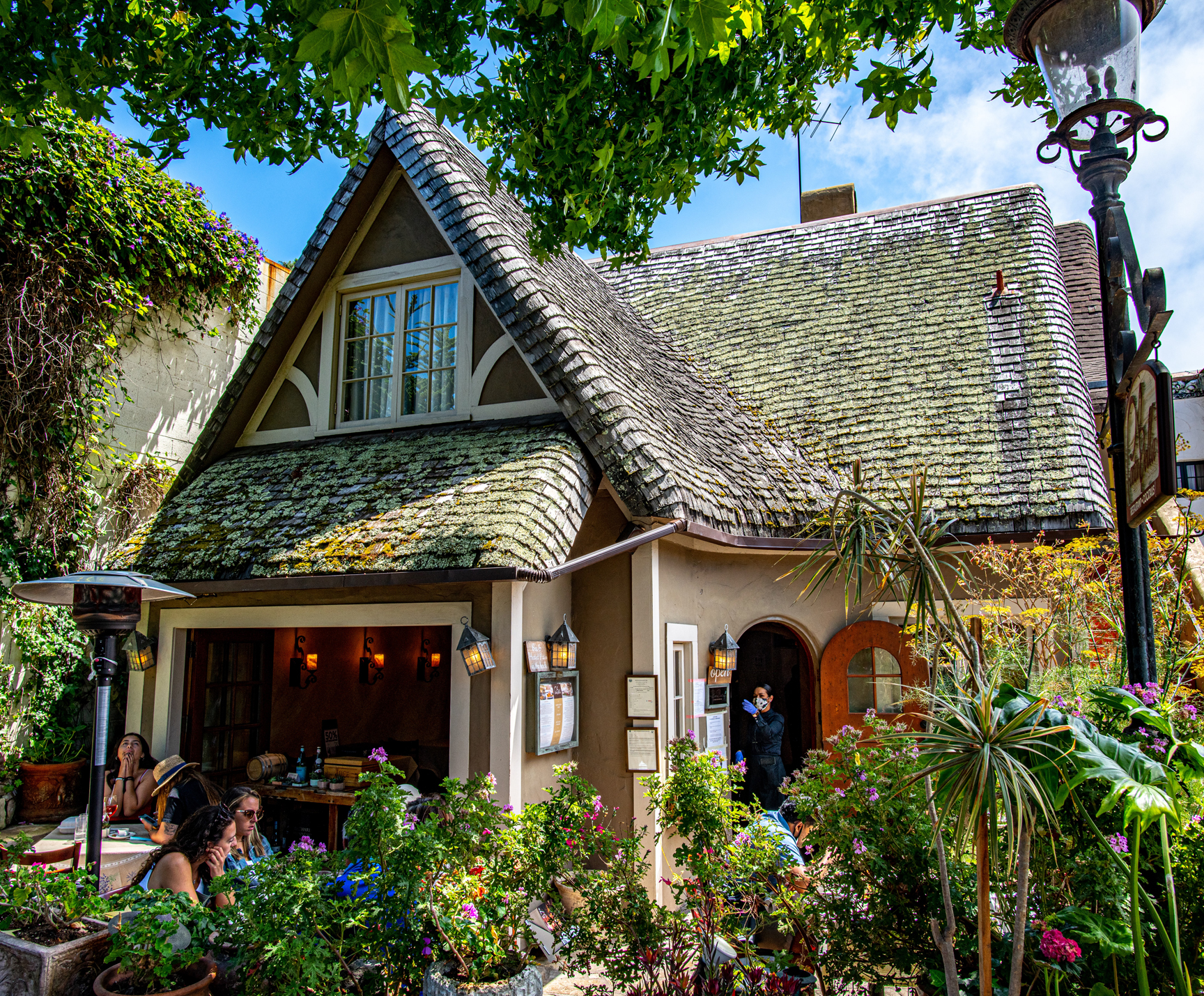
Carmel-by-the-Sea is an incorporated city with its own city government, planning department, zoning regulations and municipal boundaries. Incorporated in 1916, it encompasses roughly one square mile along the Monterey Peninsula coast and is associated with the 93921 ZIP code.
This is the Carmel most visitors picture first: Ocean Avenue, Carmel Beach, cottages tucked beneath trees, galleries, restaurants, shops and residential streets surrounding the commercial village.
But the incorporated city represents only a small portion of what people commonly call Carmel.
That is the first source of confusion.
“Carmel” Extends Well Beyond Carmel-by-the-Sea
Outside the city limits are numerous residential neighborhoods and communities that are commonly identified as Carmel.
Much of this larger area uses Carmel, CA 93923 mailing addresses.
That does not make those properties part of the City of Carmel-by-the-Sea. They are generally located in unincorporated Monterey County and are subject to County rather than Carmel-by-the-Sea municipal land-use jurisdiction.
This broader Carmel identity includes areas such as Carmel Point, Hatton Fields, Carmel Meadows, Carmel Hills and other neighborhoods surrounding the incorporated village, as well as larger properties and communities extending east toward the lower Carmel Valley.
Locally, people sometimes refer to this larger area as greater Carmel, although Greater Carmel is not itself an incorporated city or a single official government planning district.
For homebuyers, this distinction is important. Two properties advertised as being in Carmel can have dramatically different lot sizes, architecture, climate, walkability, jurisdiction and relationships to the coast.
You can explore those differences in our Carmel real estate and neighborhood guide.
 A Carmel Address Does Not Necessarily Mean Carmel-by-the-Sea
Mailing addresses are one of the biggest sources of confusion.
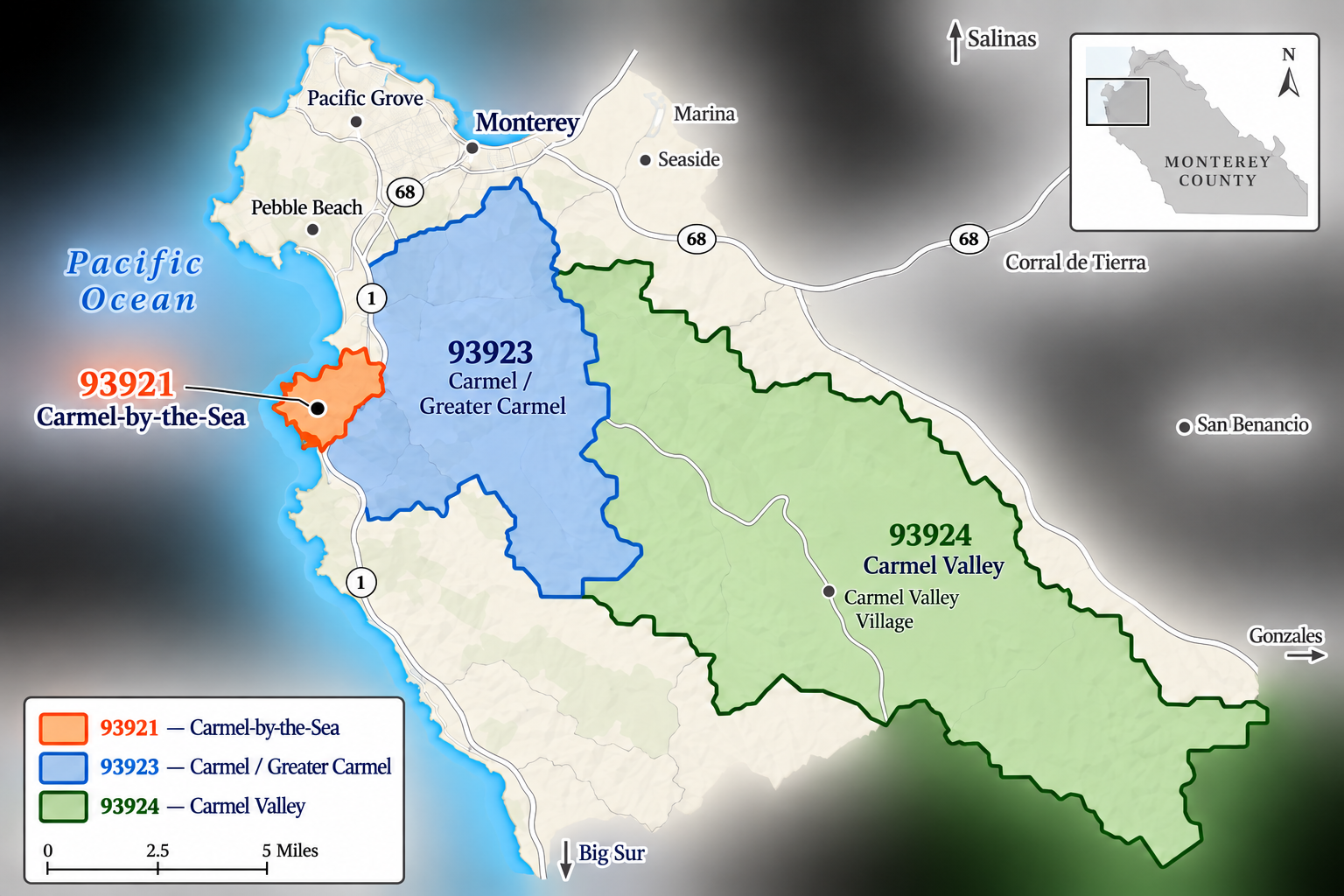
Carmel-by-the-Sea is associated with 93921, while large portions of the surrounding unincorporated Carmel area use 93923.
Some well-known examples make the distinction easier to understand.
Quail Lodge, for example, uses a Carmel, CA 93923 address even though it sits several miles inland along Carmel Valley Road.
Teháma also uses a Carmel, CA 93923 address, despite occupying nearly 2,000 acres of hills, meadows and open space well outside the compact boundaries of Carmel-by-the-Sea.
The same general principle applies to numerous homes and neighborhoods around Carmel: the city shown in a mailing address does not necessarily identify the property's municipal jurisdiction or even fully describe its physical setting.
Then What Exactly Is Carmel Valley?
This is where the geography becomes particularly interesting.
Carmel Valley is first a physical valley.
The valley follows the Carmel River inland from near the Monterey Peninsula coast toward the Santa Lucia Mountains. It extends far beyond the community commonly called Carmel Valley Village.
As a result, properties in the western or lower portion of the valley can have a geographic connection to Carmel Valley while still carrying a Carmel 93923 mailing address.
Monterey County's planning structure reflects this as well. The County maintains a Carmel Valley Master Plan covering a broad portion of the valley, including areas much closer to Highway 1 than many people unfamiliar with the region would expect.
Farther inland is Carmel Valley Village, the community most people today associate with a Carmel Valley mailing address. The Village and much of the surrounding inland valley use Carmel Valley, CA 93924.
This leads to an important distinction:
Carmel Valley as a geographic place is larger than Carmel Valley as a postal identity.
That simple fact explains much of the apparent contradiction.
For a deeper look at the area, visit our Carmel Valley real estate and neighborhood guide.
The Lower Carmel Valley Is a Transition Zone
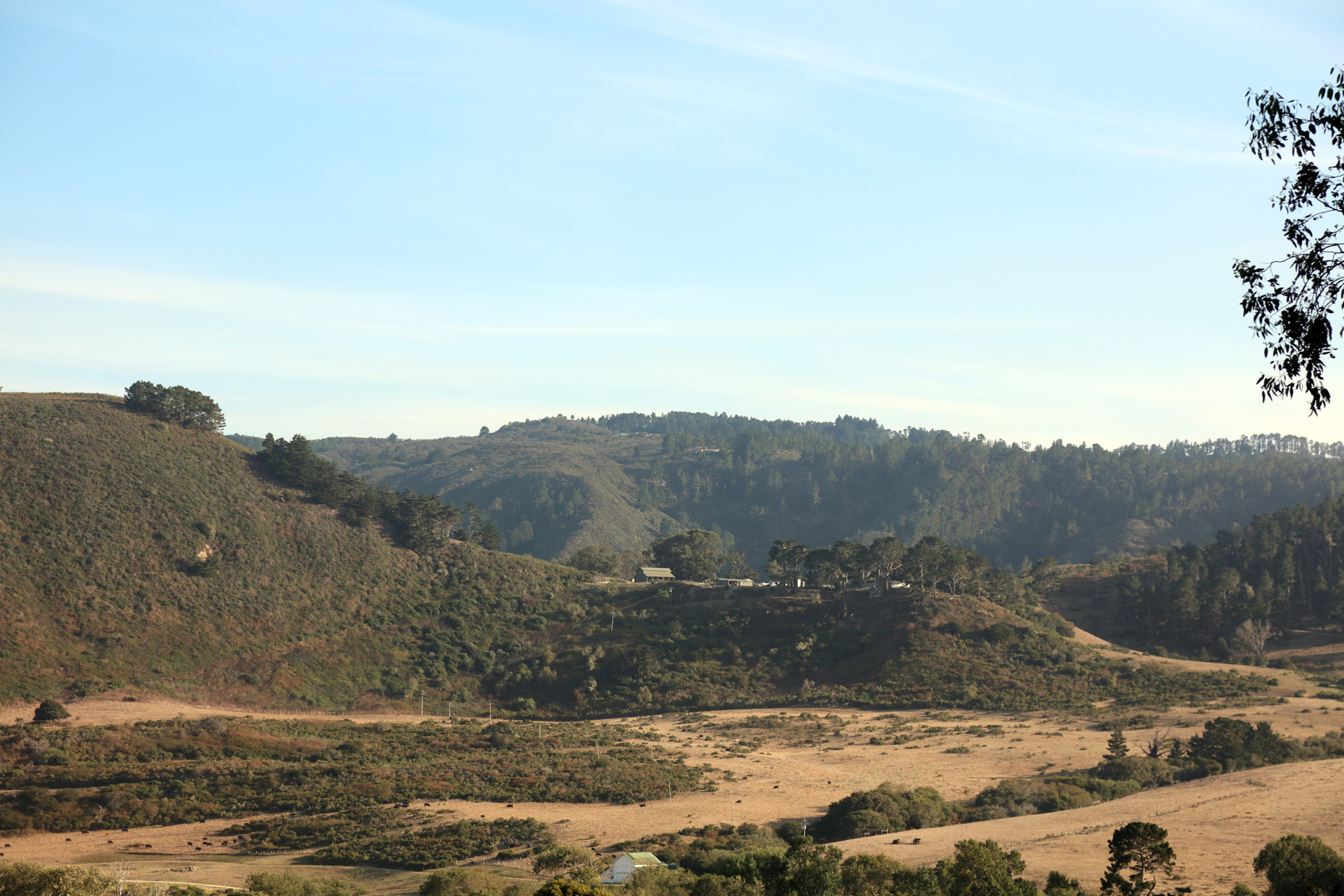
The first few miles east of Highway 1 are particularly interesting because they do not feel completely coastal or completely inland.
They form a transition between the two.
Someone can leave a cool or foggy morning near Carmel Beach and drive east on Carmel Valley Road toward blue skies and sunshine without traveling very far.
The change is gradual rather than absolute. Weather varies by season, elevation, wind direction and individual microclimate, but the influence of the Pacific Ocean generally becomes less dominant as you travel inland.
This transition is one of the reasons neighborhoods in western Carmel Valley can offer a very different living experience from both Carmel-by-the-Sea and areas around Carmel Valley Village.
From Monterey Pines to Oaks and Open Hills
The vegetation changes along with the climate.
Carmel-by-the-Sea has long been known as a village in a forest by the sea. Monterey pines, coast live oaks and Monterey cypress all contribute to the wooded character of Carmel and the nearby Monterey Peninsula.
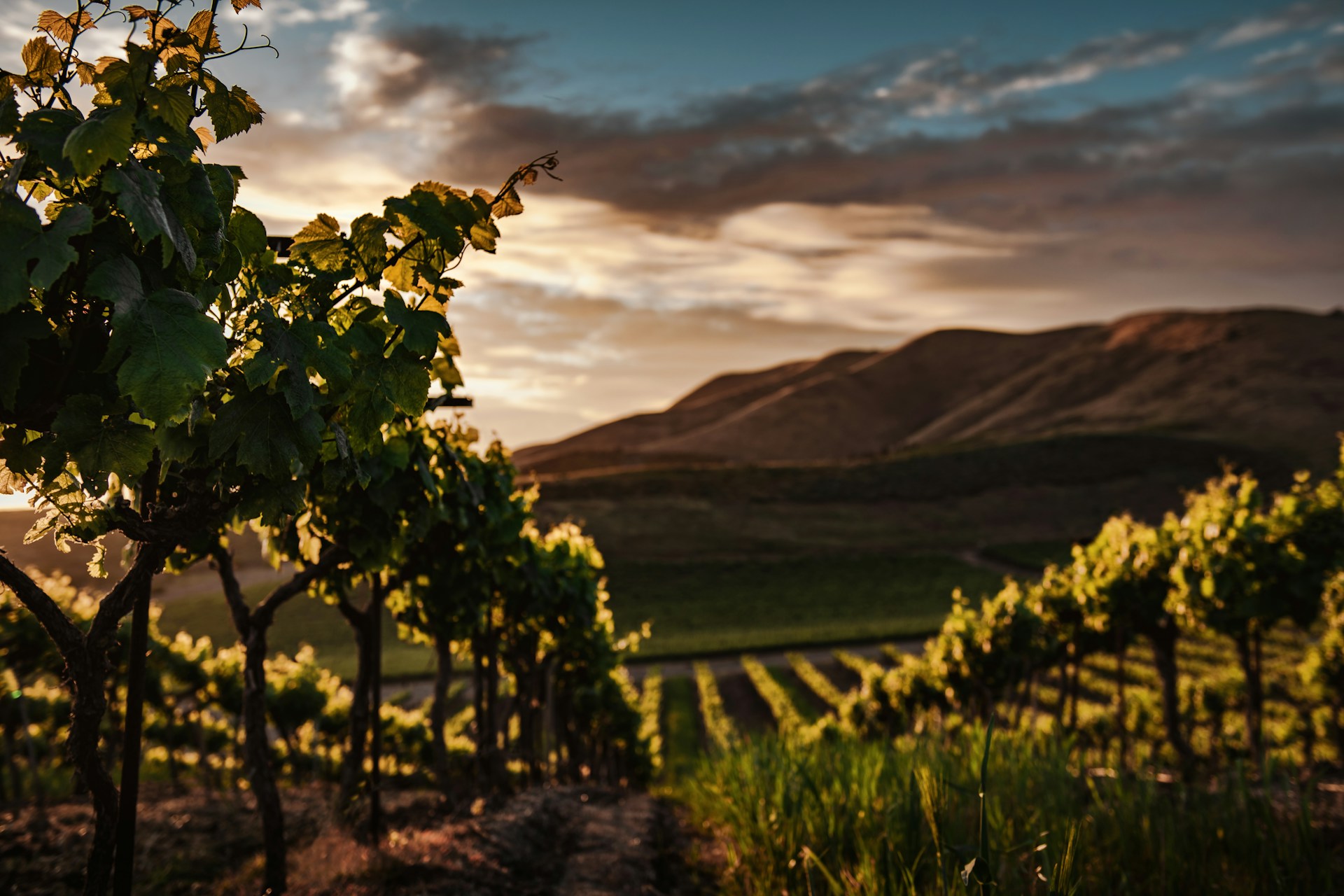
As Carmel Valley Road moves inland, however, the landscape gradually begins to open.
Monterey pines do not suddenly disappear at a particular line, and pines and oaks overlap throughout portions of the area. But the visual character increasingly shifts toward coast live oaks, grasslands, meadows and rolling hills.
The farther inland you travel, the more pronounced that transition becomes.
This is one reason a drive of only several miles can feel like a much larger geographic journey.
The Climate Changes Too
Climate may be the most meaningful distinction for someone deciding where to live.
Carmel-by-the-Sea sits directly beside the Pacific Ocean and is strongly influenced by the marine environment. Temperatures are generally moderated by the ocean, and the summer marine layer can bring cool mornings, low clouds and fog.
Move inland and that marine influence generally begins to diminish.
The western portion of Carmel Valley can still experience fog and cool coastal air, but sunshine often appears earlier and daytime temperatures can become warmer.
Continue farther toward Carmel Valley Village and the difference becomes increasingly noticeable. Carmel Valley is well known for sunnier, warmer inland conditions than the immediate Monterey Peninsula coastline.
There is no exact climatic dividing line.
Instead, Carmel and Carmel Valley sit along a microclimate continuum from the Pacific Ocean into the Santa Lucia Mountains.
Why the Difference Matters More Than the ZIP Code
For someone buying a home, the distinction matters because the lifestyle changes along with the landscape.
Living In or Near Carmel-by-the-Sea
Living in or immediately around Carmel-by-the-Sea generally emphasizes proximity to the coast and village.
Depending on the neighborhood, residents may be close to:
- Carmel Beach
- Ocean Avenue
- Restaurants and cafés
- Art galleries
- Shopping
- Mission Trail Nature Preserve
- Scenic Road
- Highway 1
Homes are often situated on relatively compact parcels, particularly within the incorporated city, and walkability can be an important part of the ownership experience.
Living in Greater Carmel
Move outside the incorporated city while retaining a Carmel address and the range of properties becomes much broader.
Buyers may find larger homes, more conventional garages, hillside properties, gated communities, ocean and valley views, larger parcels and neighborhoods that remain only minutes from Carmel-by-the-Sea.
This is why searching for a home simply by the word “Carmel” can produce such different properties.
Living in Western Carmel Valley
Continue east into the lower or western Carmel Valley and another lifestyle begins to emerge.
There is generally more open land, larger parcels, golf communities, mature oaks and a stronger connection to the surrounding hills.
At the same time, Highway 1, Carmel-by-the-Sea, Pebble Beach, Monterey and Pacific Grove can remain remarkably close.
For some buyers, this creates an appealing middle ground: more space and somewhat warmer weather without giving up convenient access to the Monterey Peninsula coast.
Living Farther Into Carmel Valley
Travel farther inland toward Carmel Valley Village and beyond and the landscape becomes increasingly rural.
Vineyards, tasting rooms, ranches, equestrian properties, larger acreage and the Santa Lucia Mountains become more prominent.
Outdoor living can also become a larger part of the residential experience, with pools, patios, vineyards, horse facilities and substantial land becoming more common.
Explore the different communities in our complete Carmel Valley real estate guide.
Quail Lodge Shows Why the Labels Overlap
Quail Lodge and Quail Meadows provide one of the clearest examples of why Carmel and Carmel Valley terminology can overlap.
Properties in the area use Carmel 93923 addresses and are only a few miles from Highway 1 and Carmel-by-the-Sea.
Yet the setting has many characteristics associated with Carmel Valley: golf, larger homesites, more open space, mature oak trees and a climate that begins transitioning away from the immediate coast.
Calling Quail simply “Carmel Valley” misses part of its relationship with Carmel.
Calling it only “Carmel” can miss its relationship with the valley.
In practical terms, it belongs to both conversations.
Teháma Is Another Example
Teháma illustrates the same overlap on a much larger scale.
Teháma properties use Carmel, CA 93923 addresses, and the community is closely connected to Carmel, Monterey and the rest of the Monterey Peninsula.
At the same time, its landscape of oak-covered hills, meadows, ridgelines and large estate homesites shares many of the physical and lifestyle characteristics associated with Carmel Valley.
For real estate purposes, it makes sense for a buyer considering Teháma to look at both the broader Carmel luxury market and Carmel Valley estate properties.
September Ranch Sits Near the Heart of This Transition
Historic September Ranch provides another fascinating example.
The property lies along Carmel Valley Road only a few miles east of Highway 1 and uses a Carmel 93923 identity, while its geography and history are deeply connected to the lower Carmel Valley.
Its landscape sits near the transition we have been describing: between the stronger marine influence and forested environment closer to the coast and the increasingly sunny, oak-covered hills and open grasslands of the valley.
Today, September Ranch is entering a new chapter as ONE Carmel.
But the history of that land extends back nearly two centuries through Mexican-era land grants, early Carmel Valley ranching, dairy operations, cattle, quarrying and decades of equestrian use.
That history deserves a story of its own.
A Simple Way to Think About Carmel
For someone unfamiliar with the area, the geography can be simplified this way:
Carmel-by-the-Sea is the incorporated coastal city centered around Ocean Avenue and Carmel Beach.
Carmel is also commonly used more broadly for surrounding communities and neighborhoods, many of which lie outside the city limits and use Carmel 93923 addresses.
Carmel Valley is both a physical valley extending inland from near the Monterey Peninsula coast and the name commonly associated with increasingly inland communities east of Carmel.
Carmel Valley Village is the inland village community centered within the 93924 ZIP code.
And between coastal Carmel and Carmel Valley Village is a substantial transition zone where geography, mailing addresses, climate and lifestyle overlap.
Understanding that overlap is much more useful than trying to draw one imaginary line on a map.
Why Carmel Can Feel Like Several Places at Once
Perhaps the best way to understand Carmel is not by asking exactly where one name ends and another begins.
Instead, look at what changes as you travel east from the Pacific.
The marine layer generally becomes less persistent.
The forest begins to open.
Monterey pines mingle with and gradually give greater visual prominence to coast live oaks.
Compact coastal neighborhoods give way to golf communities, larger parcels, open hillsides and estate properties.
Continue farther inland and vineyards, ranches and the distinctly warmer character associated with Carmel Valley become increasingly apparent.
Yet throughout much of that journey, Carmel-by-the-Sea, Pebble Beach, Pacific Grove, Monterey and the Pacific Ocean remain surprisingly close.
That compressed geography is one of the characteristics that makes this part of the Monterey Peninsula so unusual.
Carmel is a city name, a mailing identity and a broader sense of place.
And along its eastern edge, it is where the coast gradually begins to become the valley.
For more information about the communities on either side of that transition, explore our Carmel real estate guide and Carmel Valley real estate guide.
Frequently Asked Questions About Carmel and Carmel Valley
Is Carmel the same thing as Carmel-by-the-Sea?
Not always. Carmel-by-the-Sea is the incorporated coastal city centered around Ocean Avenue and Carmel Beach. Carmel is also commonly used for a much larger group of surrounding unincorporated neighborhoods and communities that use Carmel mailing addresses.
Does a Carmel 93923 address mean a property is inside Carmel-by-the-Sea?
No. Many properties with Carmel 93923 addresses are located outside the incorporated City of Carmel-by-the-Sea and are under Monterey County jurisdiction.
What ZIP code is Carmel-by-the-Sea?
Carmel-by-the-Sea is associated with the 93921 ZIP code.
What ZIP code is Carmel Valley?
Carmel Valley Village and much of the inland valley use Carmel Valley, CA 93924 addresses. However, portions of the geographic lower Carmel Valley use Carmel, CA 93923 mailing addresses.
Is Quail Lodge in Carmel or Carmel Valley?
Both descriptions can make sense depending on context. Quail Lodge uses a Carmel 93923 address but is geographically located along Carmel Valley Road in the western or lower Carmel Valley, only a few miles inland from Highway 1.
Is Teháma in Carmel or Carmel Valley?
Teháma properties use Carmel, CA 93923 mailing addresses and the community is outside incorporated Carmel-by-the-Sea. Its location, acreage, climate and landscape also give it strong geographic and lifestyle connections to Carmel Valley.
Is ONE Carmel in Carmel or Carmel Valley?
ONE Carmel, on the historic September Ranch property, uses a Carmel identity and is located only a few miles east of Highway 1. The property also lies within the lower Carmel Valley landscape and has long historical ties to Carmel Valley ranching. It is a good example of how the Carmel and Carmel Valley identities can overlap.
Is Carmel Valley warmer than Carmel-by-the-Sea?
Generally, yes. The influence of the Pacific Ocean typically becomes less pronounced as Carmel Valley extends inland, resulting in more sunshine and warmer daytime temperatures. The change is gradual, however, and exact conditions vary by season, elevation and microclimate.
Comparing Carmel and Carmel Valley Real Estate?
The difference between Carmel and Carmel Valley is much easier to understand once you experience the neighborhoods themselves.
A home near Carmel Beach, a larger property in Hatton Fields, a golf-course residence at Quail Lodge, a Teháma estate and a property near Carmel Valley Village can all be within a relatively short drive of one another while providing very different climates, landscapes and lifestyles.
If you are deciding which part of the Monterey Peninsula best fits what you are looking for, call Mark Bruno and the Monterey Peninsula Home Team at (831) 917-8190. We can help you compare the individual neighborhoods, properties and ownership considerations rather than relying simply on the city name shown in an online real estate search.
Start by exploring current Carmel homes for sale or Carmel Valley homes and neighborhoods.