


Robinson Jeffers, Tor House, and Carmel’s Literary Legacy
.jpg) Carmel-by-the-Sea has always attracted people who see more than scenery in the coastline. For artists, writers, architects, and dreamers, Carmel has offered something deeper: a dramatic meeting of sea, stone, wind, cypress, fog, and human imagination. Few people captured that relationship more powerfully than poet Robinson Jeffers.
Carmel-by-the-Sea has always attracted people who see more than scenery in the coastline. For artists, writers, architects, and dreamers, Carmel has offered something deeper: a dramatic meeting of sea, stone, wind, cypress, fog, and human imagination. Few people captured that relationship more powerfully than poet Robinson Jeffers.
Jeffers is one of the most important literary figures associated with Carmel. His home, Tor House, and the nearby Hawk Tower, stand near Carmel Point as physical reminders of Carmel’s early creative identity. Built from stone gathered from the rocky shore of Carmel Bay, Tor House is more than a historic residence. It is one of the clearest expressions of Carmel’s relationship between architecture, landscape, poetry, and place.
This is the fifth article in our Carmel-by-the-Sea history series. The first article explored Carmel Mission and the Spanish colonial roots of Carmel-by-the-Sea. The second article looked at the First People of Carmel and the Indigenous history of the Monterey Peninsula. The third article traced Carmel’s transformation from rancho land to coastal village before incorporation. The fourth article explored Carmel’s artist colony and how writers, painters, and bohemians shaped the village. This article focuses on Robinson Jeffers, Tor House, Hawk Tower, and Carmel’s enduring literary legacy. Explore the complete history of Carmel-by-the-Sea, from Indigenous roots and Carmel Mission to the artist colony, storybook cottages, Carmel Beach, preservation, and luxury real estate.
Photo Credit: The original uploader was Gamaliel at English Wikipedia., Public domain, via Wikimedia Commons
Who Was Robinson Jeffers?
Robinson Jeffers was an American poet whose work became closely tied to the rugged California coast. Born in 1887, Jeffers eventually settled in Carmel with his wife, Una, and their family. In Carmel, he found the landscape that would define much of his life’s work: the Pacific Ocean, rocky shoreline, cypress trees, hawks, granite, and the dramatic meeting of land and sea.
Jeffers was not simply a writer who happened to live in Carmel. Carmel became part of his artistic identity. His poetry is often associated with the wildness of the Central Coast, the power of nature, the limits of human ambition, and the beauty of what he saw as the nonhuman world.
That perspective made Jeffers a distinctive literary voice. His work was often austere, intense, and deeply connected to the physical world around him. While other writers may have used landscape as background, Jeffers made the coast itself central to his vision.
Why Jeffers Came to Carmel
By the time Jeffers arrived, Carmel was already emerging as a place for artists, writers, performers, and independent thinkers. The village’s early creative culture made it a natural fit for someone seeking distance from conventional urban life.
Carmel offered Jeffers what many early creative residents were seeking: natural beauty, relative quiet, proximity to the sea, and room to live in a more personal way. The village was small, informal, and still connected to its natural setting. For Jeffers, that setting became essential.
At Carmel Point, Jeffers and Una found a place where stone, ocean, and sky seemed to meet with unusual force. That site would become Tor House.
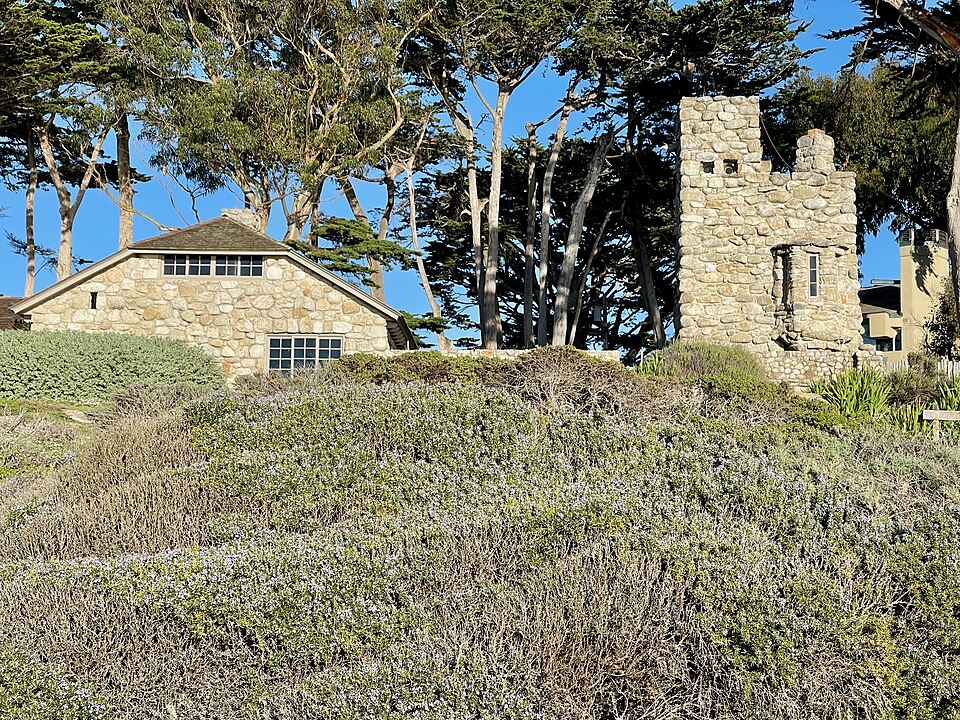
Tor House and Hawk Tower - Gregory Ford Henderson, CC BY-SA 4.0 <https://creativecommons.org/licenses/by-sa/4.0>,
via Wikimedia Commons
The Building of Tor House
Tor House began as a family home, but it became one of the most famous literary houses in California. The word “tor” refers to a rocky outcrop or hill, and the name reflected the granite and coastal landscape that surrounded the home.
Jeffers worked directly on the house and later the tower, learning masonry and participating in the physical labor of construction. Granite boulders were gathered from the rocky shore of Carmel Bay and incorporated into the walls. This was not merely decorative. It was symbolic. Jeffers was building a home out of the same landscape that inspired his poetry.
The result was a structure that feels inseparable from its setting. Tor House does not impose itself on Carmel Point in the way a grand mansion might. Instead, it feels rooted, almost geologic, as though it belongs to the shore.
Hawk Tower: A Stone Tower Above the Sea
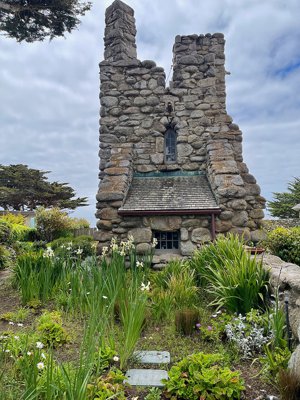
Hawk Tower is one of the most memorable features of the Tor House property. Built by Jeffers as a gift for Una, the tower reflects both romance and rugged practicality. It also captures Carmel’s distinctive blend of imagination, craftsmanship, and landscape.
The tower’s stonework, ocean views, and vertical form make it one of Carmel’s most recognizable historic structures. It is not polished in a formal European sense. It is handmade, symbolic, and deeply personal.
Hawk Tower also represents the creative independence that helped define early Carmel. In many communities, a poet building a stone tower by the sea might seem eccentric. In Carmel, it became part of the village’s soul.
Tor House as a Literary Landmark
Tor House is important not only because Robinson Jeffers lived there, but because it is where he wrote much of the work that defined his career. The Robinson Jeffers Tor House Foundation notes that Jeffers wrote all of his major poetical works at Tor House.
That gives the property unusual literary significance. It is not simply a preserved residence. It is the creative setting where Jeffers’ mature voice emerged and where Carmel’s coastline entered American literature in a powerful way.
For readers, scholars, and visitors, Tor House offers something rare: the ability to experience the landscape, architecture, and atmosphere that shaped a major literary figure. The house, tower, gardens, and views all help explain Jeffers’ work in a way that a page alone cannot.
Jeffers and the Central Coast Landscape
Robinson Jeffers’ poetry is inseparable from the Central Coast. Carmel Bay, Point Lobos, hawks, granite, surf, cliffs, and storms all appear as part of a larger vision of nature’s scale and power.
Jeffers is often associated with the idea that human life should be understood within a much larger natural order. That viewpoint can feel especially understandable in Carmel, where the coastline often seems older, stronger, and more enduring than anything built beside it.
This is part of why Jeffers remains so relevant to Carmel today. Carmel’s appeal has never been only about buildings. It is about the relationship between buildings and landscape. Tor House may be one of the purest examples of that relationship.
Carmel’s Literary Legacy Beyond Jeffers
Robinson Jeffers was not the only writer connected to Carmel. The village’s early literary world included figures such as George Sterling, Mary Austin, Jack London, Upton Sinclair, and Sinclair Lewis, among others. Together, these writers helped establish Carmel as one of California’s most important literary communities.
But Jeffers occupies a special place because his work and his home are so physically tied to Carmel. Tor House and Hawk Tower remain visible, visitable, and closely connected to the landscape that inspired him.
In that sense, Jeffers gives Carmel’s literary history a permanent architectural presence. His poetry lives on in books, but his vision also lives in stone.
The Tor House Foundation and Preservation
The Robinson Jeffers Tor House Foundation was established in 1978 to preserve Tor House, Hawk Tower, and the surrounding gardens. Today, the Foundation provides public access through tours and programs designed to continue Jeffers’ literary and cultural legacy.
This preservation work matters because Tor House is not just important to Jeffers scholars. It is important to Carmel. The property helps maintain a living connection between the village’s early artist colony, its architecture, its literary identity, and its continuing sense of place.
In a community where historic character is central to local identity, Tor House stands as one of Carmel’s most meaningful preservation success stories.
Why Tor House Matters to Carmel Architecture
Tor House is not a storybook cottage in the Hugh Comstock sense, but it belongs to the same broader Carmel tradition of homes shaped by imagination and place. It is handmade, personal, natural, and highly specific to its setting.
The use of local stone, the modest scale of the original house, the connection to ocean views, and the integration of gardens and courtyards all reflect values that run through Carmel’s architectural identity.
Carmel’s best homes often feel as though they belong exactly where they are. Tor House may be one of the strongest examples of that idea. It is not generic architecture placed near a famous coastline. It is architecture born from the coastline itself.
How Literary History Influences Carmel Real Estate
For modern buyers and sellers, Robinson Jeffers and Tor House may seem at first like purely cultural history. But Carmel’s literary and artistic identity has a direct relationship to real estate value.
Carmel buyers often respond to properties with story, character, craftsmanship, and connection to place. A home in Carmel is rarely evaluated only as a structure. Its setting, architectural personality, garden, relationship to the village, proximity to the beach, and sense of history all matter.
That is why Carmel real estate often behaves differently from more conventional luxury markets. In Carmel, authenticity can be a major value driver. Buyers are often looking for homes that feel emotionally connected to the village’s history and landscape.
Explore current Carmel homes for sale to see how the village’s literary heritage, architecture, and coastal setting continue to shape today’s real estate market.
Carmel Point, Place Value, and the Power of Setting
Tor House is located in the Carmel Point area, one of the most historically and visually distinctive parts of Carmel. Carmel Point offers proximity to Carmel Beach, Carmel River State Beach, coastal walking routes, and some of the most beautiful residential settings in the village.
This area helps illustrate a key concept in Carmel real estate: place value. In Carmel, the most compelling locations are not just convenient. They carry atmosphere, history, and emotional power.
Tor House is a perfect example. Its value as a landmark comes from more than the structure itself. It comes from the relationship between the structure, the poet, the coastline, the stone, the views, and the cultural memory of the village.
From Literary Landmark to Living Village Identity
One of the reasons Carmel remains so compelling is that its history is still visible. Tor House is not a forgotten plaque or an abstract reference in a history book. It remains part of the living cultural landscape of Carmel-by-the-Sea.
Visitors can still tour the property, learn about Jeffers, see the stonework, experience the gardens, and understand how deeply the site is tied to Carmel’s literary past.
That continuity helps preserve Carmel’s authenticity. The village has become a world-class luxury market, but places like Tor House remind residents and visitors that Carmel’s identity was built by artists, writers, and people who valued beauty over standardization.
Why This Chapter Matters in the Carmel History Cluster
Robinson Jeffers and Tor House are essential to the Carmel-by-the-Sea history cluster because they connect several of the village’s most important themes: literature, architecture, landscape, preservation, and real estate value.
The mission era gives Carmel historical depth. The rancho and early village period explain how the settlement formed. The artist colony explains Carmel’s creative culture. Robinson Jeffers and Tor House give that culture one of its most enduring symbols.
In the next article in this series, we will explore Carmel’s architecture in greater depth, including cottages, storybook homes, village character, and how Carmel’s built environment became one of the most recognizable and desirable in California.
Additional Information
Thinking About Buying or Selling in Carmel?
If you are considering buying or selling a home in Carmel-by-the-Sea, understanding the village’s literary and architectural history can help you better understand why certain properties create such strong emotional appeal. Carmel’s most desirable homes are often valuable not only because of location, but because they reflect the character, creativity, and sense of place that define the village.
The Monterey Peninsula Home Team helps buyers and sellers navigate the Carmel real estate market with local knowledge, neighborhood insight, and a deep appreciation for what makes this community so special.
Explore current Carmel homes for sale, learn more about Carmel Golden Rectangle homes for sale, or browse Carmel oceanfront real estate to see how Carmel’s literary heritage, historic architecture, and coastal lifestyle continue to shape one of California’s most distinctive housing markets.