This is part of our weekly series exploring the unusual stories, traditions, characters and forgotten places that help explain the Monterey Peninsula we know today. Explore the complete Local Lore collection →
 Carmel-by-the-Sea has accumulated so many unusual stories over the years that it can sometimes be difficult to know where the real Carmel ends and the legend begins.
Homes have names instead of conventional street addresses. Storybook cottages hide behind garden gates. Narrow streets wind beneath Monterey pines. Courtyards and passageways appear where you least expect them.
And then there is the story about high heels.
For decades, visitors have been told that women aren't allowed to wear high heels in Carmel unless they first obtain a permit from City Hall.
It sounds exactly like the kind of quirky law that gets repeated on lists of strange American ordinances whether it is true or not.
Except this one is real.
Carmel-by-the-Sea's Municipal Code still contains a provision requiring a permit to wear certain high-heeled shoes on public streets and sidewalks.
But Carmel does not have officials patrolling Ocean Avenue looking for stilettos, and the ordinance was not created because city leaders objected to fashionable footwear.
The real reason involved trees, uneven pavement and municipal liability.
What Does Carmel's High-Heel Law Actually Say?
The ordinance appears today in Chapter 8.44 of the Carmel-by-the-Sea Municipal Code, under the wonderfully formal title:
“Permits for Wearing Certain Shoes.”
The code applies to shoes whose heels meet two specific conditions:
They are more than two inches in height and have less than one square inch of bearing surface.
Someone wishing to wear shoes fitting those dimensions on Carmel's public streets and sidewalks technically must first obtain a permit.
That distinction is worth noting because the story is often shortened to:
“High heels over two inches are illegal in Carmel.”
That isn't quite what the ordinance says.
A broad heel more than two inches high does not necessarily meet the ordinance's definition. The rule specifically addresses the combination of height and a very small bearing surface — essentially the type of narrow heel most likely to catch on an irregular walking surface.
So Why Did Carmel Pass a Law About High Heels?
To understand the law, you have to understand something much more fundamental about Carmel:
The town wanted to remain a village in a forest.
Carmel's mature Monterey pines, oaks and other trees are not simply landscaping. They are part of the community's identity.
That woodland character also created a practical problem.
Tree roots pushed against pavement and paving materials, producing irregular walking surfaces.
Carmel's own historical research records that the city's urban forest was taking a toll on sidewalks as roots damaged asphalt and pavers.
People occasionally fell.
And when people fall on a public sidewalk, cities can face injury claims.
On October 9, 1963, the Carmel City Council decided to address the problem in an extremely Carmel-like way.
Instead of eliminating the trees or transforming every walkway into the kind of formal sidewalk found in a larger city, Carmel adopted a permit requirement for particularly narrow high heels.
The Permit Was Really About Liability
The current municipal code makes the original purpose unusually clear.
It explains that Carmel's appeal depends partly on maintaining its urban forest and the quiet, semiforested character of its neighborhoods.
Maintaining that environment, the ordinance acknowledges, involves a certain amount of informality in the location and surfacing of streets and sidewalks.
Those surfaces can present more risk to someone wearing very narrow high heels.
The permit therefore functions as an acknowledgment.
The person obtaining it recognizes the condition of Carmel's walking surfaces and agrees to relieve the City of liability for damages resulting from a fall while wearing shoes covered by the ordinance.
In other words, the law wasn't really trying to regulate fashion.
It was trying to protect Carmel's trees — and Carmel's legal exposure.
Does Carmel Actually Enforce the High-Heel Law?
No, not in the way most people imagine when they first hear the story.
City planning material specifically describes the ordinance as one Carmel maintains but does not enforce.
Carmel visitor information similarly notes that local police do not cite people for violating it.
The permit has instead become something of a Carmel tradition and souvenir.
Visitors who enjoy the story can obtain one without charge from City Hall.
That transformation may be the most Carmel part of the entire story:
A municipal liability measure from 1963 eventually became part of the village's personality.
Why Didn't Carmel Just Fix All the Sidewalks?
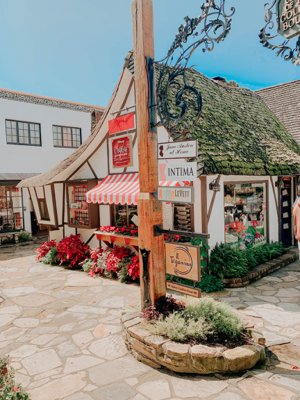
That question gets to something deeper than high heels.
Carmel-by-the-Sea was deliberately resistant to becoming what early residents sometimes called “citified.”
The village developed around trees rather than clearing them all away.
Residential streets often remain narrow and informal. Conventional sidewalks are absent from many blocks. Buildings frequently sit among mature landscaping rather than being separated from nature by broad paved streetscapes.
That informality is one of the reasons walking around Carmel feels different from walking through a conventional downtown.
It also means the physical environment sometimes requires a little more attention.
Uneven paving, tree roots, stone paths, sloping streets and unconventional walkways are part of the experience.
The Law Tells Us Something Important About Carmel
At first glance, the high-heel ordinance looks like nothing more than an amusing piece of municipal trivia.
But look a little closer and it tells a surprisingly good story about the community.
Carmel faced a choice between making its environment more conventional and accepting some of the complications that came with preserving its unusual character.
The city chose character.
The same philosophy can still be seen throughout Carmel-by-the-Sea.
Cottages sit beneath mature trees.
Stone walls, garden paths and hidden courtyards replace standardized suburban landscaping.
Residential streets can feel almost rural even though Ocean Avenue may be only a few blocks away.
For a deeper look at how this philosophy shaped the village itself, explore our Complete History of Carmel-by-the-Sea.
From High Heels to Storybook Cottages
The high-heel permit is hardly Carmel's only unusual tradition.
The village's individualism has influenced everything from architecture to street design.
Builders such as Michael J. Murphy and Hugh Comstock helped create houses that rejected standardized design in favor of craftsmanship, scale and personality.
Comstock's famous storybook cottages eventually became part of Carmel's international image.
That architecture works because of its setting: trees, narrow lanes, gardens, stonework and a village designed to be experienced on foot.
Read more in our guide to Carmel-by-the-Sea architecture, cottages and storybook homes.
Walkability Is Still Part of the Carmel Experience
The irony of Carmel's high-heel ordinance is that Carmel is one of the most walkable communities on the Monterey Peninsula.
For many residents, that is precisely the attraction.
Depending on location, it may be possible to walk from home to morning coffee, restaurants, art galleries, shops, Sunset Center, Carmel Beach and Scenic Road without getting into a car.
That lifestyle is especially important in areas such as the Golden Rectangle and other neighborhoods surrounding the village core.
The most desirable walking route, however, isn't always determined simply by distance.
Slope, street surface, nighttime lighting, beach access and the destinations someone visits most frequently all matter.
And apparently, so does the choice of shoes.
You probably don't need to worry about the Carmel Police Department inspecting your footwear.
But comfortable shoes are still a very good idea.
Carmel's irregular paths, tree roots, hills, stone surfaces and informal streets are part of what makes exploring the village so enjoyable — and occasionally a little challenging in stilettos.
Is the High-Heel Permit Still Real?
Yes.
As of 2026, Chapter 8.44 remains in the Carmel-by-the-Sea Municipal Code.
The City continues to maintain a formal legal framework for issuing the permit, even though the ordinance is not actively enforced as a footwear restriction.
That makes this a perfect example of why we started Stories, Legends & Local Lore of the Monterey Peninsula.
You hear a story that sounds too strange to be true.
You investigate it.
And sometimes you discover that the real history is even better than the legend.
Why Locals Still Tell This Story
There is a reason Carmel's high-heel permit has endured as a favorite piece of local trivia for more than six decades.
It captures something genuine about the town.
Carmel has always been willing to do things a little differently.
Its architecture is different.
Its streets are different.
Its relationship with trees and the natural landscape is different.
And when tree roots, high heels and municipal liability collided in 1963, Carmel came up with a solution that could probably have happened nowhere else.
Explore Carmel-by-the-Sea
Carmel Real Estate & Neighborhood Guide
Golden Rectangle Real Estate & Neighborhood Guide
Carmel Cottages & Storybook Homes
Complete History of Carmel-by-the-Sea
Carmel Architecture, Cottages & Storybook Homes
More Stories, Legends & Local Lore of the Monterey Peninsula →
Historical sources consulted: City of Carmel-by-the-Sea Municipal Code, Chapter 8.44; City of Carmel-by-the-Sea Historic Context Statement; City planning and historical materials; and Carmel-by-the-Sea visitor information regarding the high-heel permit.